Facts
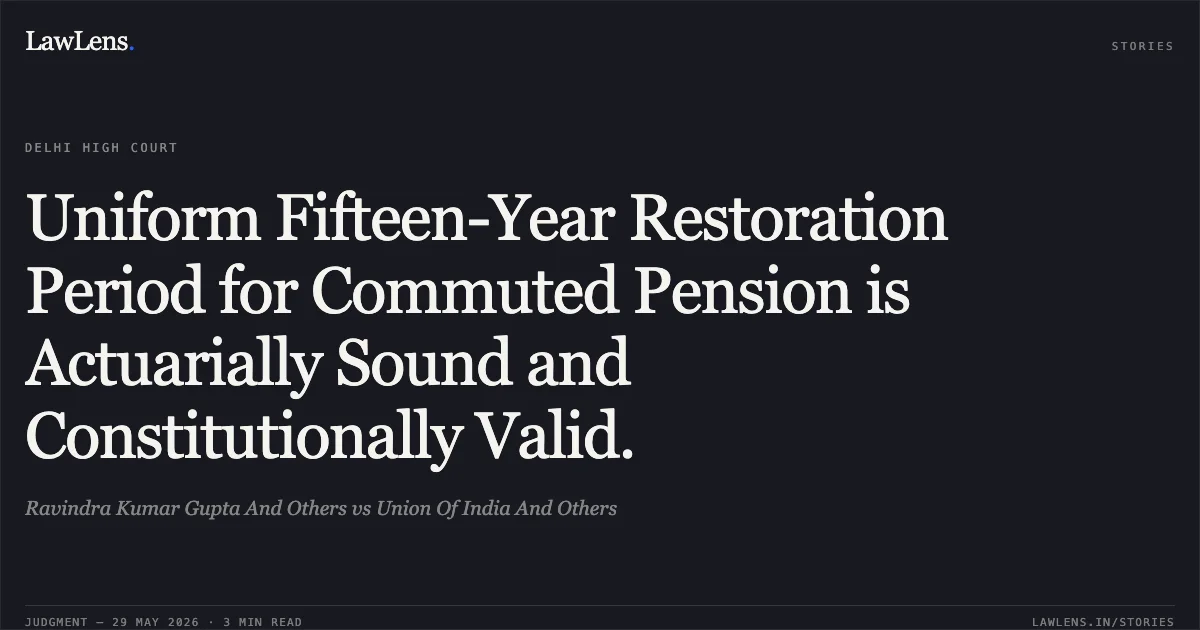
The petitioners (pensioners from various Central Government departments, paramilitary forces, and autonomous bodies) challenged the continued recovery of the commuted portion of their pension for a fixed period of 15 years under Rule 10A of the CCS (Commutation of Pension) Rules, 1981
Source reference: p. 7, 9They argued that due to successive revisions by the Central Pay Commissions (CPCs), the actuarial factors have changed, leading to the full recovery of the commuted amount (plus interest) within 11.5 to 12 years
Source reference: p. 13Consequently, they claimed the 15-year recovery period results in "excess recovery" and unjust enrichment for the State
Source reference: p. 13Procedurally, the batch includes challenges against orders from the Central Administrative Tribunal (CAT), direct writ petitions for constitutional relief, and a challenge by the Union of India against an interim stay granted by the Armed Forces Tribunal (AFT)
Source reference: p. 7-8Issues
1. Whether the continued recovery of commuted pension for a uniform statutory period of fifteen years under Rule 10A of the CCS Commutation Rules is arbitrary, unconstitutional, or amounts to unjust enrichment in light of revised commutation factors
Source reference: p. 8-92. Whether the court can judicially interfere with the 15-year restoration period, which is based on actuarial policy and expert recommendations of the Central Pay Commissions
Source reference: p. 20-21Law Applied
Rule 10A of the CCS (Commutation of Pension) Rules, 1981, which mandates pension restoration only after 15 years
Source reference: p. 23-24Supreme Court precedent in Common Cause v. Union of India (1987), which established that restoration is based on the "years-of-purchase" basis—including a two-year buffer for risk—rather than a simple interest-based loan recovery
Source reference: p. 25-26Doctrine of "manifest arbitrariness" from Shayara Bano v. Union of India, holding that subordinate legislation is valid unless it is capricious or lacks a determining principle
Source reference: p. 45-46Principle of estoppel (approbate and reprobate), asserting that those who voluntarily opt for a statutory benefit cannot later challenge its underlying conditions
Source reference: p. 34-35Reasoning
The court reasoned that pension commutation is a voluntary welfare scheme, not a commercial loan transaction; therefore, mathematical comparisons regarding interest rates are misplaced
Source reference: p. 41-42The Government assumes a "mortality risk" because if a pensioner dies before 15 years, the balance is not recovered from heirs
Source reference: p. 18, 26The court noted that the 6th and 7th CPCs consciously retained the 15-year period after considering revised longevity and financial variables, indicating an informed policy choice
Source reference: p. 40Applying the "years-of-purchase" logic from Common Cause, the court found that the 15-year rule maintains "actuarial equilibrium" for the entire pension population
Source reference: p. 27, 42It held that judicial review is limited in complex economic policies where expert bodies (like CPCs) have evaluated multifaceted variables like inflation, tax exemptions, and longevity
Source reference: p. 28-29, 43The court concluded that the 15-year period is not "manifestly arbitrary" as it is uniform, rational, and based on a discernible determining principle
Source reference: p. 46Holding
The court held that Rule 10A and the 15-year restoration period are constitutionally valid and do not constitute unjust enrichment
The Union of India's petition [W.P.(C) 12781/2024] was allowed, setting aside the AFT's interim stay, and all other petitions by pensioners were dismissed
Source reference: p. 49On equitable grounds, the court directed that for those whose recovery was stayed during litigation, the remaining amount should not be recovered in a lump sum but should continue as monthly deductions beyond the 15-year mark for a duration equal to the stay period
Source reference: p. 49Acts & Sections Cited
1 provisions across 1 statute referred to in this judgment. Linked provisions open on LawLens.
Income Tax Act, 19611
Original Court PDF
Ravindra Kumar Gupta And OthersvsUnion Of India And Others
Click to open original judgment
Original judgment, available to read, download and summarize on LawLens.in