Facts
The Petitioner (Decree Holder) entered into an agreement dated 29.06.2015 with the Respondent (Judgment Debtor) to purchase Floor Space Index (FSI) for ₹29 crores
Source reference: p. 2Following disputes regarding project permissions, the Petitioner invoked Clause 36 of the agreement, which empowered the Petitioner to unilaterally appoint a Sole Arbitrator
Source reference: p. 4Despite the Respondent expressing disagreement with the non-mutual appointment on 15.09.2016, the Arbitrator proceeded to pass an Award on 06.07.2018 directing the Respondent to pay ₹29 crores plus 18% interest
Source reference: p. 8, 2The Respondent’s subsequent challenge under Section 34 of the Arbitration & Conciliation Act was dismissed on 09.04.2024 solely on the grounds of a 1450-day delay, without a merit-based review of the appointment's validity
Source reference: p. 2, 24The Petitioner then filed the present execution petition.
Source reference: no citationIssues
1. Whether an arbitral award passed by a unilaterally appointed arbitrator—in violation of the principle of equality—is a nullity and unenforceable
Source reference: p. 8, 92. Whether an objection regarding the inherent lack of jurisdiction due to an ineligible arbitrator can be raised for the first time at the stage of execution proceedings, even if a Section 34 challenge was previously dismissed on delay
Source reference: p. 23, 24Law Applied
Section 12(5) of the Arbitration & Conciliation Act, 1996, which renders individuals ineligible for appointment if they fall under the Seventh Schedule, unless waived by an "express agreement in writing" after the dispute arises
Source reference: p. 10Constitution Bench decision in Central Organisation for Railway Electrification (CORE) v. ECI SPIC SMO MCML (JV) (2025), which held that unilateral appointment clauses violate Article 14 and the principle of procedural equality
Source reference: p. 9Doctrine from Bhadra International (India) Pvt. Ltd. v. Airport Authority of India (2026), stating that an award by an ineligible arbitrator is void ab initio and a nullity
Source reference: p. 13Division Bench precedents in Kotak Mahindra Bank Ltd. v. Narendra Kumar Prajapat (2023) and M/s Mahavir Prasad Gupta & Sons v. Govt. of NCT of Delhi (2025), which establish that such awards are unenforceable at the execution stage
Source reference: p. 24, 26Reasoning
The Court reasoned that Clause 36 of the agreement was fundamentally flawed because it granted the Petitioner the exclusive power to appoint the arbitrator, thereby stripping the Respondent of equal participation in the constitution of the tribunal
Source reference: p. 4, 9Under Section 12(5), such an appointment is invalid as a matter of law unless there is an express written waiver; the Court noted that the Respondent's participation in proceedings or the lack of an earlier successful challenge does not constitute a waiver, as waiver cannot be inferred from conduct
Source reference: p. 11, 24The Court determined that since the arbitrator was ineligible, they lacked "inherent jurisdiction," making the resulting award coram non judice
Source reference: p. 18Consequently, the dismissal of the Section 34 petition on a procedural ground (delay) did not "cure" the award's status as a nullity. Since a decree passed without jurisdiction is a nullity, its invalidity can be set up at any stage, including execution
Source reference: p. 20, 27Holding
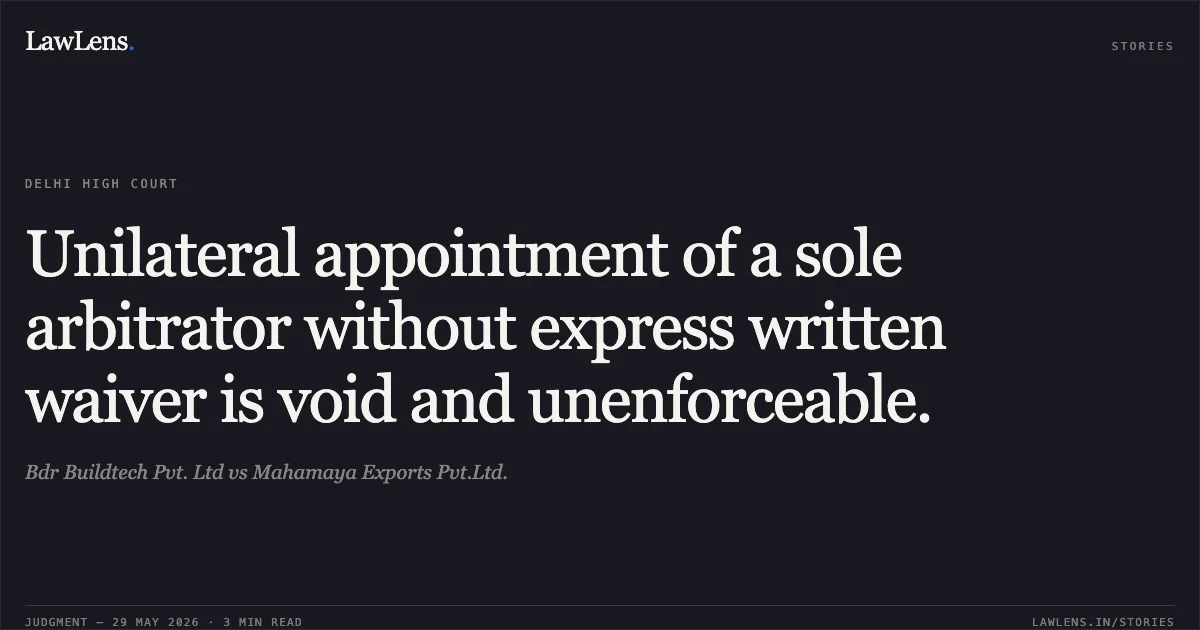
The Court held that the unilateral appointment of the arbitrator rendered the Award dated 06.07.2018 void and unenforceable in law
It further held that objections regarding the inherent lack of jurisdiction can be raised at the execution stage
Source reference: p. 23The enforcement petition was dismissed, though the Court granted the parties liberty to take fresh steps for the appointment of a lawful arbitrator to adjudicate the disputes
Source reference: p. 27, 28Acts & Sections Cited
12 provisions across 2 statutes referred to in this judgment. Each provision opens on LawLens.
Arbitration and Conciliation Act, 1996
Code of Civil Procedure, 19081
Original Court PDF
Bdr Buildtech Pvt. LtdvsMahamaya Exports Pvt.Ltd.
Click to open original judgment
Original judgment, available to read, download and summarize on LawLens.in