Facts
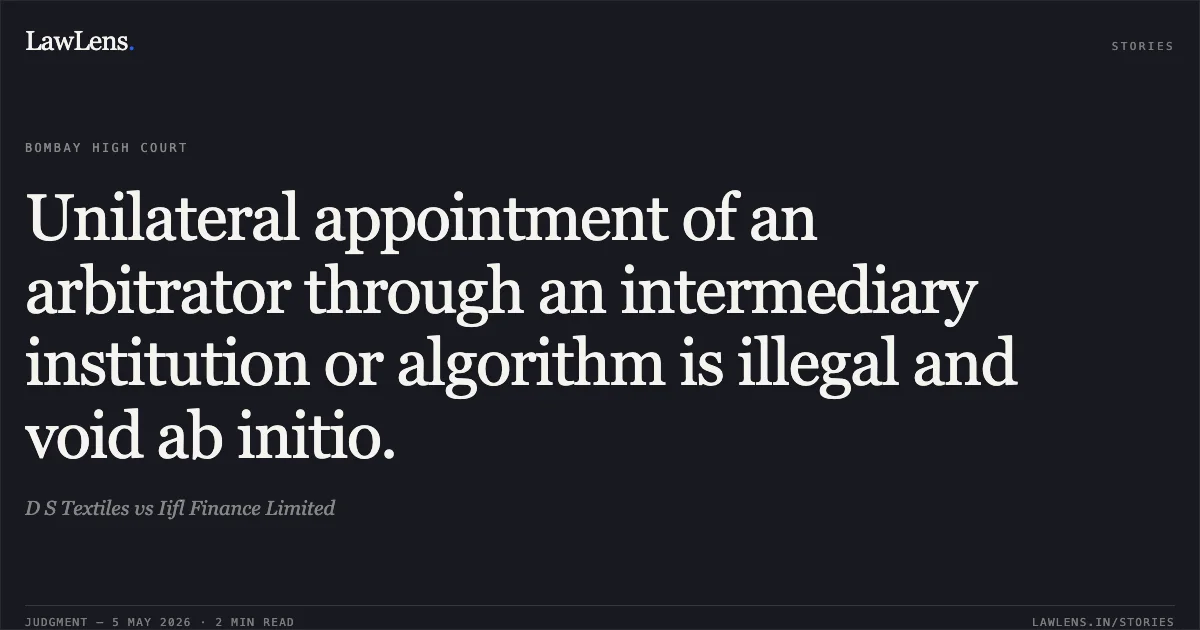
The Petitioners challenged the unilateral appointment of an arbitrator by the Respondent (IIFL Finance Limited), a non-banking financial company (NBFC).
Source reference: p. 1-2The unilaterally appointed arbitrator had passed urgent interlocutory orders under Section 17 of the Arbitration and Conciliation Act, 1996, including the attachment of bank accounts, without detailing the manner of the tribunal's constitution.
Source reference: p. 2-3Upon the filing of these petitions, the Respondent sought to withdraw the arbitration proceedings, requesting the court to dispose of the petitions as infructuous.
Source reference: p. 2The court noted a recurring "modus operandi" where finance companies use unilateral appointments to coerce settlements and withdraw only when legally challenged.
Source reference: p. 2-3Issues
1. Whether the unilateral appointment of an arbitrator through an "institution" or algorithm-based selection by one party is legally valid under the Arbitration and Conciliation Act, 1996.
Source reference: p. 2, para. 32. Whether the participation in proceedings or the withdrawal of arbitration by the appointing party cures the foundational illegality of a unilateral appointment.
Source reference: p. 2-3, para. 4-5Law Applied
The court applied Section 12(5) and Section 11 of the Arbitration and Conciliation Act, 1996, emphasizing that there are only two lawful methods for appointment: mutual consent or court appointment.
Source reference: p. 3Perkins Eastman Architects DPC v. HSCC (India) Ltd. (2020), which established that a party interested in the outcome cannot unilaterally appoint an arbitrator.
Source reference: p. 4, 6Bhadra International (India) Pvt. Ltd. v. Airports Authority of India (2026), which clarified that the principle of equal treatment is "foundational" and "explicit," and that unilateral appointment is void ab initio.
Source reference: p. 4-5Central Railway v. ECI (2025) and Lite Bite Foods Pvt. Ltd. v. AAI (2019) to affirm that neutrality must exist in the arbitral-forum selection process itself.
Source reference: p. 4, 7-8Reasoning
The court reasoned that attempting to "whitewash" a unilateral appointment by routing it through an "institution" of one party's choice is a "colourable and manipulative device" to circumvent settled law.
Source reference: p. 9The court observed that the independence of an arbitrator is compromised at the threshold if the manner of constitution is one-sided.
Source reference: p. 8The court rejected the notion that a Section 21 notice or subsequent participation constitutes "express agreement in writing" required to waive ineligibility under the proviso to Section 12(5).
Source reference: p. 9-10The court found that the Respondent's strategy of withdrawing proceedings upon a challenge was an attempt to avoid a judicial ruling on their illegal practices while continuing to use the same flawed process against parties who lack the means to approach the Court.
Source reference: p. 10-11Holding
The Court held that unilateral appointments, regardless of the involvement of a self-selected "institution," are fundamentally illegal and a "veneer" for bias.
The Court quashed and set aside the impugned interlocutory orders. Although the arbitration was withdrawn, the Court directed that a copy of the judgment be placed before the Respondent’s Board of Directors and Audit Committee to ensure compliance with the law and the framing of legal arbitration policies.
Source reference: p. 11-12Acts & Sections Cited
5 provisions across 1 statute referred to in this judgment. Each provision opens on LawLens.
Arbitration and Conciliation Act, 19965
Original Court PDF
D S TextilesvsIifl Finance Limited
Click to open original judgment
Original judgment, available to read, download and summarize on LawLens.in