Facts
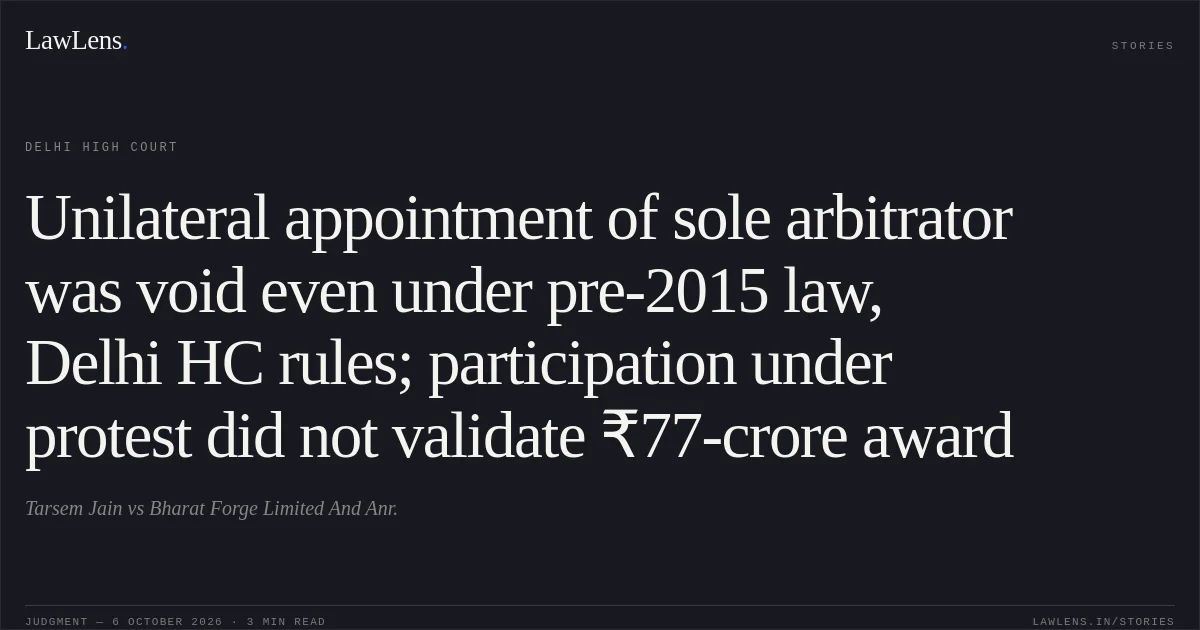
The appellant and BF Infrastructure Limited entered into a Share Purchase Agreement (SPA) containing an arbitration clause providing for a sole arbitrator to be appointed in accordance with the Arbitration and Conciliation Act, 1996.
Source reference: pp. 2–4After disputes arose, the appellant invoked arbitration and, following the respondents’ failure to agree to an appointment, unilaterally nominated the sole arbitrator.
Source reference: pp. 2–4The respondents objected to the appointment before the arbitrator, but the objections were rejected; the arbitrator later awarded the appellant ₹77 crore and dismissed the counterclaims.
Source reference: pp. 2–4The respondents’ petitions under Section 34 were allowed, and the award was set aside as arising from a void appointment.
Source reference: pp. 2–4The appellant appealed under Section 37.
Source reference: pp. 2–4Issues
1. Whether the appellant’s unilateral appointment of the sole arbitrator, without the respondents’ consent and contrary to the SPA’s appointment procedure, was valid
Source reference: pp. 11–132. Whether the respondents’ participation in the arbitration, failure to seek appointment under Section 11, or alleged delay in objecting amounted to waiver of their challenge
Source reference: pp. 12–143. Whether the unilateral appointment rendered the award liable to be set aside, and whether the Single Judge’s decision fell within the permissible scope of review under Section 37
Source reference: pp. 8–11, 14–16Law Applied
Section 11(2) of the Arbitration and Conciliation Act, 1996 permits parties to agree on an appointment procedure; under Section 11(5), where parties fail to agree on a sole arbitrator, appointment is to be made by the competent court or its designate upon a party’s request.
Source reference: pp. 6–8, 10–11An appointment made contrary to the agreed procedure and statutory mechanism may be invalid.
Source reference: pp. 6–8, 10–11Section 4 concerns waiver by a party that, knowing of non-compliance with a derogable requirement, proceeds without timely objection; timely objection and participation under protest do not establish waiver.
Source reference: pp. 6–8, 10–11Section 18 requires equal treatment of parties.
Source reference: pp. 6–8, 10–11Under Sections 34 and 37, appellate review is confined to the grounds and limits applicable to setting aside an award; Section 37 does not permit an independent reassessment of the award.
Source reference: pp. 6–8, 10–11The Court relied on MMTC Ltd. v. Vedanta Ltd., (2019) 4 SCC 163, and UHL Power Co. Ltd. v. State of H.P., (2022) 4 SCC 116, on the restricted scope of Section 37 review.
Source reference: pp. 9–10The Court relied on Central Organisation for Railway Electrification v. ECI SPIC SMO MCML (JV), (2025) 4 SCC 641, on the concerns raised by unilateral appointment of a sole arbitrator.
Source reference: p. 14The Court relied on BCCI v. Kochi Cricket (P) Ltd., (2018) 6 SCC 287, on the application of amended Section 34 to petitions filed after the amendment.
Source reference: pp. 15–16Reasoning
Clause 20.4 required the dispute to be referred to a sole arbitrator appointed in accordance with the Act; it did not authorize either party to appoint the arbitrator unilaterally.
Source reference: pp. 11–13The appellant’s notice purporting to permit unilateral appointment after 15 days altered the agreed procedure, and the appellant then appointed the arbitrator without the respondents’ consent.
Source reference: pp. 11–13In the absence of agreement, the appointment mechanism under Section 11 applied; the appellant, as the party invoking arbitration, was required to seek appointment through that mechanism.
Source reference: pp. 11–13The respondents objected before the arbitrator and participated under protest, so their conduct did not validate the appointment or establish waiver under Section 4.
Source reference: pp. 12–14, 18The Court also held that Section 12(5) did not apply to this pre-amendment arbitration, but that did not validate an appointment contrary to the SPA and Section 11; the unilateral appointment raised concerns about impartiality and equal treatment.
Source reference: pp. 14–17The Single Judge’s conclusion that the appointment was void was therefore within the permissible limits of review under Section 37.
Source reference: pp. 7–10, 21Holding
The Court held that the sole arbitrator had been appointed in violation of Clause 20.4 of the SPA and Section 11 of the Act, and that the respondents had not waived their objection.
It found no ground to interfere with the Single Judge’s decision setting aside the award.
Source reference: pp. 15–16The appeal was dismissed, and the pending application was disposed of.
Source reference: pp. 15–16Acts & Sections Cited
12 provisions across 1 statute referred to in this judgment. Each provision opens on LawLens.
Arbitration and Conciliation Act, 1996
Original Court PDF
Tarsem JainvsBharat Forge Limited And Anr.
Click to open original judgment
Original judgment, available to read, download and summarize on LawLens.in