Facts
The plaintiff (respondent), a dealer for M/s Schneider Electric India Pvt. Ltd., received a purchase order from the defendant (appellant) in March 2008. After delivery issues and a subsequent fresh purchase order in August 2008, material worth ₹44,00,000 was supplied, but the defendant paid only ₹40,00,000.
Source reference: para 2.1The plaintiff filed a suit for recovery of the balance, including interest and penalties paid to the manufacturer.
Source reference: para 2.2The Commercial Court, Ajmer, partly decreed the suit, awarding the principal amount of ₹4,00,000 with 24% interest p.a. from the date of notice (01.12.2011) based on printed terms in the plaintiff's invoices.
Source reference: para 3.2, 3.3The defendant appealed, limiting the challenge solely to the 24% interest rate.
Source reference: para 5Issues
1. Whether a printed stipulation regarding interest on a unilateral invoice, without express consent or a separate agreement, constitutes a binding contractual term.
Source reference: para 8, 8.22. Whether the award of interest at the rate of 24% per annum is excessive, penal, or contrary to statutory provisions under the Sale of Goods Act and the CPC.
Source reference: para 5.5, 8.16Law Applied
Section 61 of the Sale of Goods Act, 1930, which empowers courts to award reasonable interest in the absence of a "contract to the contrary".
Source reference: para 8.11Proviso to Section 34 of the Code of Civil Procedure (CPC), 1908, which governs interest in commercial transactions, noting that where no contractual rate exists, the rate should align with those charged by nationalized banks for commercial loans.
Source reference: para 8.13, 8.14Principle from M/S. Oriental Structural Engineers Pvt. Ltd. v. State of Kerala (2021) 6 SCC 150, which establishes that interest for delayed payment is compensatory, not punitive, and must be just and equitable.
Source reference: para 8.15Reasoning
The High Court observed that the foundational purchase orders were silent on interest.
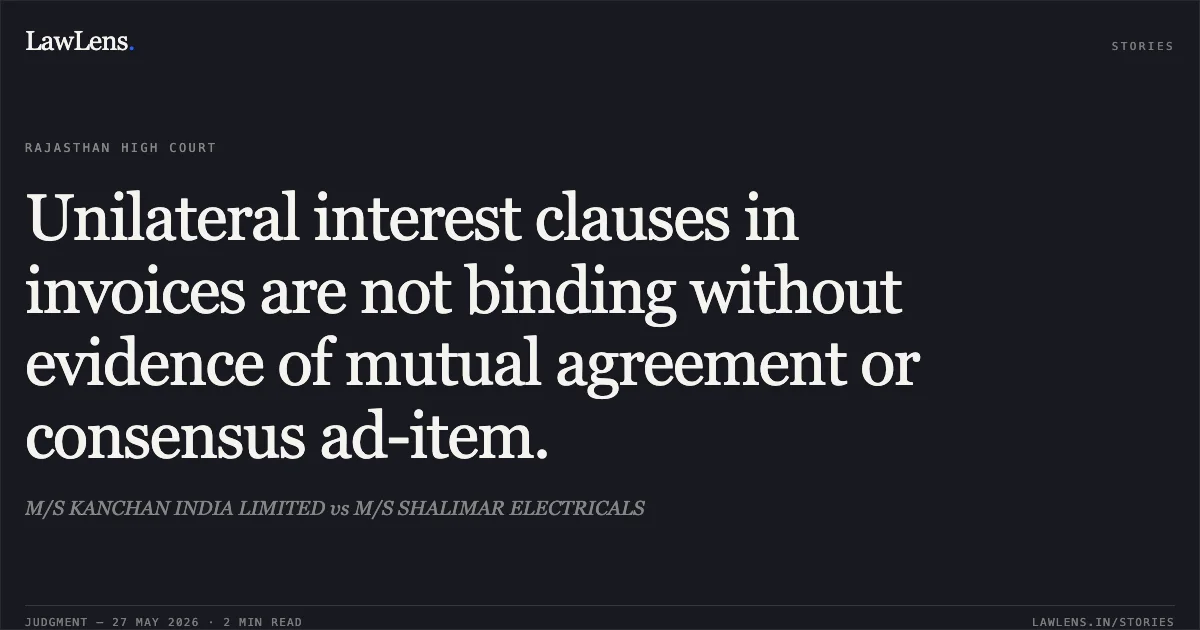
Source reference: para 8.9The court ruled that invoices are unilateral documents; mere printing of an interest clause does not satisfy the requirement of consensus ad-idem (meeting of minds) unless the purchaser expressly accepted that specific term.
Source reference: para 8.3, 8.5While acceptance of goods creates liability for the principal price, it does not imply acceptance of every onerous condition printed on an invoice.
Source reference: para 8.4Since the plaintiff failed to produce evidence of a negotiated agreement on interest, the court held that no "contract to the contrary" existed under Section 61 of the Sale of Goods Act.
Source reference: para 8.10, 8.12Consequently, the 24% rate was deemed unconscionable and penal rather than compensatory.
Source reference: para 8.16, 8.18Holding
The Court partly allowed the appeal, answering that the 24% interest rate was legally unsustainable in the absence of a concluded contract.
The High Court exercised its discretion under Section 61 of the Sale of Goods Act and Section 34 CPC to reduce the interest rate from 24% to 9% per annum, effective from the date of the legal notice (01.12.2011) until realization.
Source reference: para 8.20The decree regarding the principal amount of ₹4,00,000 remained affirmed.
Source reference: para 8.21Acts & Sections Cited
3 provisions across 3 statutes referred to in this judgment. Each provision opens on LawLens.
Code of Civil Procedure, 19081
Sale of Goods Act, 19301
Arbitration and Conciliation Act, 19961
Original Court PDF
M/S KANCHAN INDIA LIMITEDvsM/S SHALIMAR ELECTRICALS
Click to open original judgment
Original judgment, available to read, download and summarize on LawLens.in


