Facts
The petitioners, comprising teaching and non-teaching staff of Dayanand Adarsh Vidyalaya, Tilak Nagar, filed a batch of petitions seeking arrears of salary, implementation of the 7th Central Pay Commission (CPC), and retiral dues
Source reference: p.3-4The school management ceased all educational activities and stopped paying salaries from April 1, 2020, asserting that the institution had become financially unviable
Source reference: p.4Although the management applied for formal closure on July 17, 2019, the Directorate of Education (DoE) never granted prior approval
Source reference: p.4-5The school argued that the factual shutdown constituted a closure in substance, thereby limiting liability to the school’s depleted assets
Source reference: p.4Conversely, the petitioners contended that the shutdown was illegal and that liability should extend to the parent societies—Arya Samaj (Regd.), Tilak Nagar, and Delhi Arya Pratinidhi Sabha—which exercised real control over the institution
Source reference: p.5-9Issues
1. Whether a recognized private school can be treated as "closed" in law merely by a factual stoppage of functioning without prior approval from the Directorate of Education under the statutory framework.
Source reference: p.11 / para. 182. Whether the petitioners are entitled to salaries and service benefits for the period following the unilateral stoppage of the school's operations on April 1, 2020.
Source reference: p.10 / para. 153. Whether the liability for staff dues can be fastened upon the parent societies or managing bodies beyond the school as a separate unit.
Source reference: p.10 / para. 15Law Applied
The Court applied Section 3 and Section 4 of the Delhi School Education Act (DSEA), 1973, which mandate that the closure of classes and financial stability are subject to statutory regulation
Source reference: p.12Rule 46 of the Delhi School Education Rules (DSER), 1973, was identified as the mandatory provision requiring "prior approval" of the Director for the closure of any recognized school
Source reference: p.12The Court clarified that Rule 55, regarding the lapse of recognition, does not legitimize an unauthorized shutdown
Source reference: p.12It relied on the Division Bench ruling in Manju Tomar & Ors. v. NCT and the Supreme Court’s affirmation in NDMC & Anr. v. Manju Tomar & Ors. (2024), which established that a closure de hors Rule 46 is illegal and cannot be used to shift the burden of staff salaries
Source reference: p.13Anjna Sharma v. Shishu Bharti Vidyalaya was cited to establish that a society remains liable for the accruals of its branches, even if one branch closes
Source reference: p.14, 18Reasoning
The Court reasoned that "closure" is a statutory process, not a managerial declaration; therefore, a factual lock on the gate does not extinguish legal obligations
Source reference: p.11-12Under Rule 46, the insistence on prior approval is mandatory to protect students and staff, and the management cannot benefit from its own wrongful act of unilateral cessation
Source reference: p.12-13The Court rejected the "institutional collapse" defense, noting that under Section 10 of the DSEA, salary parity and financial stability are continuing conditions of recognition
Source reference: p.12, 14Regarding the extension of liability, the Court observed that the DSEA does not view a school as an isolated shell but as an enterprise under a managing committee supervised by a trust or society
Source reference: p.16-17Applying the "real and effective control" test, the Court found that while the school is primarily liable, the entity that actually managed the funds and took the decision to stop the school must satisfy the dues
Source reference: p.19-20However, because the record presented an inconclusive picture of whether control rested with the local Arya Samaj or the Delhi Arya Pratinidhi Sabha, the Court delegated the factual determination of "effective control" to the DoE
Source reference: p.20-21Holding
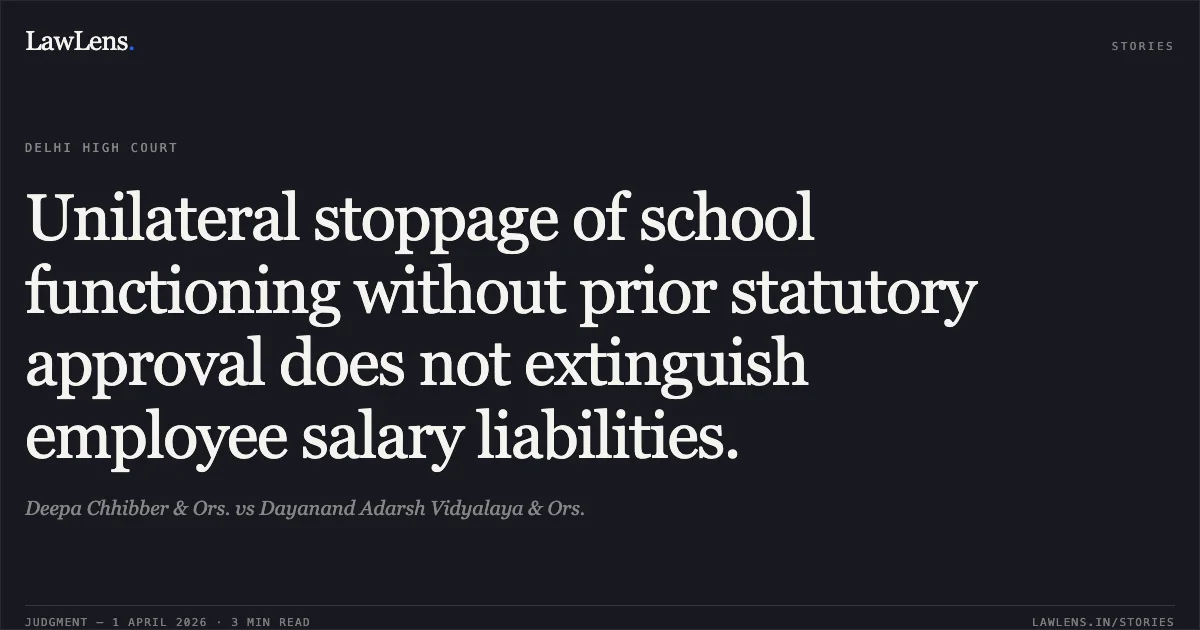
The Court held that Dayanand Adarsh Vidyalaya was not lawfully closed on April 1, 2020, and the unilateral stoppage did not defeat the petitioners' service claims
(i) the DoE must determine within eight weeks which entity (Respondent Nos. 2, 6, or 7) exercised effective control and is thus liable alongside the school; (ii) a nominated officer shall compute petitioner-specific dues, including 7th CPC arrears and retiral benefits, with 6% simple interest per annum; (iii) for employees who neither resigned nor retired, salaries must continue to be paid until a lawful closure or termination occurs; and (iv) the DoE must pass a reasoned decision on the school's pending closure application within ten weeks, ensuring all employee dues are secured before granting approval.
Source reference: p.22, 23, 24, 25The contempt petition was disposed of as the claims were merged into the writ proceedings
Source reference: p.21-22Acts & Sections Cited
5 provisions across 1 statute referred to in this judgment. Each provision opens on LawLens.
Delhi School Education Act, 19735
Original Court PDF
Deepa Chhibber & Ors.vsDayanand Adarsh Vidyalaya & Ors.
Click to open original judgment
Original judgment, available to read, download and summarize on LawLens.in


