Facts
The Appellant (Defendant), formerly RR Heterocyclics Ltd., entered into an Agreement of Sale dated 23.01.2003 with the Respondent (Plaintiff) for agricultural land measuring Ac.18-31 guntas for a consideration of Rs. 37,55,000/-.
Source reference: p. 6The Plaintiff paid an advance of Rs. 2,00,000/- and possession was delivered.
Source reference: p. 7Under Clause 8, the Defendant was obligated to effect mutation and deliver original title documents.
Source reference: p. 30On 21.03.2003, the Defendant unilaterally cancelled the agreement and forfeited the advance, citing the Plaintiff's failure to pay the first installment due on 28.02.2003.
Source reference: p. 8, 12The Plaintiff filed O.S. No. 14 of 2005 seeking specific performance, contending the delay was due to the Defendant’s failure to mutate the property in its name.
Source reference: p. 8The Trial Court decreed the suit in favor of the Plaintiff.
Source reference: p. 16Issues
1. Whether time was the essence of the contract and whether the Plaintiff was ready and willing to perform her part under Section 16(c) of the Specific Relief Act?
Source reference: p. 15, 232. Whether the suit for specific performance was maintainable without seeking a declaration to set aside the cancellation notice dated 21.03.2003?
Source reference: p. 23, 243. Whether the unilateral cancellation of the agreement and forfeiture of the advance by the Defendant was legally valid?
Source reference: p. 23, 63Law Applied
Section 16(c) of the Specific Relief Act, 1963, requiring the plaintiff to aver and prove continuous readiness and willingness.
Source reference: p. 39The principle from Chand Rani v. Kamal Rani, establishing that in sales of immovable property, time is not naturally the essence unless expressly intended by parties and surrounding circumstances.
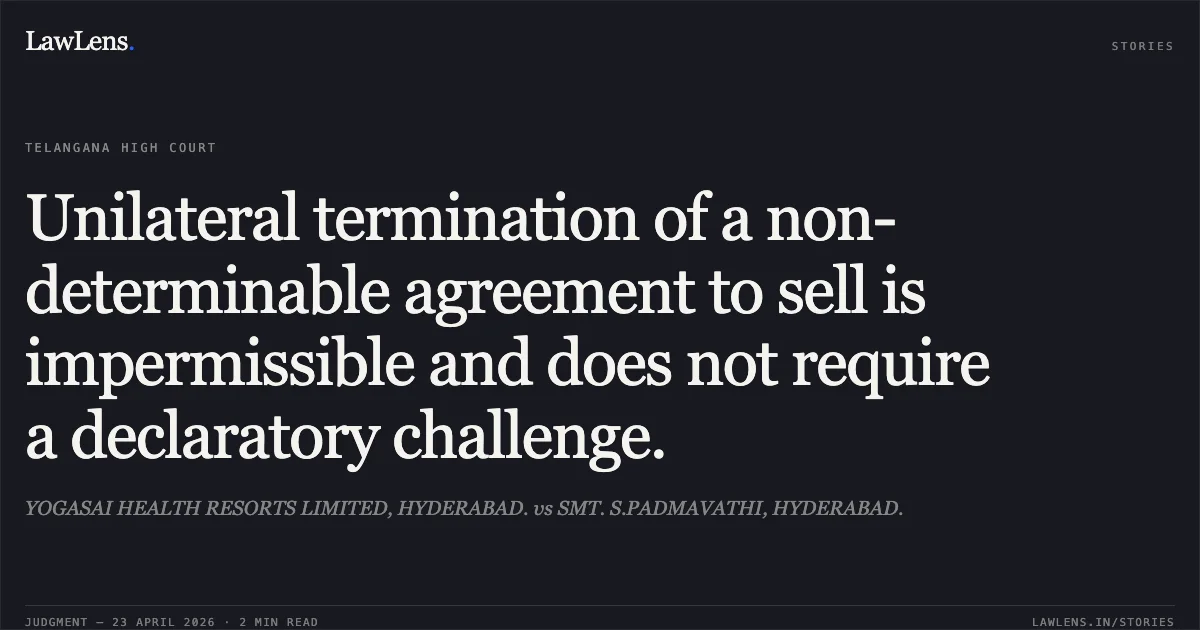
Source reference: p. 35, 48K.S. Manjunath v. Moorasavirappa, holding that if a contract provides no unilateral right to terminate (non-determinable), the aggrieved party may sue for specific performance without seeking a declaration against the termination notice.
Source reference: p. 28Section 55 of the Indian Contract Act was applied to determine the effect of failure to perform at a fixed time.
Source reference: p. 65Reasoning
The Court observed that while the agreement mentioned "time is the essence," Clause 8 created a reciprocal obligation for the Defendant to provide mutation and title documents.
Source reference: p. 31, 37Since the Defendant admitted it had not mutated the property in its name at the time of the dispute, it could not fault the Plaintiff for withholding installments.
Source reference: p. 43, 61The Court found the Plaintiff demonstrated "readiness" (financial capacity) by depositing the balance consideration in court and "willingness" (conduct) by repeatedly approaching the Defendant's director.
Source reference: p. 59, 70Distinguishing the case from I.S. Sikandar, the Court noted the agreement was non-determinable (lacked a forfeiture/termination clause for installment defaults); thus, the Defendant’s unilateral rescission was an illegal repudiation, and the Plaintiff was not required to seek a formal declaration against it.
Source reference: p. 32, 63Holding
The Court held that time was not the essence given the Defendant’s own breach of Clause 8 and the suit was maintainable without a declaratory relief against the cancellation notice because the termination was unilateral and unauthorized by the contract.
The High Court dismissed the appeal, upheld the Trial Court's decree for specific performance, and directed the Defendant to execute the sale deed upon receipt of the deposited balance consideration of Rs. 35,55,000/-.
Source reference: p. 16, 74, 78Acts & Sections Cited
13 provisions across 5 statutes referred to in this judgment. Each provision opens on LawLens.
Specific Relief Act, 19635
Indian Contract Act, 18723
Indian Stamp Act, 18993
Code of Civil Procedure, 19081
Arbitration and Conciliation Act, 19961
Original Court PDF
YOGASAI HEALTH RESORTS LIMITED, HYDERABAD.vsSMT. S.PADMAVATHI, HYDERABAD.
Click to open original judgment
Original judgment, available to read, download and summarize on LawLens.in