Facts
The appellant (defendant) challenged a summary decree dated January 15, 2025, passed by a learned Single Judge under Chapter XIIIA of the Original Side Rules.
Source reference: para. 1-2The decree ordered the appellant to pay Rs. 10,00,000/- with 15% interest for a loan advanced by the respondent (plaintiff).
Source reference: para. 2The appellant contended that the respondent is an unlicensed money lender under the West Bengal Money Lenders Act, 1940, and further argued that the suit constitutes a "commercial dispute" under the Commercial Courts Act, 2015, which should have followed different procedural mandates.
Source reference: para. 3-4The respondent maintained that the transaction was an "accommodation loan" due to personal acquaintance and not a professional money-lending business.
Source reference: para. 8Issues
1. Whether the respondent's status as a potentially unlicensed money lender under the West Bengal Money Lenders Act, 1940, creates a triable issue that precludes the passing of a summary decree under Chapter XIIIA
Source reference: para. 16-172. Whether the dispute qualifies as a "commercial dispute" under Section 2(1)(c)(i) of the Commercial Courts Act, 2015, affecting the suit's maintainability
Source reference: para. 4, 19Law Applied
Section 13 of the West Bengal Money Lenders Act, 1940, which prohibits a court from passing a decree in favor of a money lender unless they hold an effective license or pay a prescribed penalty.
Source reference: para. 16The Three-Judge Bench guidance of the Hon’ble Supreme Court in SLP (Crl.) No. 5485/2024 (orders dated July 23, 2024, February 16, 2026, and April 6, 2026), which established that proceedings by private money lenders should be "nipped in the bud" unless a license is produced or it is shown that the money was not advanced at interest.
Source reference: para. 13-14Chapter XIIIA of the Original Side Rules of the High Court and Section 2(1)(c)(i) of the Commercial Courts Act, 2015.
Source reference: para. 2, 4Reasoning
The Court observed that the Supreme Court's directives in SLP (Crl.) No. 5485/2024 are not restricted to specific state laws but apply generally to private money lending across India; they mandate that a lender must produce a license at the threshold.
Source reference: para. 14In the instant case, while the plaint admitted that money was lent with interest, the respondent failed to produce a license.
Source reference: para. 15The High Court reasoned that under Section 13 of the 1940 Act, the absence of a license constitutes a statutory hurdle that requires judicial inquiry.
Source reference: para. 16Consequently, because the learned Trial Judge failed to determine whether the respondent fell under the definition of a "money lender" or whether the Act applied to this specific transaction, a legitimate "triable issue of substance" was raised.
Source reference: para. 17Such issues cannot be resolved in a summary proceeding under Chapter XIIIA, which is reserved for cases where the defendant has no real defense.
Source reference: para. 17Holding
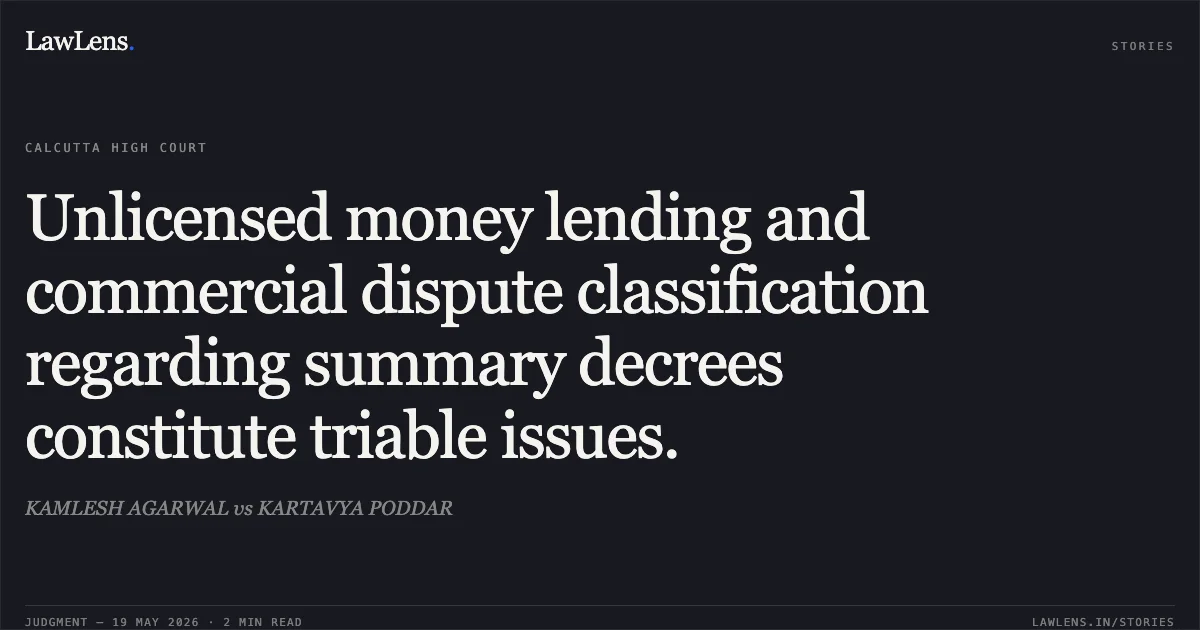
The existence of triable issues regarding the West Bengal Money Lenders Act and the Commercial Courts Act made the summary decree improper.
The High Court allowed the appeal and set aside the judgment and decree dated January 15, 2025. The matter was remanded, leaving the questions of the respondent's status as a money lender and the commercial nature of the dispute open for the Trial Judge to decide through a regular trial.
Source reference: para. 18, 19-20Acts & Sections Cited
1 provisions across 1 statute referred to in this judgment. Each provision opens on LawLens.
Commercial Courts Act, 20151
Original Court PDF
KAMLESH AGARWALvsKARTAVYA PODDAR
Click to open original judgment
Original judgment, available to read, download and summarize on LawLens.in