Facts
The State appealed an acquittal order dated 30.07.1998 passed by the Additional Sessions Judge, Palanpur, in a trial involving 12 accused persons.
Source reference: p.1, 4The prosecution alleged that on 28.05.1996, the accused formed an unlawful assembly and assaulted the complainant’s husband, Siddharajsing, with swords, dharias, and sticks over a land dispute involving the deceased's step-mother (Accused No. 3).
Source reference: p. 2, 6During the trial, the prosecution examined 18 witnesses. However, the complainant (PW-2) gave contradictory testimony in cross-examination, and several eye-witnesses and panchas (independent witnesses) turned hostile.
Source reference: p. 13-14Issues
1. Whether the trial court erred in its appreciation of oral and documentary evidence, resulting in a perverse judgment of acquittal
Source reference: p. 9 / para. 112. Whether the testimony of the interested witnesses (PW-2, PW-4, and PW-6) was reliable enough to sustain a conviction despite material contradictions
Source reference: p. 15-16 / para. 153. Whether the Appellate Court should interfere with an order of acquittal where two reasonable views are possible
Source reference: p. 19 / para. 19-20Law Applied
The court applied Section 378 of the CrPC regarding appeals against acquittal.
Source reference: p. 1The court relied on the principle that the presumption of innocence is doubled upon acquittal.
Source reference: p. 19The court cited Chandrappa v. State of Karnataka (2007) 4 SCC 415, establishing that an appellate court should not disturb an acquittal if two reasonable conclusions are possible.
Source reference: p. 19-20It further applied Section 134 of the Evidence Act, noting that quality, not quantity, of witnesses matters, as affirmed in Jagdish v. State of Haryana (2019) 7 SCC 711.
Source reference: p. 16Inderjeet Singh v. State (NCT of Delhi) regarding the reliability of interested witnesses and unnatural conduct.
Source reference: p. 17Reasoning
PW-2 (the complainant) admitted in cross-examination that she falsely impleaded certain individuals based on village hearsay and identified an assailant who had been dead for ten years.
Source reference: p. 14-15The court noted that if 12 people had attacked the deceased with various weapons, the medical report should have reflected multiple injuries, yet only one fatal head injury was recorded.
Source reference: p. 14The lack of electricity at the scene cast doubt on the witnesses' ability to identify the assailants in the midnight darkness.
Source reference: p. 15The court observed that the conduct of PW-6 (brother of the deceased) was unnatural as he failed to intervene.
Source reference: p. 15-16Applying the Chandrappa doctrine, the court determined that the trial court's view was a "reasonable" one and not perverse, as the recovery panchnamas were not proved and the primary witnesses were deemed unreliable.
Source reference: p. 13-15, 21Holding
The High Court held that the prosecution failed to prove the charges beyond a reasonable doubt and that there was no manifest illegality or perversity in the lower court's findings.
The High Court dismissed the appeal and confirmed the trial court's judgment of acquittal.
Source reference: p. 22The accused's bail bonds were cancelled, and the acquittal was upheld.
Source reference: p. 22Acts & Sections Cited
12 provisions across 4 statutes referred to in this judgment. Each provision opens on LawLens.
Code of Criminal Procedure, 19732
Indian Penal Code, 18608
Scheduled Castes and the Scheduled Tribes (Prevention of Atrocities) Act, 19891
Arms Act, 19591
Original Court PDF
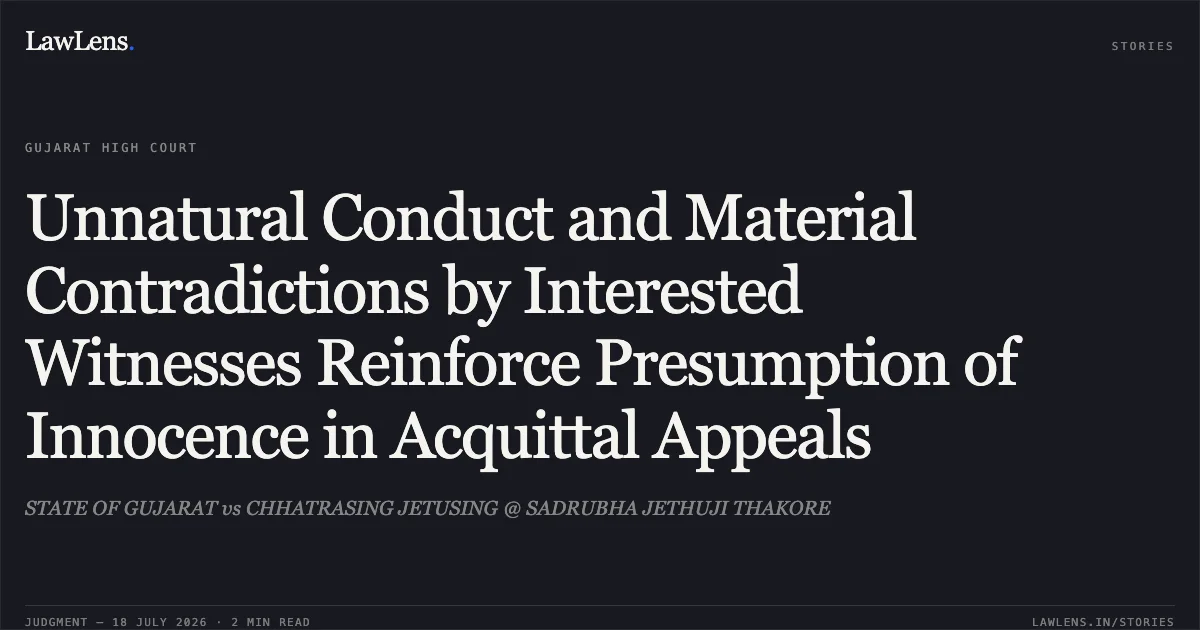
STATE OF GUJARATvsCHHATRASING JETUSING @ SADRUBHA JETHUJI THAKORE
Click to open original judgment
Original judgment, available to read, download and summarize on LawLens.in