Facts
The petitioner sought compensation for the custodial death of his 19-year-old son, Deepak, who died on 16.01.2018 while in the custody of Police Station Karawal Nagar
Source reference: para. 1, 41The deceased was arrested on 15.01.2018; the petitioner alleged that both he and his son were subjected to physical assault and extortion demands by police officials
Source reference: para. 2The following morning, the petitioner was informed his son had committed suicide
Source reference: para. 3A post-mortem opined the cause of death as "asphyxia due to ante-mortem hanging"
Source reference: para. 5A departmental enquiry subsequently established negligence on the part of the police officers for failing to properly monitor the deceased and for the presence of unauthorized items (blades and a stole) in the lock-up
Source reference: para. 8, 11The respondents argued that compensation is not automatic and should be limited to the statutory Delhi Victim Compensation Scheme, 2018
Source reference: para. 15-16Issues
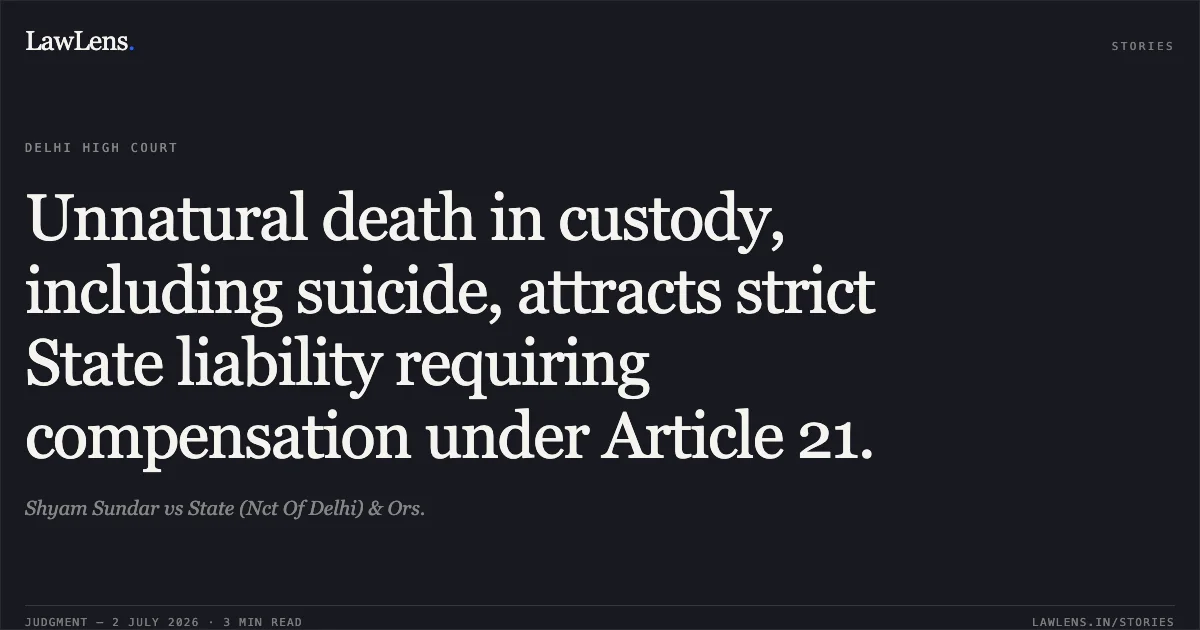
1. Whether an unnatural death in custody, including suicide, attracts strict liability for the State to pay compensation under Article 21 of the Constitution
Source reference: para. 20, 282. Whether the quantum of compensation for custodial death should be determined by the statutory Victim Compensation Scheme or by the "multiplier principle" derived from motor accident jurisprudence
Source reference: para. 30, 37Law Applied
The court applied the principle of strict liability for the protection of fundamental rights under Article 21 of the Constitution, as established in Nilabati Behera v. State of Orissa, which held that the State has a non-delegable duty of care toward persons in custody
Source reference: para. 24It relied on In re: Inhuman Conditions in 1382 Prisons to classify suicide in custody as an "unnatural death"
Source reference: para. 22, 27Regarding the calculation of damages, the court followed the Division Bench ruling in Kiran v. State, which borrowed the "no-fault liability" norms and the "multiplier principle" from the Motor Vehicles Act to assess custodial death claims
Source reference: para. 31, 37further guided by the standardization of the multiplier method in Sarla Verma v. DTC and National Insurance Co. Ltd. v. Pranay Sethi
Source reference: para. 32, 41Reasoning
The court reasoned that when a person is deprived of liberty, the State assumes a heightened and "absolute" duty to protect their life; any unnatural death—even suicide—reflects a systemic failure of this duty
Source reference: para. 21, 28The court rejected the State's defense that compensation is tied only to the Delhi Victim Compensation Scheme, noting that the remedy in public law for the violation of Article 21 is distinct from, and in addition to, statutory schemes
Source reference: para. 37-38Applying the facts, the court noted that the deceased was only 19 years old and that police negligence was already prima facie established via departmental proceedings
Source reference: para. 11, 41To ensure a "genuine attempt... to restore the dignity of the being," the court adopted the multiplier approach to provide a realistic recompense rather than a "token" sum under the statutory scheme
Source reference: para. 40-41Holding
The court held that the petitioner is entitled to monetary compensation under public law for the infringement of the deceased's right to life
It answered that the multiplier principle is the appropriate yardstick for calculation
Source reference: para. 39Based on a monthly income of ₹12,000, 40% future prospects, a 50% deduction for personal expenses, and a multiplier of 18, the court calculated the loss of dependency at ₹18,14,400
Source reference: para. 41-42After adding ₹30,000 for conventional heads (funeral expenses and loss of estate), the court ordered the respondents to pay a total compensation of ₹18,44,400 to the petitioner within eight weeks
Source reference: para. 42-43Acts & Sections Cited
1 provisions across 1 statute referred to in this judgment. Each provision opens on LawLens.
Motor Vehicles Act, 19881
Original Court PDF
Shyam SundarvsState (Nct Of Delhi) & Ors.
Click to open original judgment
Original judgment, available to read, download and summarize on LawLens.in


