01Facts
The petitioners invoked Section 482 of the Code of Criminal Procedure, 1973, seeking quashing of the FIR and subsequent proceedings in Balumath P.S. Case No. 206 of 2020, including the order dated 12 January 2024 by which cognizance was taken for offences under Sections 406, 420, 385, 386, 387 read with Section 34 of the Indian Penal Code
¶ 2The informant alleged that the petitioners engaged him to transport coal, promised to pay the transportation charges, and thereafter failed to pay a total sum of ₹1,11,89,616.
¶ 4It was further alleged that the petitioners threatened to have him killed with the assistance of extremists and told him to forgo the outstanding amount
¶ 4Following investigation, the police submitted a charge-sheet and the Magistrate took cognizance.
¶ 502Issues
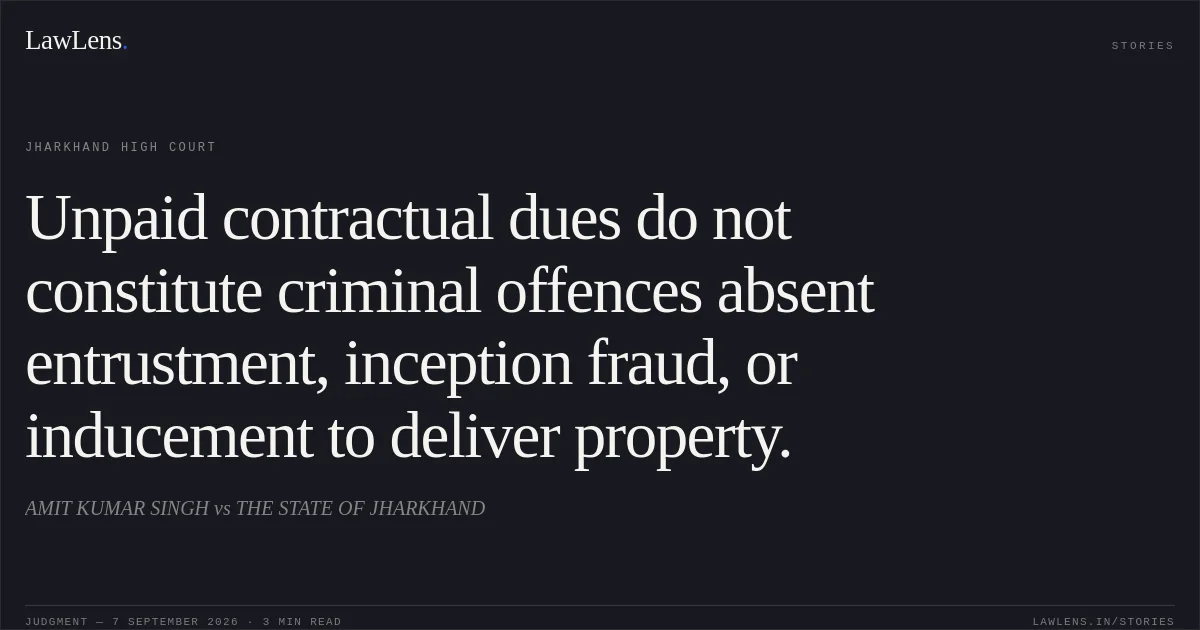
i.Whether the allegations, even if accepted in their entirety, disclosed the ingredients of criminal breach of trust under Sections 405/406 IPC in the absence of entrustment and dishonest misappropriation of property?
¶ 13–14ii.Whether the failure to pay transportation charges, without an allegation of deception or dishonest intention from the inception of the transaction, constituted cheating under Section 420 IPC?
¶ 15–16iii.Whether the alleged threats, without any allegation that the informant was induced to deliver property, valuable security, or a signed/sealed instrument convertible into valuable security, constituted extortion or offences under Sections 385, 386 or 387 IPC?
¶ 17–18iv.Whether continuation of the criminal proceedings amounted to an abuse of the process of law warranting exercise of the High Court’s inherent jurisdiction under Section 482 CrPC?
¶ 1903Law Applied
The Court applied Section 482 CrPC to prevent abuse of process where the allegations do not disclose the essential ingredients of the alleged offences.
For criminal breach of trust under Sections 405/406 IPC, there must be entrustment of property and dishonest misappropriation, conversion, or use in violation of a legal direction or contract, as stated in Ram Narayan Popli v. CBI.
¶ 13For cheating under Section 420 IPC, deception and dishonest or fraudulent intention must exist from the inception of the transaction; a subsequent breach of contract or inability to pay does not by itself constitute cheating, as reaffirmed in Shailesh Kumar Singh @ Shailesh R. Singh v. State of Uttar Pradesh, Uma Shankar Gopalika v. State of Bihar, and Satishchandra Ratanlal Shah v. State of Gujarat.
¶ 6–9, 15–16A mere breach of promise or contract does not constitute criminal breach of trust without entrustment
¶ 9Extortion requires putting a person in fear of injury, including death or grievous hurt, with the intention of dishonestly inducing delivery of property, valuable security, or a signed/sealed instrument convertible into valuable security; absent such delivery or inducement, Sections 385, 386 and 387 IPC are not attracted
¶ 17–18Provisions in the judgment · 9 · Linked ones open on LawLens
Code of Criminal Procedure, 1973 Section 482
Indian Penal Code, 1860 Section 34Section 385Section 386Section 387Section 405Section 406Section 415Section 420
04Reasoning
The Court found no allegation that the transportation charges or any other property had been entrusted to the petitioners and subsequently misappropriated; the alleged unpaid dues represented consideration for services rendered and could not themselves be treated as entrusted property
¶ 14The complaint also did not allege that the petitioners had deceived the informant or possessed a dishonest intention at the beginning of the arrangement. Accordingly, the alleged non-payment amounted, at most, to a contractual or civil dispute and did not satisfy Section 420 IPC
¶ 16Although threats were alleged, the materials did not state that the petitioners induced the informant to deliver any property, valuable security, or convertible instrument. Consequently, the foundational offence of extortion was absent, and Sections 385, 386 and 387 IPC could not be sustained, even with the aid of Section 34 IPC.
¶ 18Since none of the offences was made out even on the assumption that the allegations were true, continuation of the prosecution would amount to an abuse of process
¶ 1905Holding
The High Court held that the allegations did not disclose offences under Sections 406, 420, 385, 386 or 387 read with Section 34 IPC.
¶ 20The FIR, the subsequent proceedings in Balumath P.S. Case No. 206 of 2020, and the cognizance order dated 12 January 2024 were therefore quashed and set aside insofar as the present petitioners were concerned
¶ 20The criminal miscellaneous petition was allowed to that extent.
¶ 21Original Court PDF
AMIT KUMAR SINGHvsTHE STATE OF JHARKHAND
Click to open original judgment
Original judgment, available to read, download and summarize on LawLens.in