Facts
The respondent-plaintiff purchased the suit property from his uncle, Galabhai Kalubhai Meda, through a registered sale deed dated 19 June 2019 and claimed ownership and possession over it.
Source reference: paras. 2–4.2; pp. 1–3Alleging interference by the defendants, he instituted Regular Civil Suit No. 7 of 2019 seeking declaration of title and permanent injunction.
Source reference: paras. 2–4.2; pp. 1–3The Trial Court dismissed the suit on 18 December 2023.
Source reference: paras. 2–4.2; pp. 1–3On appeal, the Principal District Judge, Mahisagar, re-appreciated the evidence, declared the plaintiff owner of the suit property, and granted a permanent injunction by judgment dated 10 June 2026.
Source reference: paras. 2–4.2; pp. 1–3The original defendants challenged that decision in the present second appeal under Section 100 CPC, contending that the sale was invalid for want of co-owner consent and was void under Section 9 of the Gujarat Prevention of Fragmentation and Consolidation of Holdings Act, 1947 (“Fragmentation Act”).
Source reference: paras. 2–4.2; pp. 1–3Issues
1. Whether the plaintiff’s purchase of the suit property through a registered sale deed was invalid because the consent of the other co-owners had not been obtained?
Source reference: paras. 5.1, 7; pp. 3–42. Whether the sale deed was void as being in violation of Section 9 of the Fragmentation Act, and whether the Civil Court lacked jurisdiction to adjudicate the dispute?
Source reference: paras. 5, 8–9.1; pp. 3–53. Whether the second appeal involved any substantial question of law warranting interference under Section 100 CPC?
Source reference: paras. 10–12; pp. 5–8Law Applied
The Court applied Section 100 of the Code of Civil Procedure, 1908, under which a second appeal lies only where a substantial question of law arises.
Source reference: paras. 6–7; p. 4It relied on Sections 54 and 44 of the Transfer of Property Act, 1882: Section 54 recognises transfer of title through a sale, while Section 44 permits a co-owner to transfer his share in immovable property without obtaining the prior consent of the other co-owners.
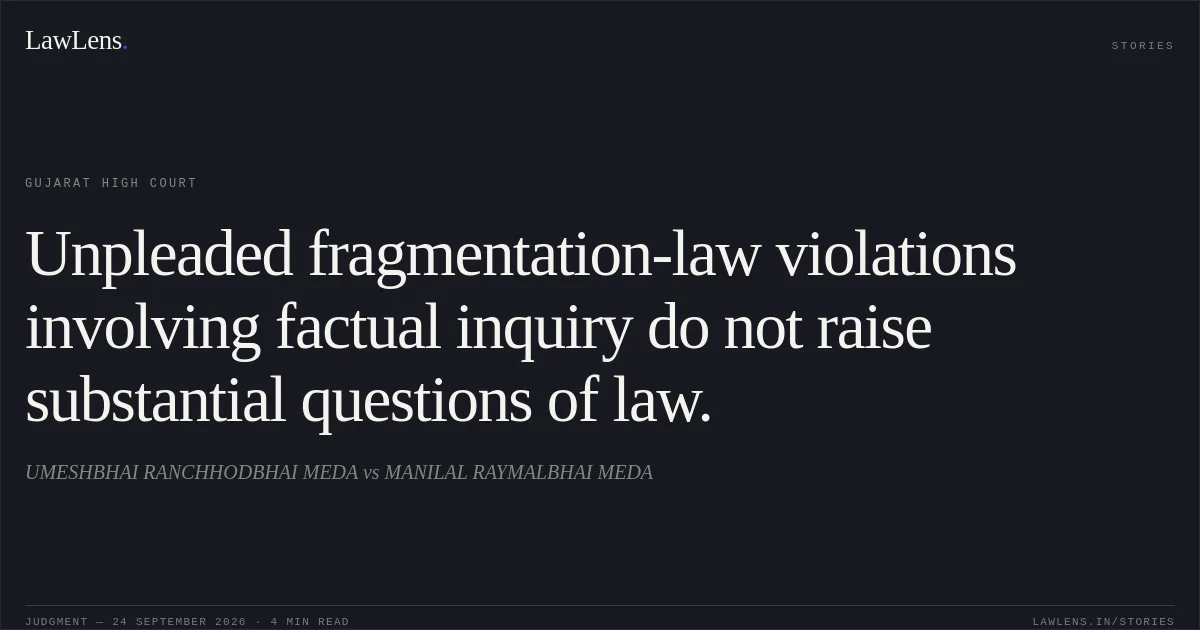
Source reference: paras. 6–7; p. 4The Court considered Section 9 of the Gujarat Prevention of Fragmentation and Consolidation of Holdings Act, 1947, but held that the alleged violation involved a mixed question of fact and law requiring pleadings and factual inquiry.
Source reference: para. 8.1; p. 4It also relied on the newly inserted Section 9(4), introduced by the Gujarat Ordinance dated 14 July 2026, which deemed transfers or partitions made between 29 January 1948 and 31 March 2026, contrary to the Act, to have been regularised without penalty or premium.
Source reference: paras. 9–9.1; pp. 5–6The Court further followed Russi Fisheries (P) Ltd. v. Bhavna Seth, 2026 SCC OnLine SC 555, and Jaichand (Dead) through LRs v. Sahnulal, 2024 SCC OnLine SC 3864, reaffirming that factual findings of the First Appellate Court cannot ordinarily be disturbed in second appeal absent perversity, inadmissible evidence, absence of evidence, or violation of mandatory law.
Source reference: paras. 10.1–10.2; pp. 6–8Reasoning
The Court found that the plaintiff had acquired the suit property through a registered sale deed and had been placed in possession by the original owner, satisfying the requirements of a sale under Section 54 of the Transfer of Property Act.
Source reference: para. 6; p. 4The objection that consent of the other co-owners was necessary was rejected because Section 44 permits a co-owner to transfer his share without prior consent from the remaining co-owners.
Source reference: para. 7; p. 4The defendants’ reliance on Section 9 of the Fragmentation Act was also rejected because the issue had not been pleaded or raised before the Trial Court, and no complaint had been made before the competent revenue authority.
Source reference: paras. 8–8.1; pp. 4–5The Court held that the alleged statutory violation was not a pure question of law and could not be raised for the first time in second appeal.
Source reference: paras. 8–8.1; pp. 4–5In any event, the subsequent insertion of Section 9(4) regularised the relevant transfers made within the specified period, thereby substantially removing the defendants’ objection.
Source reference: paras. 9–9.1; pp. 5–6Since the First Appellate Court’s findings were based on appreciation of the evidence and no perversity or legal error was demonstrated, no substantial question of law arose under Section 100 CPC.
Source reference: paras. 10–11; pp. 5–8Holding
The High Court held that the plaintiff’s registered sale deed was not invalid merely because the consent of other co-owners had not been obtained.
The defendants’ objection under Section 9 of the Fragmentation Act was neither properly pleaded nor supported by a factual inquiry, and was in any event affected by the statutory regularisation introduced through Section 9(4).
Source reference: paras. 7–9.1; pp. 4–6Finding no substantial question of law, the Court dismissed the second appeal in limine, confirmed the First Appellate Court’s judgment and decree declaring the plaintiff owner and granting permanent injunction, imposed no order as to costs, and disposed of the connected Civil Application for stay.
Source reference: paras. 11–12; p. 8Acts & Sections Cited
4 provisions across 3 statutes referred to in this judgment. Each provision opens on LawLens.
Code of Civil Procedure, 19081
Gujarat Prevention of Fragmentation and Consolidation of Holdings Act, 19471
Transfer of Property Act, 18822
Original Court PDF
UMESHBHAI RANCHHODBHAI MEDAvsMANILAL RAYMALBHAI MEDA
Click to open original judgment
Original judgment, available to read, download and summarize on LawLens.in