Facts
On 19 December 2008, Upinder Kumar was driving car No. HP-33A-6465 near Bindrabani Bridge, Mandi, when tanker No. HP-34A-1565, driven by respondent No. 2, collided with the car.
Source reference: para. 2The claimant sustained multiple grievous injuries, was initially taken to Zonal Hospital, Mandi, and thereafter referred to IGMC, Shimla, where he underwent surgery.
Source reference: para. 2He filed a claim petition under Section 166 of the Motor Vehicles Act, 1988, seeking compensation of ₹30,00,000.
Source reference: para. 2The driver and owner alleged that the accident occurred due to the claimant’s negligence, while the Insurance Company disputed liability, questioned the validity of the driving licence and alleged breach of the insurance policy.
Source reference: paras. 3–4The Motor Accidents Claims Tribunal awarded ₹2,06,745 with interest at 7.5% per annum and directed the insurer to indemnify the award.
Source reference: paras. 1, 7The Insurance Company challenged the award under Section 173 of the Act, principally contending that the claimant himself was negligent, as allegedly reflected in the FIR.
Source reference: paras. 8, 10Issues
Whether the accident occurred due to the rash and negligent driving of the driver of tanker No. HP-34A-1565, rather than due to the claimant’s own negligence?
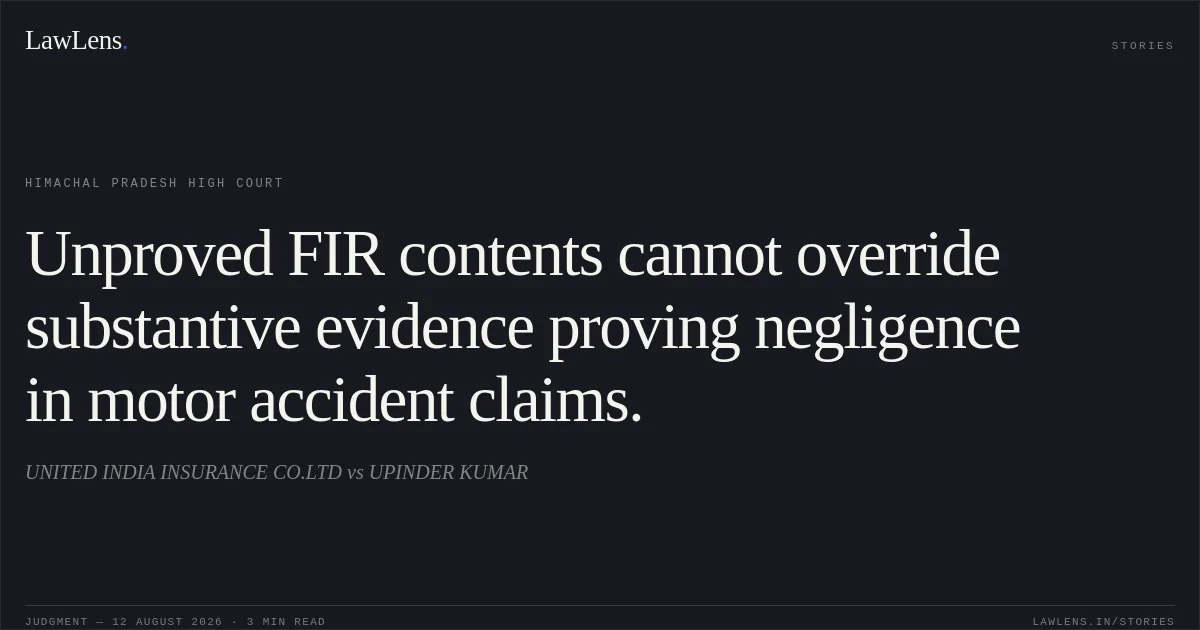
Source reference: paras. 17–25Whether the FIR, which allegedly attributed negligence to the claimant, was sufficient to displace the claimant’s evidence and justify interference with the Tribunal’s finding of negligence?
Source reference: paras. 10, 18–24Whether the Tribunal’s award directing the insurer to indemnify the compensation required interference in appeal?
Source reference: paras. 1, 7, 25–27Law Applied
The Court applied Sections 166 and 173 of the Motor Vehicles Act, 1988, governing claims for compensation and appeals against awards, respectively.
Source reference: no citationIn motor accident claims, negligence is assessed on the touchstone of preponderance of probabilities, and claimants are not required to prove their case beyond reasonable doubt, as held in Bimla Devi v. Himachal Road Transport Corporation, (2009) 13 SCC 530, Kusum Lata v. Satbir, (2011) 3 SCC 646, Bimla Devi v. Satbir Singh, (2013) 14 SCC 345, and Mathew Alexander v. Mohd. Shafi, (2023) 13 SCC 510.
Source reference: paras. 12–16An FIR and police papers are not substantive evidence and ordinarily serve to corroborate or contradict testimony; where the informant is not examined, the evidentiary value of the FIR is substantially weakened.
Source reference: para. 21Further, where evidence recorded before the Tribunal conflicts with the FIR, reliable evidence before the Tribunal may be preferred, as held in National Insurance Co. Ltd. v. Chamundeswari, (2021) 18 SCC 596.
Source reference: para. 23Reasoning
The claimant testified that the accident resulted from the rash and negligent driving of the tanker driver.
Source reference: para. 18Although the FIR showed the claimant as an accused and allegedly attributed negligence to him, its author/informant, Neeraj, was not examined by the Insurance Company.
Source reference: para. 21The Court therefore held that the FIR could not, by itself, establish the manner of the accident or the claimant’s negligence.
Source reference: para. 21The claimant’s testimony had to be read as a whole: he denied negligence, explained that he had become unconscious after the accident, and stated that the FIR had been lodged by the other side.
Source reference: para. 22Applying the civil standard of preponderance of probabilities and relying on the oral evidence, including the evidence concerning the tanker’s involvement and the testimony of the eyewitness, the Court found the tanker driver responsible for the accident.
Source reference: paras. 23–24The alleged inconsistency between the FIR and the evidence recorded before the Tribunal did not warrant rejecting the latter, particularly when the FIR author was not produced and the criminal case against the claimant ultimately resulted in his acquittal.
Source reference: paras. 21–23Holding
The Court held that the accident was caused by the rash and negligent driving of the tanker driver and that the Insurance Company failed to establish that the claimant was solely responsible for the accident.
The Tribunal’s award of ₹2,06,745, together with interest at 7.5% per annum, and its direction requiring the insurer to indemnify the award were upheld.
Source reference: paras. 25–27The appeal was dismissed, and pending applications, if any, were also disposed of.
Source reference: paras. 25–27Acts & Sections Cited
5 provisions across 2 statutes referred to in this judgment. Each provision opens on LawLens.
Motor Vehicles Act, 19882
Indian Penal Code, 18603
Original Court PDF
UNITED INDIA INSURANCE CO.LTDvsUPINDER KUMAR
Click to open original judgment
Original judgment, available to read, download and summarize on LawLens.in