Facts
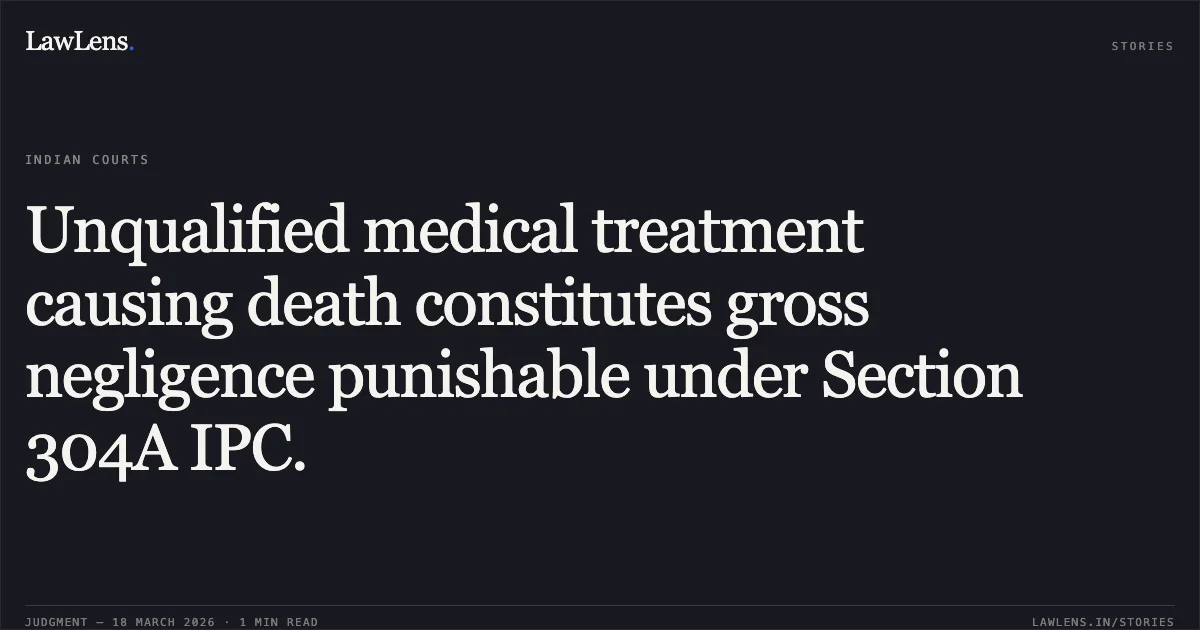
The appellant, Arakhit Tandi, was a local practitioner in Nuapada who provided medical treatment despite possessing no recognized medical qualifications
Source reference: p. 3In 2000, a two-year-old child suffering from fever was brought to the appellant, who diagnosed the ailment as malaria and administered two chloroquine injections
Source reference: p. 3, 8Immediately following the administration of the injections, the child’s condition deteriorated; he became unconscious and died shortly thereafter
Source reference: p. 3The police initially registered an Unnatural Death case, which was later converted to a charge-sheet under Section 304 of the IPC
Source reference: p. 3-4The trial court convicted the appellant on 05.09.2002 under Section 304A IPC, sentencing him to two years of rigorous imprisonment
Source reference: p. 1-2The appellant challenged this conviction and sentence in the present appeal, which remained pending for over two decades
Source reference: p. 2Issues
1. Whether the act of an unqualified person administering medical injections resulting in death constitutes "rash and negligent act" under Section 304A IPC
Source reference: p. 6, 92. Whether the conviction under Section 304 IPC was sustainable in the absence of evidence regarding criminal intention or knowledge
Source reference: p. 63. Whether the substantive sentence should be modified considering the long pendency of the appeal and the period of incarceration already undergone
Source reference: p. 10Law Applied
The Court primarily applied Section 304A of the IPC, which pertains to causing death by a rash or negligent act not amounting to culpable homicide
Source reference: p. 6It contrasted this with Section 304 of the IPC, which requires the prosecution to prove "criminal intention" or "knowledge" that the act was likely to cause death
Source reference: p. 6The Court also relied on the principle that a person who undertakes medical treatment without requisite qualification or knowledge exposes human life to serious risk, which constitutes gross negligence
Source reference: p. 9Reference was also made to the legal standards set in the Dr. Khusaldas case regarding medical negligence
Source reference: p. 6Reasoning
The Court found the ocular evidence of P.W.s 1, 2, and 3 to be consistent and cogent in proving that the appellant administered the injections
Source reference: p. 8This was corroborated by the medical testimony of P.W. 10 and the chemical examination report, which confirmed the presence of chloroquine in the child's viscera and identified it as the cause of death
Source reference: p. 5, 9The Court reasoned that the appellant's lack of medical qualification combined with the act of administering potent injections to a child of tender age amounted to a total lack of due care and competence, thereby fulfilling the criteria for "gross negligence"
Source reference: p. 9However, the Court concurred with the trial court that there was no evidence to suggest the appellant intended to cause death or knew his actions were likely to result in death, thus excluding the application of Section 304 IPC
Source reference: p. 6, 10Holding
The Court affirmed the trial court's finding that the appellant was guilty under Section 304A IPC
Regarding the sentence, the Court noted that the incident occurred over 24 years prior and the appeal had been pending since 2002
Source reference: p. 10It further observed that the appellant had already undergone approximately eleven months of incarceration during the investigation and trial phases
Source reference: p. 10Consequently, the High Court partly allowed the appeal by maintaining the conviction but modifying the sentence to the period of custody already undergone
Source reference: p. 11The Court also awarded an honorarium of Rs. 7,500 to the Amicus Curiae for his assistance
Source reference: p. 11Acts & Sections Cited
3 provisions across 2 statutes referred to in this judgment. Each provision opens on LawLens.
Indian Penal Code, 18601
Code of Criminal Procedure, 19732
Original Court PDF
ARAKHIT TANDIvsSTATE
Click to open original judgment
Original judgment, available to read, download and summarize on LawLens.in