Facts
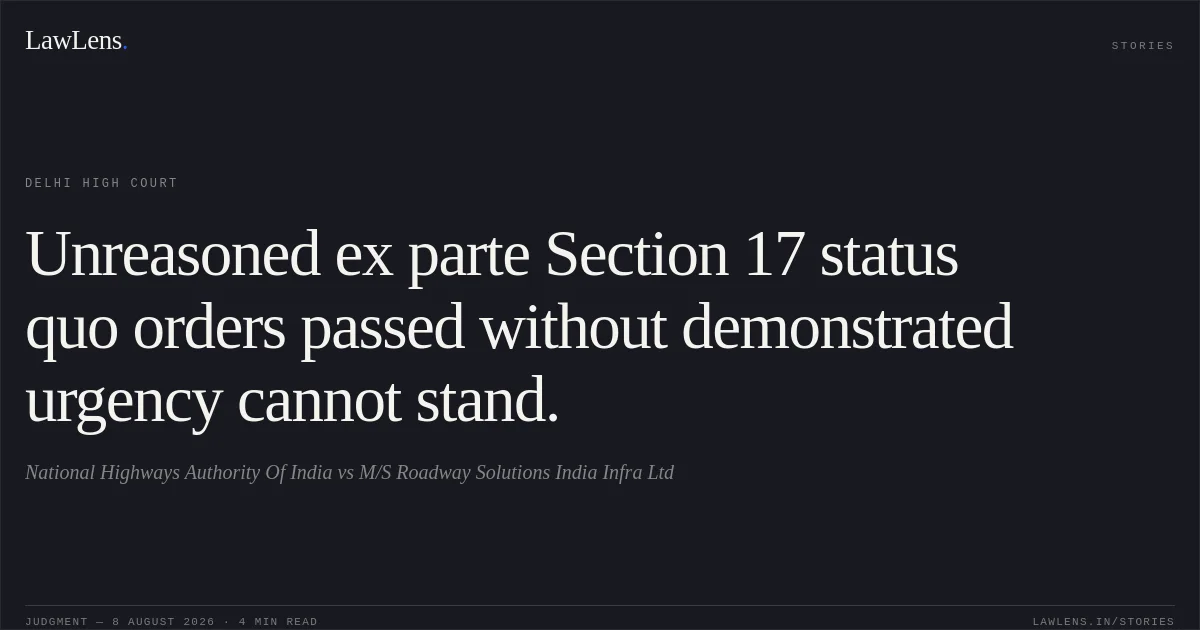
The National Highways Authority of India (“NHAI”) awarded the respondent an Engineering, Procurement and Construction contract dated 19 January 2024 for construction of a section of the Vadodara–Mumbai Expressway in Gujarat.
Source reference: p. 2, para. 2Disputes concerning performance of the works led to successive settlement agreements and termination notices.
Source reference: p. 2, paras. 3–5After the Division Bench permitted NHAI to pass an appropriate order pursuant to its termination notice and, if necessary, issue a fresh tender, NHAI terminated the contract on 17 January 2026 and issued a request for proposal for completing the balance works.
Source reference: p. 2–3, paras. 6–7A three-member arbitral tribunal was subsequently constituted.
Source reference: p. 3, para. 8During the arbitration, NHAI issued a show-cause notice dated 6 July 2026 proposing to declare the respondent a “Non-Performer” and initiate debarment proceedings. The respondent replied on 16 July 2026 and sought a personal hearing.
Source reference: p. 3, paras. 9–10On 28 July 2026, the respondent filed an application under Section 17 of the Arbitration and Conciliation Act, 1996 (“the Act”), seeking, inter alia, suspension of the termination and restraint against its declaration as a Non-Performer or debarment.
Source reference: p. 3, para. 11Although the application was served on NHAI by email on 28 July 2026, the arbitral tribunal, without hearing NHAI or receiving its response, passed an ex parte ad-interim order on 30 July 2026 directing the parties to “maintain status quo” as existing on 28 July 2026.
Source reference: p. 4, para. 12NHAI challenged that order under Section 37(2)(b) of the Act.
Source reference: no citationThe respondent contended that immediate protection was necessary because a debarment order could cause serious and irreversible reputational and commercial harm.
Source reference: p. 5, paras. 18–19Issues
Whether the arbitral tribunal was justified in granting ex parte ad-interim relief under Section 17 of the Act without affording NHAI an opportunity of hearing or considering its response?
Source reference: p. 4–5, paras. 12, 16–17Whether the tribunal’s direction to “maintain status quo” could be sustained when the impugned order contained no reasons, did not consider urgency or a prima facie case, and failed to define the scope of the direction?
Source reference: p. 6, para. 20; p. 5, para. 17Whether the expansive reliefs sought under Section 17, including relief concerning a termination effected in January 2026, were appropriate for interim adjudication?
Source reference: p. 6, paras. 21–23Law Applied
The Court applied Section 37(2)(b) of the Arbitration and Conciliation Act, 1996, which permits an appeal against an order of an arbitral tribunal granting or refusing to grant an interim measure under Section 17.
Source reference: p. 1, para. 1Section 17 empowers an arbitral tribunal to grant interim measures, but such relief must be judicially exercised on the basis of relevant considerations, including urgency, a prima facie case, and the applicable principles governing interim relief.
Source reference: p. 5, para. 17An ex parte interim order must be supported by reasons, must be narrowly and precisely framed, and ordinarily cannot be sustained where the affected party has not been heard despite the absence of demonstrated urgency.
Source reference: p. 4–6, paras. 12, 16–20Relief under Section 17 is interim in character and should not ordinarily assume the form of substantive or final relief, particularly in relation to a termination already effected.
Source reference: p. 6, paras. 21–23Reasoning
The Court found that the tribunal’s order dated 30 July 2026 was unreasoned and did not examine either urgency or the existence of a prima facie case.
Source reference: p. 6, para. 20NHAI had received the Section 17 application only two days earlier and had not been afforded an opportunity to respond or be heard.
Source reference: p. 4, para. 12Although the respondent claimed urgency on the ground that debarment could be ordered at any time after the reply to the show-cause notice, NHAI stated that no debarment order would be passed before 12 August 2026 and that a hearing on debarment had not yet been fixed.
Source reference: p. 7, para. 25In these circumstances, the Court considered that the parties could be adequately heard by the tribunal on the already-fixed date.
Source reference: no citationThe Court also expressed doubt regarding the omnibus prayers seeking, among other reliefs, suspension of a termination completed in January 2026, observing that such reliefs were substantive and final in nature rather than genuinely interim.
Source reference: p. 6, paras. 21–23The tribunal’s undefined “status quo” direction was therefore unsustainable, particularly since one co-arbitrator had indicated that he had not consented to the ex parte protection.
Source reference: p. 4, para. 15Holding
The appeal under Section 37(2)(b) was allowed.
The High Court set aside the arbitral tribunal’s ad-interim order dated 30 July 2026 directing NHAI to maintain status quo.
Source reference: p. 7–8, paras. 27–31The parties were directed to complete pleadings concerning the Section 17 application by 11 August 2026 and advance full arguments before the tribunal on 12 August 2026; the tribunal was requested to hear and decide the application on that date without granting an adjournment or indulgence.
Source reference: p. 7, paras. 27–29The order was set aside in view, particularly, of NHAI’s undertaking that the respondent would not be debarred before 12 August 2026.
Source reference: p. 7–8, para. 30The Court clarified that its observations were confined to the appeal and would not influence the tribunal’s independent adjudication on the merits.
Source reference: p. 8, paras. 32–33Acts & Sections Cited
3 provisions across 1 statute referred to in this judgment. Each provision opens on LawLens.
Arbitration and Conciliation Act, 19963
Original Court PDF
National Highways Authority Of IndiavsM/S Roadway Solutions India Infra Ltd
Click to open original judgment
Original judgment, available to read, download and summarize on LawLens.in