Facts
The appellant school appointed the first respondent as a teacher on an ad hoc basis for successive academic years from 2003 to 2006. On 25 January 2006, she was placed on probation for one year from 1 January 2006, with the appointment terms expressly providing that continuation beyond 31 December 2006 would require a fresh order and that completion of probation would not result in automatic confirmation.
Source reference: para. 3The appellant subsequently questioned the genuineness and legal validity of the respondent’s B.Ed. qualification obtained from Bharatiya Shiksha Parishad, Lucknow. The appellant found that the institution was not recognised by the National Council for Teacher Education (NCTE), and the respondent was informed that her qualification could not be accepted.
Source reference: paras. 4, 6By order dated 7 March 2007, she was permitted to continue only until the end of the academic year 2006–07, after which her services were not required.
Source reference: paras. 4, 6The respondent challenged the order before the High Court, contending that she had acquired regular status upon completion of probation and that her discontinuance without an enquiry and prior approval violated Sections 79 and 83 of the Andhra Pradesh Education Act, 1982.
Source reference: paras. 5, 7The Single Judge allowed the writ petition, and the Division Bench dismissed the appellant’s intra-court appeal.
Source reference: paras. 9–10Issues
Whether a teacher appointed on probation could claim automatic confirmation or continuation after expiry of the probationary period, contrary to the express terms of appointment?
Source reference: paras. 3, 17Whether discontinuance of the respondent’s probationary service attracted the enquiry and prior-approval requirements under Sections 79 and 83 of the Andhra Pradesh Education Act, 1982?
Source reference: paras. 14–19Whether the respondent’s B.Ed. qualification from an institution not recognised by the NCTE had any legal effect for appointment as a teacher?
Source reference: paras. 12–13Whether the absence of an enquiry violated natural justice when the invalidity of the respondent’s qualification was undisputed and no prejudice could have resulted?
Source reference: paras. 20–26Law Applied
Under Sections 14, 16 and 17(4) of the National Council for Teacher Education Act, 1993, a teacher-education qualification obtained from an institution not recognised by the NCTE has no legal effect and cannot constitute the requisite qualification for appointment as a teacher.
Source reference: para. 13Section 79 of the Andhra Pradesh Education Act, 1982 requires an enquiry before dismissal, removal or reduction in rank for disciplinary purposes, while Section 83 requires prior approval for retrenchment.
Source reference: para. 14However, termination of a probationer in accordance with the terms of appointment, through a non-stigmatic order of discharge, is ordinarily not punitive and does not attract Section 79 or Section 83 unless applicable rules provide otherwise.
Source reference: paras. 17–19Applying Dipti Prakash Banerjee v. Satyendra Nath Bose National Centre for Basic Sciences, the Court distinguished between an allegation constituting the “foundation” of termination and one operating merely as its “motive”.
Source reference: para. 18The principles of natural justice are flexible and breach of the audi alteram partem rule does not invalidate an action absent actual prejudice; no futile enquiry or remand is required where the facts are admitted or indisputable and only one conclusion is possible, as recognised in Chairman, Board of Mining Examination v. Ramjee, Escorts Farms Ltd. v. Commissioner, Viveka Nand Sethi v. Chairman, J&K Bank Ltd., and State of Uttar Pradesh v. Sudhir Kumar Singh.
Source reference: paras. 23–26Reasoning
The Court held that the respondent remained a probationer because the appointment order expressly denied automatic confirmation and required a fresh order for continuation beyond the stipulated period.
Source reference: para. 17Her non-retention was by way of a non-stigmatic discharge, not a disciplinary punishment.
Source reference: para. 19Although the respondent’s unrecognised B.Ed. qualification may have motivated the appellant’s decision, it was not the foundation of a punitive termination; consequently, Sections 79 and 83 of the 1982 Act were inapplicable.
Source reference: para. 19In any event, the respondent’s qualification was admittedly obtained from an institution lacking NCTE recognition and therefore had no legal validity under the NCTE Act.
Source reference: paras. 12–13Even if an enquiry had been required, the respondent could not have established a valid qualification or secured a different outcome. The failure to conduct an enquiry therefore caused no prejudice, making the procedural challenge unsustainable.
Source reference: paras. 20–22Recognition allegedly granted to the institution in 2022 could not retrospectively validate the degree obtained in 1997.
Source reference: paras. 27–28Holding
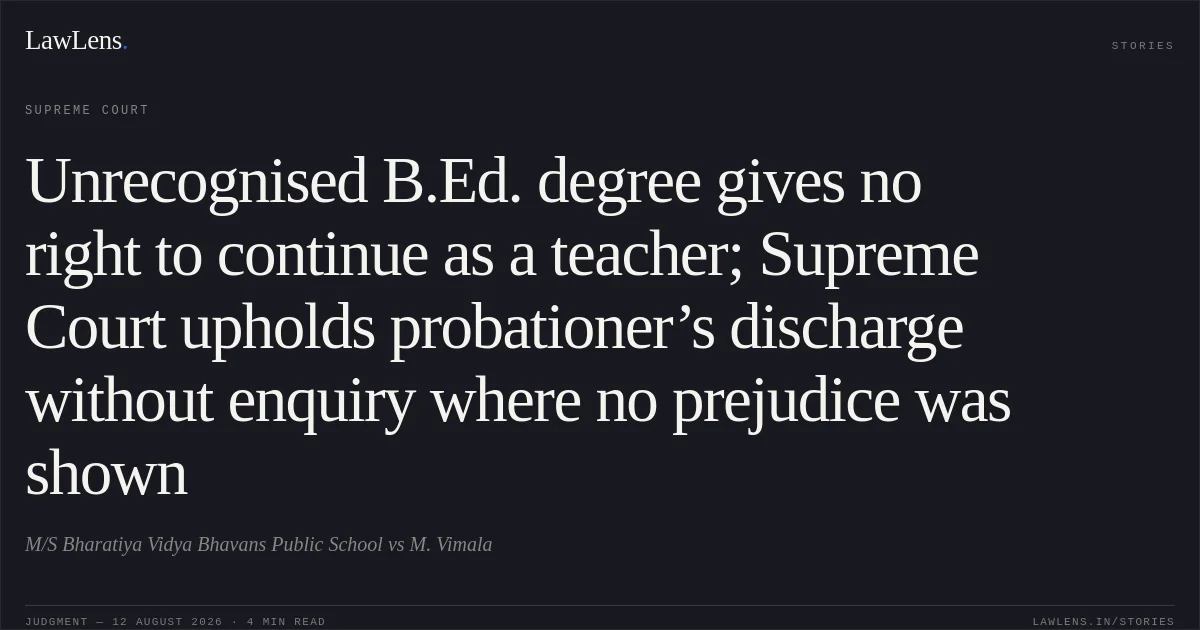
The Supreme Court held that the respondent had no enforceable right to continuation as a teacher after the probationary period, that her non-stigmatic discharge did not attract Sections 79 or 83 of the Andhra Pradesh Education Act, 1982, and that her B.Ed. degree from an unrecognised institution was legally ineffective.
The High Court’s judgment, including the order of the Single Judge, was set aside; the writ petition was dismissed; and the civil appeal was allowed.
Source reference: para. 31Original Court PDF
M/S Bharatiya Vidya Bhavans Public SchoolvsM. Vimala
Click to open original judgment
Original judgment, available to read, download and summarize on LawLens.in