Facts
The petitioner was the registered owner of a tractor (CG-10-D-6291)
Source reference: para. 3On June 14, 2025, he exchanged this tractor with Respondent No. 3 (a showroom) to purchase a new vehicle, executing an agreement and surrendering possession
Source reference: para. 3Respondent No. 3 subsequently sold the tractor to Respondent No. 4 on September 27, 2025
Source reference: para. 4On November 13, 2025, while Respondent No. 4 was driving the vehicle, an accident occurred resulting in one death and one injury
Source reference: para. 4, 12Despite the transfers, the petitioner’s name remained in the Regional Transport Office (RTO) records as the registered owner
Source reference: para. 8, 13Consequently, the police filed a charge-sheet on March 10, 2026, naming the petitioner as an accused
Source reference: para. 5The petitioner moved the High Court under Section 528 of the BNSS to quash the FIR, charge-sheet, and the order of cognizance
Source reference: para. 2Issues
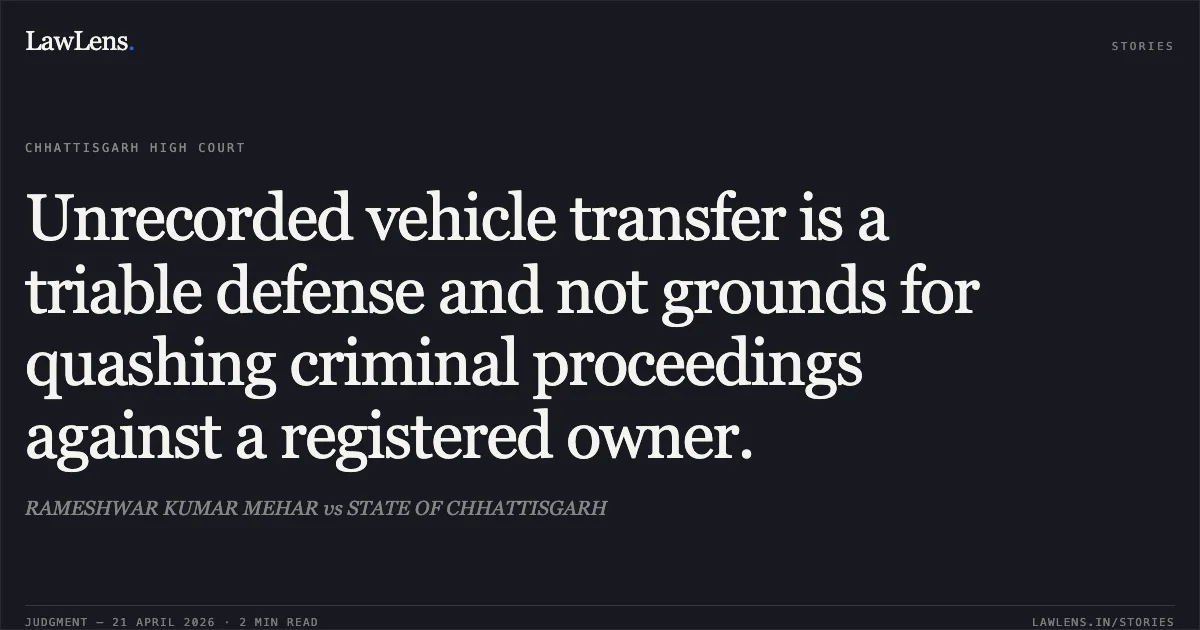
1. Whether the criminal proceedings against the petitioner should be quashed on the grounds that he had transferred ownership and possession of the vehicle prior to the accident
Source reference: para. 5, 72. Whether the non-transfer of ownership in RTO records is sufficient to maintain a criminal prosecution against the registered owner at the stage of quashing
Source reference: para. 14, 15Law Applied
The Court primarily applied Section 528 of the Bhartiya Nagarik Suraksha Sanhita (BNSS), which governs the inherent powers of the High Court to prevent abuse of process
Source reference: para. 2It relied on the landmark precedent of State of Haryana v. Bhajan Lal (1992), which established that the power to quash criminal proceedings should be exercised sparingly and only when allegations, taken at face value, do not disclose an offence
Source reference: para. 6, 17The Court also considered provisions of the Bhartiya Nyay Sanhita (BNS)—specifically Sections 281 (rash driving), 125 (endangering life), and 106(1) (causing death by negligence)—alongside Sections 146 and 196 of the Motor Vehicles Act regarding insurance and vehicle operation
Source reference: para. 2Reasoning
The Court reasoned that the power to quash under inherent jurisdiction is not intended for a "mini-trial" or a detailed appreciation of evidence
Source reference: para. 10, 18It observed that because the petitioner remained the registered owner in official RTO records on the date of the incident, there was prima facie material to justify the filing of a charge-sheet
Source reference: para. 8, 13, 16The Court noted that the legal effect of the private sale agreements and the question of whether the petitioner had "completely divested himself of ownership" are mixed questions of fact and law
Source reference: para. 14These contentions constitute a defense that must be adjudicated during the trial through evidence, rather than in a quashing petition
Source reference: para. 15Since the allegations were not "absurd or inherently improbable," they did not meet the exceptional criteria for interference under the Bhajan Lal principles
Source reference: para. 17Holding
The Court dismissed the petition, holding that there were no grounds to interfere with the FIR or the ongoing criminal proceedings at this stage
The Court ruled that the trial must proceed to determine the actual liability and the validity of the ownership transfer, clarifying that its observations in this order should not influence the merits of the trial
Source reference: para. 20The prayer to delete the petitioner's name from the Final Report and Criminal Case No. 497 of 2026 was denied
Source reference: para. 2, 20Acts & Sections Cited
6 provisions across 3 statutes referred to in this judgment. Each provision opens on LawLens.
Bharatiya Nagarik Suraksha Sanhita, 20231
Bharatiya Nyaya Sanhita, 20233
Motor Vehicles Act, 19882
Original Court PDF
RAMESHWAR KUMAR MEHARvsSTATE OF CHHATTISGARH
Click to open original judgment
Original judgment, available to read, download and summarize on LawLens.in


