Facts
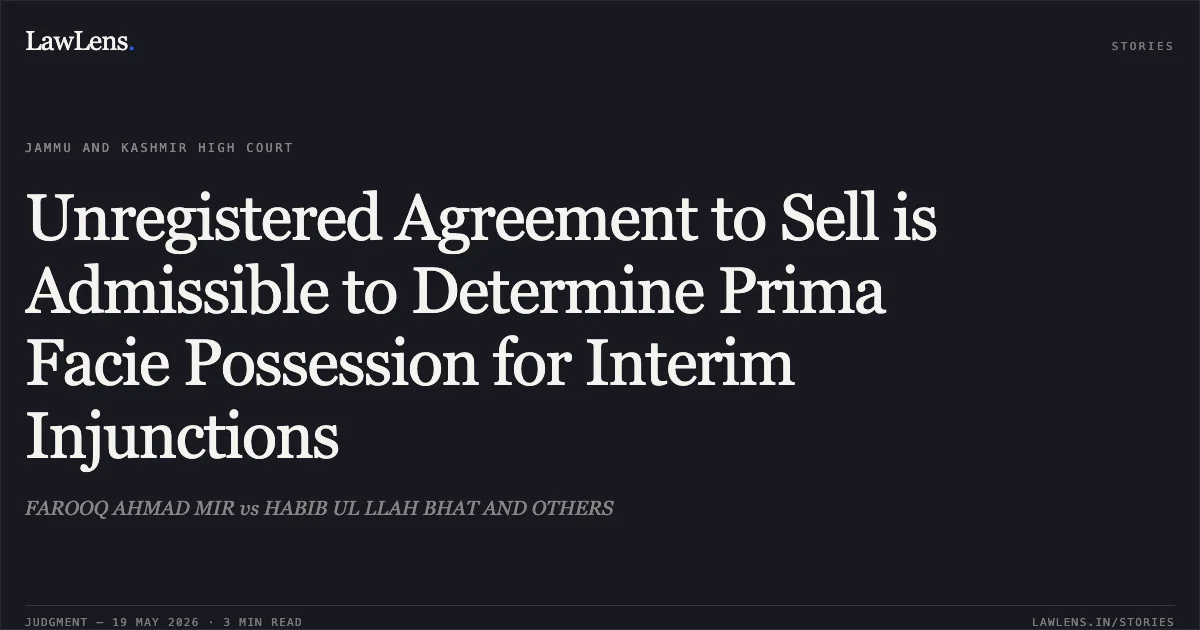
The Petitioner (Defendant) challenged the order dated 28.02.2026 passed by the Principal District Judge, Kupwara, which upheld the Trial Court’s (Munsiff, Sogam) grant of an interim injunction in favor of the Respondents (Plaintiffs).
Source reference: para. 01The Respondents had filed a suit for permanent injunction asserting possession over land, a building, and an access pathway.
Source reference: para. 02The Petitioner contended that the lower courts erroneously relied on an unregistered and unstamped agreement to sell and that the property was joint and undivided.
Source reference: para. 05The case came before the High Court under its supervisory jurisdiction under Article 227 of the Constitution of India.
Source reference: para. 01Issues
1. Whether an unregistered and unstamped agreement to sell can be relied upon for the limited purpose of establishing prima facie possession at the stage of interim injunction.
Source reference: para. 06, 132. Whether the High Court should interfere with the discretionary orders of the lower courts under Article 227 of the Constitution in the absence of patent perversity or jurisdictional error.
Source reference: para. 11, 18Law Applied
The Court applied the principles governing interlocutory injunctions—prima facie case, balance of convenience, and irreparable injury—as established in Zenit Mataplast (P) Ltd. v. State of Maharashtra.
Source reference: para. 07It relied on Wander Ltd. v. Antox India (P) Ltd. regarding the limited scope of appellate interference in discretionary orders.
Source reference: para. 09Regarding the admissibility of unregistered documents, the Court applied Section 49 of the Registration Act and the precedent in S. Kaladevi v. V.R. Somasundaram, which allows unregistered documents to be used for "collateral purposes" or as evidence of the nature of possession.
Source reference: para. 14-15The Court delineated the restrictive scope of Article 227 as a "custodian of justice" rather than a court of appeal, citing P. Suresh v. D. Kalaivani and Ahmedabad Mfg. & Calico Ptg. Co. Ltd. v. Ram Tahel Ramnand.
Source reference: para. 19-20Reasoning
The Court reasoned that at the interlocutory stage, the judiciary is not required to conclusively determine title but only to preserve the status quo based on tentative findings.
Source reference: para. 07-08It found that the lower courts correctly prioritized the "factum of peaceful use and possession" over the technicalities of title, as possession is paramount in a suit for simpliciter injunction.
Source reference: para. 12The Court rejected the Petitioner's argument regarding the inadmissibility of the unregistered agreement, clarifying that such a document is legally permissible for the "collateral purpose" of assessing the character of possession.
Source reference: para. 13, 15The Court determined that the Petitioner failed to demonstrate any "patent arbitrariness, perversity, or capriciousness" in the lower courts' findings.
Source reference: para. 11Since the view taken by the Trial Court was "reasonably possible" based on the material on record, the High Court declined to substitute its own discretion for that of the subordinate court.
Source reference: para. 10-11, 18Holding
The High Court dismissed the petition and upheld the orders of the Principal District Judge, Kupwara, and the Munsiff, Sogam.
The Court held that an unregistered agreement to sell can be considered for the collateral purpose of determining prima facie possession and that concurrent findings of fact regarding possession should not be disturbed under Article 227 without proof of gross illegality or jurisdictional error.
Source reference: para. 15-16, 18, 22The Trial Court was directed to decide the suit independently on its merits based on evidence led during the trial.
Source reference: para. 25Acts & Sections Cited
1 provisions across 1 statute referred to in this judgment. Each provision opens on LawLens.
Registration Act, 19081
Original Court PDF
FAROOQ AHMAD MIRvsHABIB UL LLAH BHAT AND OTHERS
Click to open original judgment
Original judgment, available to read, download and summarize on LawLens.in