Facts
The petitioners claimed rights over land bearing Revenue Survey No. 233, Village Vadaj, Ahmedabad, including Shops Nos. 12, 13, 14, 15 and 17 situated in Final Plot No. 429. Their claims were based on unregistered agreements to sell executed in 1986 and 1990, and they asserted that they had been occupying and conducting business from the shops for approximately 36 years.
Source reference: p. 3; para. 4The land formed part of Town Planning Scheme No. 29, and the petitioners alleged that notices under the statutory scheme were served only upon the original landowners and not upon them as occupiers or alleged purchasers.
Source reference: pp. 3–5; paras. 4.1, 6–6.1The petitioners had earlier approached the High Court in Special Civil Application No. 14823 of 2025. By order dated 16 October 2025, the authorities were directed to consider their representation after granting them an opportunity of hearing. The representation was rejected by order dated 4 December 2025.
Source reference: p. 5; para. 5The petitioners consequently challenged the order dated 4 December 2025 and the notification dated 22 February 2024, and sought allotment of an alternative plot or protection against implementation of the Town Planning Scheme.
Source reference: pp. 2, 5–6; para. 3The respondents contended that the petitioners had no registered title, that their civil suits for specific performance of the unregistered agreements were pending, and that the sanctioned Town Planning Scheme had resulted in statutory vesting of the relevant land in the Municipal Corporation.
Source reference: pp. 7–10; paras. 7.1–7.6Issues
Whether the petitioners, relying upon unregistered agreements to sell and claiming to be occupiers of the subject land, were entitled to statutory notice and participation in the preparation or implementation of the Town Planning Scheme under Rule 26 of the Gujarat Town Planning and Urban Development Rules, 1979?
Source reference: pp. 11–13; paras. 8–9Whether the notification dated 22 February 2024 and the order dated 4 December 2025 rejecting the petitioners’ representation were illegal for non-service of notice or violation of the statutory procedure?
Source reference: pp. 5–6, 11–14; paras. 6–6.1, 8–12Whether the pendency of the petitioners’ civil suits for specific performance justified restraining the authorities from implementing the sanctioned Town Planning Scheme or entitled the petitioners to an alternative plot?
Source reference: pp. 7–11; paras. 7.1–7.6Law Applied
The Court applied Article 226 of the Constitution of India in examining the legality of the administrative action.
Source reference: no citationUnder Sections 51 and 52(1) of the Gujarat Town Planning and Urban Development Act, 1976, read with Rule 26 of the Gujarat Town Planning and Urban Development Rules, 1979, notice in the prescribed Form H is required to be issued to the owner of the property in the course of preparing the preliminary and final schemes.
Source reference: pp. 11–12; para. 8Section 65 provides for sanction of the preliminary Town Planning Scheme, after which the statutory consequences under Section 67 follow, including vesting of land required by the authority and extinguishment or reconstitution of rights in original plots.
Source reference: pp. 8–9; para. 7.4Rule 37 concerns claims by the owner under Section 82 of the Act.
Source reference: p. 11; para. 8The Court further applied the principle that an unregistered agreement to sell does not, by itself, confer ownership or title upon the purchaser, and that pending specific-performance proceedings do not establish a present legal title capable of obstructing implementation of a sanctioned Town Planning Scheme.
Source reference: pp. 7–13; paras. 7.1–7.4, 8–9The decision relied upon by the petitioners in Special Civil Application No. 19717 of 2023 was distinguished because, in that case, the claimants were actual owners of the land.
Source reference: p. 13; para. 11Reasoning
The Court found that the petitioners’ names were not reflected in the revenue records and that the documents relied upon were unregistered agreements to sell rather than registered title documents.
Source reference: p. 11; para. 8Consequently, the petitioners could not be treated as owners for the purposes of Rule 26, which required notice to the recorded owners.
Source reference: p. 11; para. 8The original landowners’ names were reflected in the redistribution sheet, and the statutory notices and publication requirements were therefore held to be sufficient.
Source reference: pp. 11–12; para. 8The Court further held that the petitioners had neither acquired nor established any legal title and could not claim a right to participate in the scheme merely because they occupied shops or had pending suits for specific performance.
Source reference: p. 12; para. 9Since the Town Planning Scheme had already been sanctioned, its statutory consequences had followed, and the pendency of civil proceedings did not warrant suspension of its implementation.
Source reference: pp. 8–10; paras. 7.2–7.5The authority’s order rejecting the representation contained reasons and addressed the relevant contentions; therefore, no procedural illegality or jurisdictional error was established.
Source reference: p. 13; para. 10Holding
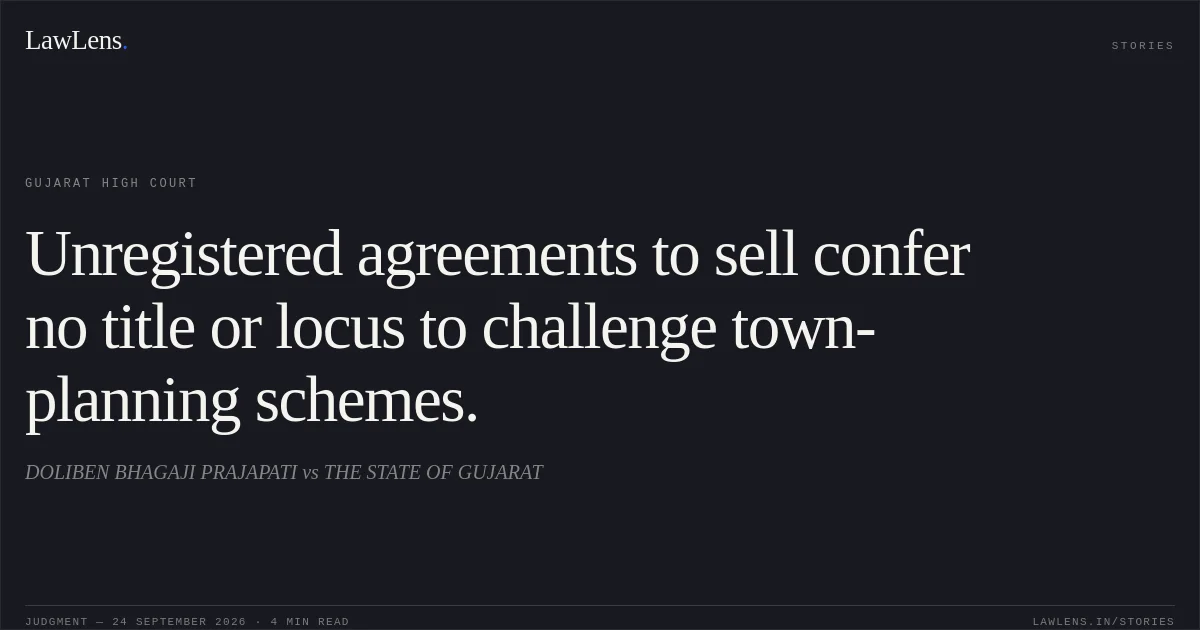
The High Court held that the petitioners, lacking established ownership and relying only on unregistered agreements to sell and pending civil suits, had no enforceable legal right to challenge the Town Planning Scheme, demand notice as owners, seek an alternative plot, or restrain its implementation.
The challenge to the notification dated 22 February 2024 and the order dated 4 December 2025 was rejected.
Source reference: p. 14; para. 12The petition was dismissed, the rule was discharged, and no order as to costs was made.
Source reference: p. 14; para. 12Acts & Sections Cited
7 provisions across 1 statute referred to in this judgment. Each provision opens on LawLens.
Gujarat Town Planning And Urban Development Act, 19767
Original Court PDF
DOLIBEN BHAGAJI PRAJAPATIvsTHE STATE OF GUJARAT
Click to open original judgment
Original judgment, available to read, download and summarize on LawLens.in