Facts
The appellants (legal representatives of the original plaintiff, Gopal) challenged the concurrent judgments of the Trial Court and the First Appellate Court which dismissed their suit for confirmation of possession, partition, and a declaration that a Will dated 15.02.1993 was null and void
Source reference: para. 1-2The plaintiff and defendants are siblings and children of the late Bhagmania Bai, who owned the suit properties
Source reference: para. 2The plaintiff asserted an oral partition and a subsequent written family arrangement (Vyavastha Patra) dated 18.04.2006 following Bhagmania Bai's death
Source reference: para. 3Conversely, Defendant No. 1 claimed title via a registered Will executed by Bhagmania Bai in 1993
Source reference: para. 4The plaintiff contested the Will’s validity, arguing it was forged because it included land already sold by the testatrix in 1980
Source reference: para. 3The Trial Court dismissed the suit, finding the family arrangement inadmissible due to lack of registration and the Will duly proved by attesting witnesses
Source reference: para. 5-6The First Appellate Court affirmed these findings
Source reference: para. 11Issues
1. Whether the registered Will dated 15.02.1993 (Ex. D-1) was validly executed and proved in accordance with the Indian Succession Act, 1925
Source reference: para. 7, 92. Whether the Vyavastha Patra (family arrangement) dated 18.04.2006 was admissible in evidence despite being an unregistered partition deed
Source reference: para. 10-113. Whether the concurrent findings of the lower courts presented any substantial question of law warranting interference under Section 100 of the Code of Civil Procedure (CPC)
Source reference: para. 12-14Law Applied
Section 100 of the CPC, which restricts the jurisdiction of Second Appeals to cases involving a "substantial question of law" and prohibits interference with concurrent findings of fact unless they are perverse or based on no evidence
Source reference: para. 1, 12The Registration Act, 1908, which mandates that documents in the nature of a partition deed must be registered to be admissible as evidence
Source reference: para. 5, 10The Indian Succession Act, 1925, requiring the testimony of attesting witnesses to prove due execution
Source reference: para. 7, 11State of Rajasthan v. Shiv Dayal (2019) 8 SCC 637, affirming that concurrent findings of fact cannot be assailed in a second appeal unless recorded de hors the pleadings or through a misreading of evidence
Source reference: para. 16Reasoning
The High Court observed that the Trial Court had specifically framed and addressed the issue of the Will’s validity, determining that the plaintiff failed to prove forgery
Source reference: para. 9The Court noted that the execution of the Will (Ex. D-1) was established through the testimony of an attesting witness, and the inclusion of previously sold property did not inherently render the Will suspicious, given the testatrix was illiterate
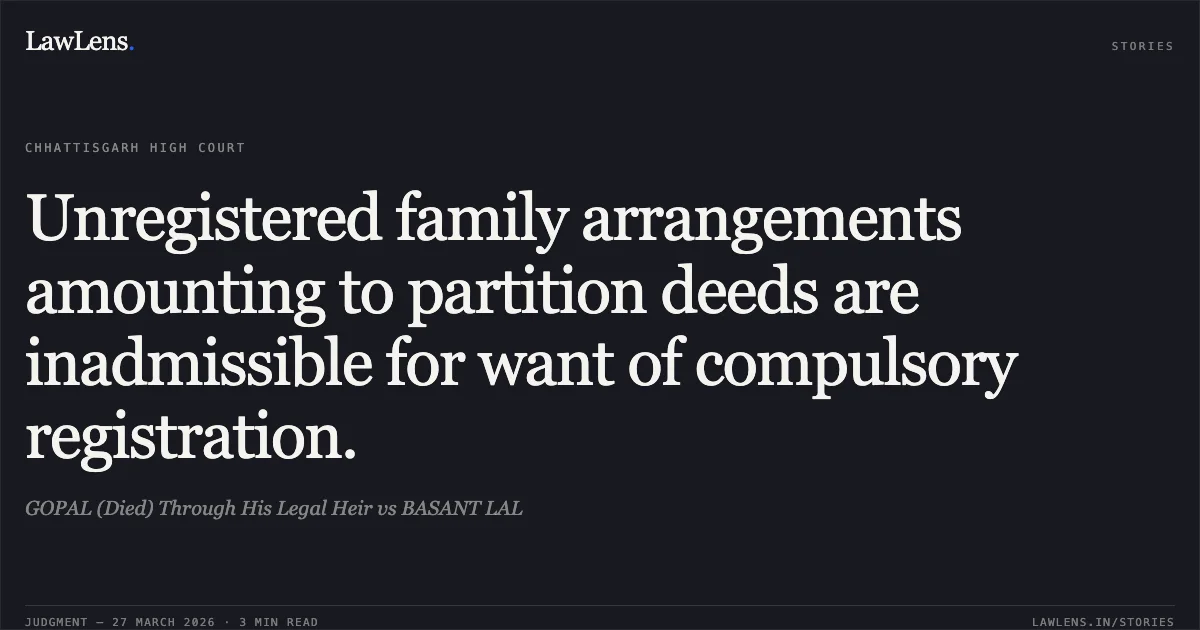
Source reference: para. 11Regarding the Vyavastha Patra, the Court found that a prior ruling in WPC No. 6834/2010 had already established that the document was an unregistered partition deed and thus inadmissible; this order had attained finality
Source reference: para. 10The Court reasoned that the appellants' arguments essentially sought a re-appreciation of evidence rather than addressing a legal error
Source reference: para. 14Since the findings of the lower courts were based on a proper appreciation of evidence and followed settled legal principles regarding registration and testamentary proof, no perversity was found
Source reference: para. 17-18Holding
The High Court dismissed the Second Appeal, holding that no substantial question of law was involved
The Court affirmed the findings of the lower courts, ruling that the registered Will (Ex. D-1) was validly proved and that the unregistered Vyavastha Patra could not be considered as evidence of partition
Source reference: para. 10-11The judgment and decree of the Trial Court and the First Appellate Court were upheld
Source reference: para. 19Original Court PDF
GOPAL (Died) Through His Legal HeirvsBASANT LAL
Click to open original judgment
Original judgment, available to read, download and summarize on LawLens.in