Facts
The property (108 sq. yards in Gandhi Nagar, Delhi) was originally part of a larger plot owned by Gian Singh, which eventually devolved to his daughter-in-law, Smt. Satvinder Kaur, following a 1996 court decree
Source reference: p. 3, 15In 1998, the plaintiffs (sons of Satvinder Kaur) and other siblings executed a notarized Relinquishment Deed in favor of their mother to facilitate the sale of the rear portion of the property
Source reference: p. 11, 17Satvinder Kaur subsequently transferred the remaining suit property (two shops) to her daughter (Defendant No. 1) in 2002 via GPA and Agreement to Sell, who then sold it to Defendant No. 2 via a registered Sale Deed in 2006
Source reference: p. 4, 10The plaintiffs filed a suit in 2008 seeking partition and a declaration that these transfers were null and void, asserting that the 1998 Relinquishment Deed was invalid due to non-registration
Source reference: p. 2, 13The Trial Court dismissed the suit
Source reference: p. 2Issues
1. Whether an unregistered Relinquishment Deed/Family Settlement can be used to establish the mother's absolute ownership and exclude the claims of other legal heirs?
Source reference: p. 13, 192. Whether the plaintiffs were estopped from challenging the sale of the suit property to a third party (Defendant No. 2) based on their prior conduct?
Source reference: p. 9, 263. Whether the transfer to Defendant No. 2 is protected under the doctrines of ostensible ownership or feeding the grant by estoppel?
Source reference: p. 12, 26, 27Law Applied
Section 17 of the Registration Act, 1908, which mandates the registration of documents and extinguishing rights in immovable property
Source reference: p. 13, 19The "Family Settlement" doctrine from Kale v. Deputy Director of Consolidation, holding that a memorandum recording a pre-existing oral partition does not require registration
Source reference: p. 21Section 41 of the Transfer of Property Act (TPA), 1882, regarding transfers by an "ostensible owner" with the implied consent of the real owners
Source reference: p. 12, 26Section 43 of the TPA regarding "feeding the grant by estoppel" where a transferor subsequently acquires interest in the property
Source reference: p. 13, 27Reasoning
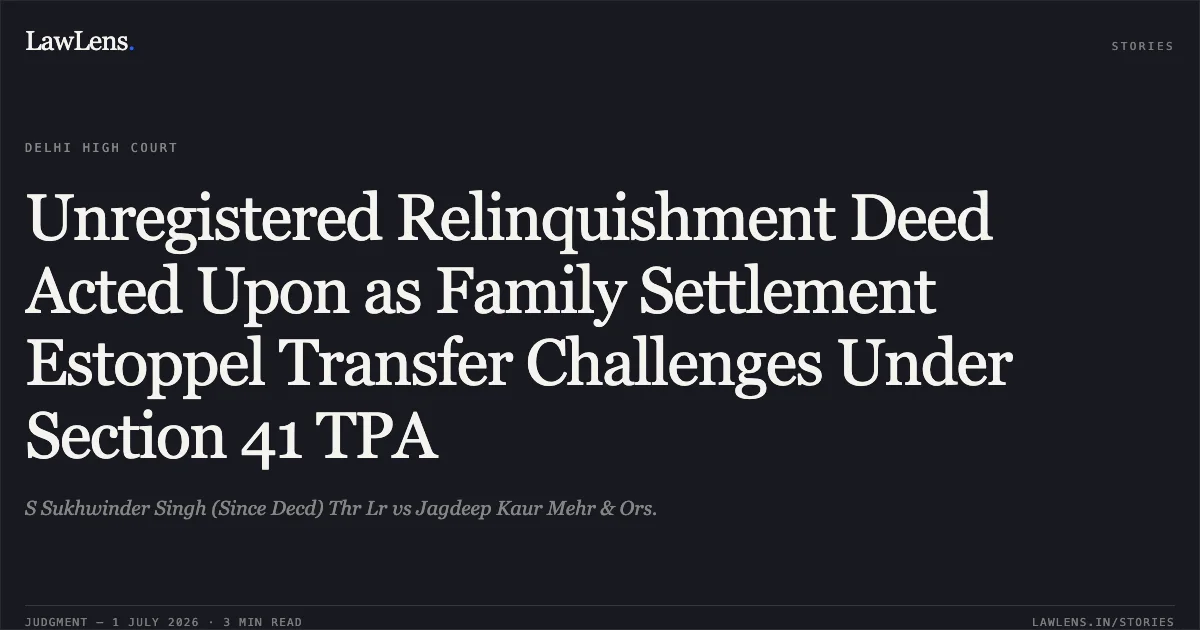
The Court reasoned that while the 1998 Relinquishment Deed was unregistered, it functioned as a record of a family arrangement that had been consistently acted upon by all parties for years
Source reference: p. 19, 22The plaintiffs, being well-educated (including an advocate), had signed the deed, allowed the mother to mutate the property in her name, collect rent exclusively, and shared in the proceeds of an earlier sale of the rear portion
Source reference: p. 17-18, 23This conduct established that Satvinder Kaur was the "ostensible owner" with the plaintiffs' implied consent under Section 41 of the TPA
Source reference: p. 26Consequently, Defendant No. 2, a bona fide purchaser for consideration, was protected against the plaintiffs' claims
Source reference: p. 12, 26Furthermore, the court noted a subsequent 2006 Memorandum of Understanding (MOU) placed on record by the plaintiffs themselves, which confirmed the division of shops and supported the validity of the mother's initial right to transfer
Source reference: p. 24-25Holding
The High Court dismissed the appeal and upheld the Trial Court's judgment
It held that the plaintiffs were estopped by their conduct from challenging the mother's title after having treated her as the absolute owner for over a decade
Source reference: p. 11, 26The Court concluded that Smt. Satvinder Kaur had validly transferred the property to Defendant No. 1, and the subsequent Sale Deed to Defendant No. 2 was legal and binding
Source reference: p. 28All pending applications were disposed of
Source reference: p. 28Acts & Sections Cited
1 provisions across 1 statute referred to in this judgment. Each provision opens on LawLens.
Code of Civil Procedure, 19081
Original Court PDF
S Sukhwinder Singh (Since Decd) Thr LrvsJagdeep Kaur Mehr & Ors.
Click to open original judgment
Original judgment, available to read, download and summarize on LawLens.in