Facts
The respondent (plaintiff) entered into a sale agreement on 14.09.2015 (Ex.A1) with the appellants (defendants) to purchase the suit property at Rs. 6,00,000 per acre, totaling Rs. 58,08,000.
Source reference: p.3, paras 4-5An initial advance of Rs. 20,00,000 was paid with a three-month deadline for the balance.
Source reference: p.3, paras 4-5On 18.12.2015, a second agreement (Ex.A2) was executed, and the appellants accepted a further advance of Rs. 10,00,000, extending the performance time to January 2016.
Source reference: p.3, para 6Despite the respondent’s notice of readiness, the appellants issued a reply notice on 20.04.2016 refusing execution, claiming the respondent lacked funds and that the advance was forfeited.
Source reference: p.4, para 7The respondent filed O.S. No. 23 of 2016 for specific performance.
Source reference: no citationThe Trial Court decreed the suit in favor of the respondent on 06.08.2018.
Source reference: p.2, para 3Issues
1. Whether the respondent was ready and willing to perform his part of the agreements?
Source reference: p.11, para 272. Whether time was the essence of the agreement?
Source reference: p.11, para 273. Whether the unregistered sale agreements were admissible in evidence?
Source reference: p.5, para 11; p.15, para 38Law Applied
The court applied the criteria for granting specific performance as established in Kamal Kumar v. Premlata Joshi and Others (2019) 3 SCC 704, which requires a valid contract, continuous readiness and willingness, and an assessment of equity and hardship.
Source reference: p.9, para 21It referenced Article 54 of the Limitation Act, 1963, which sets a three-year limitation period for specific performance from the date of performance or refusal.
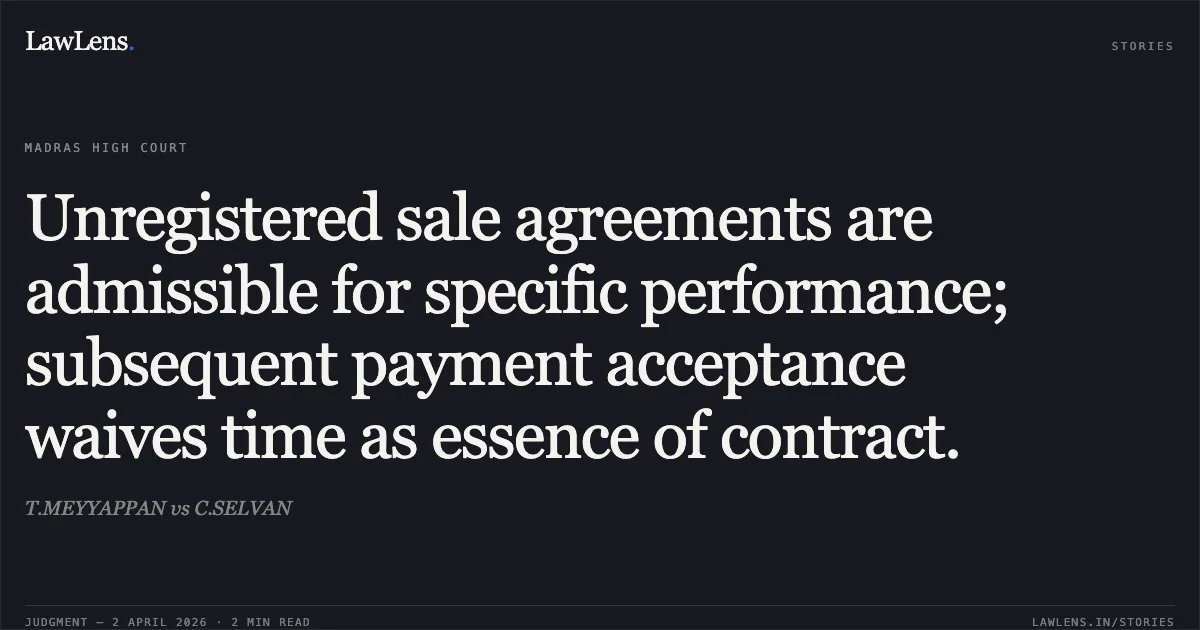
Source reference: p.13, para 33Crucially, the court applied the Proviso to Section 49 of the Registration Act, 1908, which stipulates that an unregistered document affecting immovable property may be received as evidence of a contract in a suit for specific performance.
Source reference: p.15, para 38Reasoning
The court determined that time was not the essence of the contract because the appellants accepted a substantial additional advance of Rs. 10,00,000 after the initial three-month period had expired, thereby waiving the original timeline.
Source reference: p.12, para 30The court also noted that the appellants failed to fulfill their contractual obligation to measure the land and fix boundaries.
Source reference: p.12, para 31On the issue of readiness and willingness, the respondent's bank statement (Ex.A7) proved he possessed sufficient funds (between Rs. 33,00,000 and Rs. 72,00,000) during the relevant periods.
Source reference: p.14, para 35The court highlighted that the respondent deposited the entire balance consideration of Rs. 28,08,000 into the court on 12.07.2017—prior to the filing of the written statement—which served as conclusive evidence of his readiness.
Source reference: p.14, para 36Regarding the lack of registration, the court held that under the Section 49 proviso of the Registration Act, the documents remained admissible for seeking specific performance.
Source reference: p.15, para 38Holding
The High Court dismissed the appeal and confirmed the Trial Court’s decree for specific performance.
The court held that the agreements were valid and binding, the respondent had successfully demonstrated continuous readiness and willingness to perform the contract, and the suit was filed within six months of the refusal, well within the limitation period.
Source reference: p.15, paras 37, 39The appellants were directed to execute the sale deed as per the terms of the agreement.
Source reference: no citationActs & Sections Cited
4 provisions across 3 statutes referred to in this judgment. Each provision opens on LawLens.
Code of Civil Procedure, 19082
Registration Act, 19081
Limitation Act, 19631
Original Court PDF
T.MEYYAPPANvsC.SELVAN
Click to open original judgment
Original judgment, available to read, download and summarize on LawLens.in