Facts
The Plaintiff (Raj Kumari Garg) leased the suit property in Defence Colony, New Delhi, to the erstwhile State Bank of Patiala (now SBI) via a registered lease deed dated 10.03.2003 for three years (01.01.2002 to 31.12.2004)
Source reference: p.2Although the deed allowed five renewal options of three years each subject to a 20% rent hike and written request, no fresh deed was executed after 2004
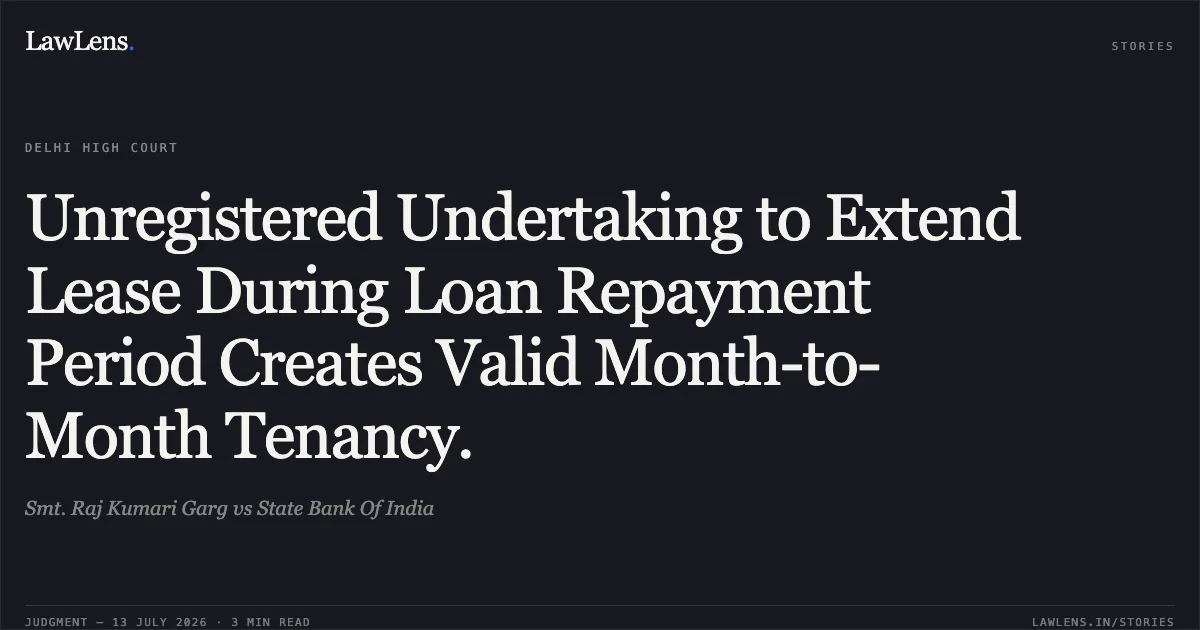
Source reference: p.3However, the Plaintiff accepted enhanced rent and availed a term loan of ₹25 Lakhs from the Bank in 2007 under a "Rent Scheme," signing an undertaking to extend the lease until the loan was repaid
Source reference: p.5The Plaintiff terminated the tenancy via notice on 09.05.2008, seeking possession and mesne profits
Source reference: p.3The Bank vacated the premises on 31.12.2017 during proceedings
Source reference: p.5The Trial Court granted mesne profits from May 2012 (when the loan was repaid) until vacation, which both parties challenged
Source reference: p.7Issues
1. Whether the Plaintiff was entitled to mesne profits for the period from 05.08.2008 to May 2012, despite the loan undertaking?
Source reference: p.13 / para. 562. Whether the continued occupation by the Bank after the initial lease expiry constituted "holding over" or an "extension"?
Source reference: p.15 / para. 623. Whether the mesne profits awarded at ₹163 per sq. ft. per month with 15% enhancement were legally justified?
Source reference: p.21 / para. 864. Whether the interest rate of 6% per annum on mesne profits was reasonable under Section 34 CPC?
Source reference: p.23 / para. 95Law Applied
Section 107 of the Transfer of Property Act, 1882, requiring registered instruments for leases exceeding one year
Source reference: p.8Principle distinguishing between "renewal" (requiring a new deed) and "extension" (prolonging the existing deed) based on Provash Chandra Dalui v. Biswanath Banerjee and State of U.P. v. Lalji Tandon
Source reference: p.15-16Section 111(a) and (b) regarding the determination of lease by efflux of time or happening of an event
Source reference: p.19Section 34 of the Code of Civil Procedure, 1908, and the discretionary principles from Central Bank of India v. Ravindra
Source reference: p.23-24Reasoning
The Court observed that while no formal "renewal" occurred due to the absence of a registered deed, the Plaintiff’s letters in 2005 and 2007 and her acceptance of enhanced rent established an "extension" on a month-to-month basis
Source reference: p.17Crucially, the undertaking signed by the Plaintiff in 2007 to secure a term loan under the "Rent Scheme" created a binding obligation to permit the Bank’s occupation until the loan’s repayment in May 2012
Source reference: p.18Consequently, the 2008 termination notice was ineffective during the loan subsistence, and the Bank’s possession only became "unauthorized" after May 2012
Source reference: p.20Regarding quantum, the Court upheld the rate of ₹163 per sq. ft. based on the testimony of PW-2 (a neighboring landlord), noting that even with differences in building age, the Bank failed to provide rebuttal evidence
Source reference: p.22Holding
(i) the Plaintiff was not entitled to mesne profits from 2008 to May 2012 as she was bound by the loan undertaking; (ii) the Bank became an unauthorized occupant only after the loan was discharged in May 2012; (iii) the mesne profit rate of ₹163 per sq. ft. was reasonable based on market evidence; and (iv) the 6% interest rate was a valid exercise of judicial discretion under Section 34 CPC
The High Court dismissed both appeals and upheld the Trial Court’s judgment. Relief for enhancement or total denial of mesne profits was refused.
Source reference: p.25Acts & Sections Cited
1 provisions across 1 statute referred to in this judgment. Each provision opens on LawLens.
Securitisation and Reconstruction of Financial Assets and Enforcement of Security Interest Act, 20021
Original Court PDF
Smt. Raj Kumari GargvsState Bank Of India
Click to open original judgment
Original judgment, available to read, download and summarize on LawLens.in