Facts
The prosecution alleged that, on an election day, the deceased was proceeding to his fields with his son, employee, nephew and another villager when the accused allegedly ambushed them and fired indiscriminately. The deceased was shot in the back and later declared dead at the hospital; the accompanying persons allegedly escaped when a patrol car arrived.
Source reference: p.1–2The trial court convicted the accused under Sections 302 and 307 read with Section 149 of the Indian Penal Code, 1860 (IPC). A1, A4 and A6 were additionally convicted under Section 148 IPC and Section 27 of the Arms Act, while A2, A3 and A5 were convicted under Section 147 IPC.
Source reference: p.2The prosecution relied principally on the testimonies of PW1, PW2 and PW7, who gave differing accounts regarding the identity of the shooter and the sequence of events.
Source reference: p.2–3The Supreme Court noted that no cartridges, bullet, weapons or chemically analysed blood-stained earth were recovered, independent witnesses were not examined, and the inquest was conducted before the First Information Statement was recorded.
Source reference: p.3–5The High Court nevertheless affirmed the convictions by relying on the eyewitness evidence and attributing the evidentiary deficiencies to alleged collusion by the Investigating Officer.
Source reference: p.7–8Issues
Whether the eyewitness testimonies, despite inconsistencies, doubtful presence of the witnesses and an alleged prior dispute with the accused, established the accused’s participation in the murder beyond reasonable doubt.
Source reference: p.2–5, p.9–10Whether the medical evidence regarding the deceased’s sitting position and close-range firing was consistent with, or materially contradicted, the prosecution’s account of an ambush and shooting from behind.
Source reference: p.6–7, p.8–10Whether the absence of recoveries, seizure of cartridges and weapons, forensic examination of blood-stained earth, and examination of independent witnesses rendered the prosecution case unreliable.
Source reference: p.3–5, p.8–11Whether the alleged motive relating to the kidnapping of a girl and political rivalry was sufficiently established to support the prosecution case.
Source reference: p.5–6, p.9–10Whether alleged defective or collusive investigation could justify conviction where the substantive prosecution evidence itself did not inspire confidence.
Source reference: p.7–11Law Applied
The Court applied Sections 302 and 307 read with Section 149 IPC concerning murder, attempt to murder and constructive liability of members of an unlawful assembly, along with Sections 147 and 148 IPC concerning rioting and rioting while armed, and Section 27 of the Arms Act concerning use of arms.
Source reference: p.2The governing criminal-law standard was that the prosecution must establish the accused’s guilt beyond reasonable doubt; suspicion, conjecture or deficiencies in investigation cannot substitute reliable evidence.
Source reference: p.10–11Related witnesses cannot be rejected solely because of their relationship, but their testimony must be scrutinised carefully where their presence is doubtful or they have an apparent motive to implicate the accused.
Source reference: p.4–5, p.9–10A faulty investigation does not automatically benefit the accused; however, where reliable substantive evidence is absent, the Court cannot presume guilt merely because the investigation was poor or the Investigating Officer was alleged to have acted collusively.
Source reference: p.11Expert medical evidence inconsistent with the eyewitness account is a material circumstance requiring the prosecution version to be rejected where the inconsistency is substantial.
Source reference: p.6–7, p.8–10Reasoning
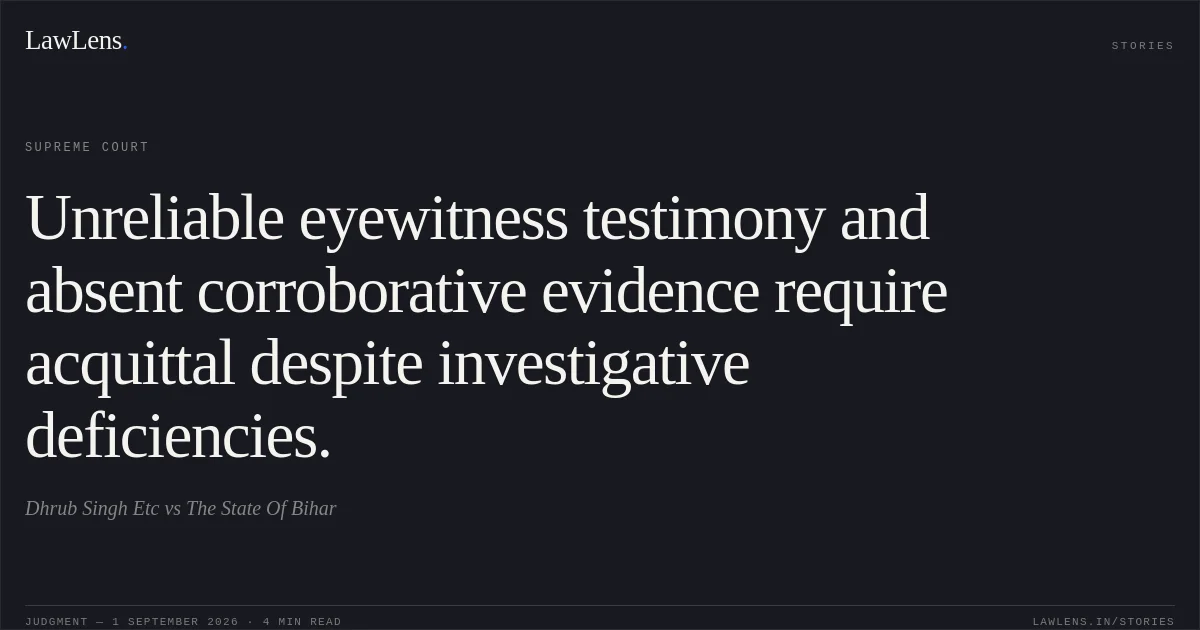
The Supreme Court held that the eyewitness evidence did not inspire confidence. Although variations in the sequence of events during an alleged ambush would not, by themselves, be fatal, the witnesses differed on the identity of the person who shot the deceased and the surrounding circumstances.
Source reference: p.2–3Their presence was doubtful because they were closely related or associated with the deceased, no eyewitness sustained injury despite the allegation of indiscriminate firing, and their blood-stained clothes were not seized despite their alleged role in carrying the deceased to the hospital.
Source reference: p.5, p.8, p.9–10The medical evidence indicated that the deceased was shot from close range while in a sitting position, which conflicted with the account that he was walking in a straight line and was shot from behind during an ambush.
Source reference: p.6–7, p.9–10The prosecution also failed to recover cartridges, the bullet, weapons or scientifically examined blood-stained earth, and did not examine the independent villager or members of the patrol party.
Source reference: p.3–5The alleged motives were unsupported by evidence: neither the kidnapping nor the claimed political rivalry was satisfactorily established, and the person allegedly responsible for the grievance was not even arrayed as an accused.
Source reference: p.5–6In these circumstances, the investigative lapses assumed significance because there was no dependable evidence independent of the doubtful eyewitness accounts.
Source reference: p.10–11Holding
The Court answered the issues against the prosecution and held that the accused’s culpability had not been established beyond reasonable doubt.
The eyewitness testimony was unreliable, the medical evidence contradicted the prosecution narrative, the motive was unsubstantiated, and the investigation yielded no corroborative recoveries or forensic evidence.
Source reference: p.10–11The appeals were allowed, the convictions were set aside, and the accused were acquitted.
Source reference: p.11; para. 12–13Those in custody were directed to be released forthwith unless required in another case; where they had been released on bail, their bail bonds were cancelled.
Source reference: p.11; para. 12–13Acts & Sections Cited
7 provisions across 3 statutes referred to in this judgment. Each provision opens on LawLens.
Indian Penal Code, 18605
Arms Act, 19591
Code of Criminal Procedure, 19731
Original Court PDF
Dhrub Singh EtcvsThe State Of Bihar
Click to open original judgment
Original judgment, available to read, download and summarize on LawLens.in