Facts
The petitioner, M/s Assam Company India Ltd., owned Maijan Tea Estate, where the respondent-workman was dismissed with effect from 15 December 2014.
Source reference: pp. 2–4, paras. 3–5In Reference Case No. 4/2016, the parties entered into a settlement before the National Lok Adalat on 12 November 2016. Under the settlement award, the management agreed to pay the respondent full back wages from the date of dismissal until 12 November 2016, provide service and retirement benefits, and pay ₹5,000 as compensation; payment was to be made within 30 days.
Source reference: pp. 2–4, paras. 3–5The agreed dues were not paid. Subsequently, insolvency proceedings were initiated against the petitioner under the Insolvency and Bankruptcy Code, 2016 (“IBC”). The NCLT approved the resolution plan submitted by BRS Ventures Investment Ltd. on 20 September 2018.
Source reference: pp. 4–5, paras. 6–7The respondent thereafter filed Misc. Case No. 1/2018 before the Labour Court for quantification and enforcement of his dues. The Labour Court quantified the respondent’s entitlement at ₹1,85,175 plus fringe benefits and directed payment within two months, failing which proceedings under Section 29 of the Industrial Disputes Act, 1947, would be initiated.
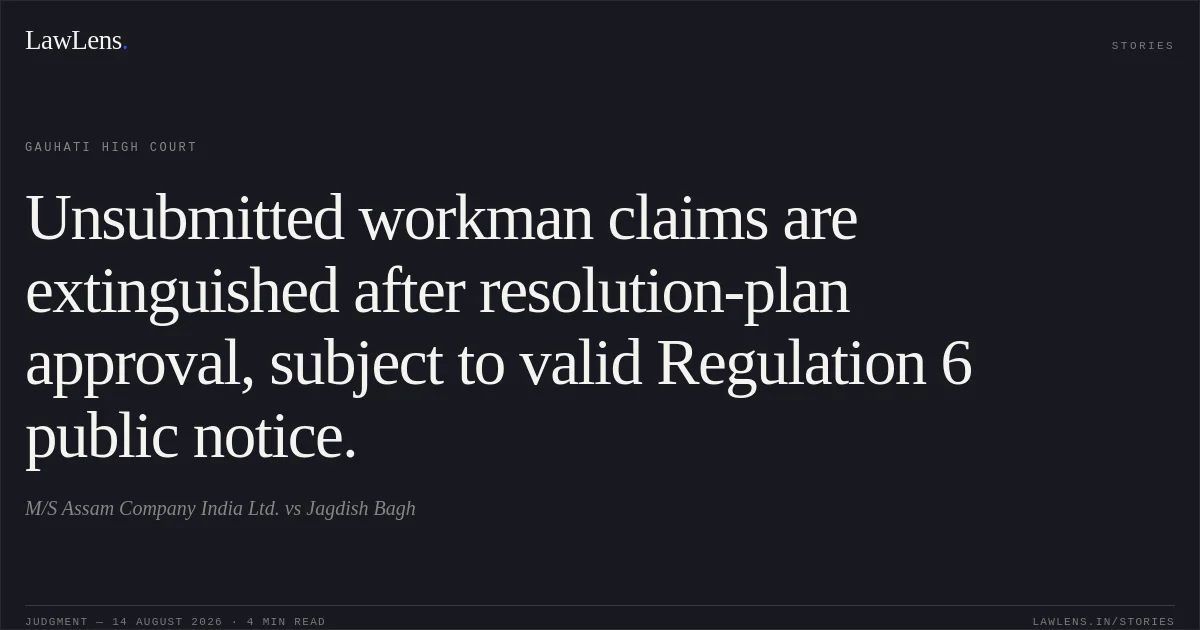
Source reference: pp. 5–6, paras. 8–10The petitioner contended that, since the respondent had not submitted his claim during the insolvency resolution process, the claim stood extinguished upon approval of the resolution plan. The respondent argued that he had not received proper notice of the insolvency proceedings and that the public announcement did not comply with Regulation 6 of the IBBI (Insolvency Resolution Process for Corporate Persons) Regulations, 2016.
Source reference: pp. 6–9, paras. 12–16Issues
1. Whether the Labour Court could direct the petitioner to pay the respondent’s quantified dues and fringe benefits notwithstanding the approval of the resolution plan under Section 31 of the IBC.
Source reference: pp. 15–17, paras. 24–272. Whether a claim not submitted during the insolvency resolution process stood extinguished when the claimant alleged that the public announcement under Regulation 6 was not properly issued.
Source reference: pp. 16–18, paras. 28–303. Whether the Labour Court’s direction to initiate proceedings under Section 29 of the Industrial Disputes Act, 1947, upon non-payment was sustainable.
Source reference: pp. 15–18, paras. 26, 31–32Law Applied
The Court applied Section 31(1) of the IBC, under which an approved resolution plan binds the corporate debtor, employees, members, creditors, governments, guarantors and other stakeholders.
Source reference: pp. 11–13, para. 21Relying on Committee of Creditors of Essar Steel India Ltd. v. Satish Kumar Gupta , (2020) 8 SCC 531, the Court held that a successful resolution applicant must be able to take over the corporate debtor on a “fresh slate” and cannot subsequently face undecided claims.
Source reference: pp. 11–13, para. 21Relying on Ghanashyam Mishra & Sons Pvt. Ltd. v. Edelweiss Asset Reconstruction Co. Ltd. , (2021) 9 SCC 657, the Court held that claims not forming part of the approved resolution plan stand extinguished and cannot thereafter be pursued.
Source reference: pp. 13–14, para. 22This rule was considered subject to proper public announcement under Regulation 6 of the 2016 Regulations, which is intended to give claimants an opportunity to submit their claims; Regulation 9 governs submission of claims by operational creditors, while Section 18 of the IBC requires the resolution professional to collect relevant information concerning the corporate debtor’s affairs.
Source reference: pp. 8–9, 16–17, paras. 15–16, 28Section 29 of the Industrial Disputes Act, 1947, concerns punishment for breach of an award or settlement.
Source reference: pp. 8–9, 16–17, paras. 15–16, 28Reasoning
The Court divided the Labour Court’s order into two components: first, the factual quantification of the respondent’s entitlement under the 2016 award; and second, the direction requiring the petitioner to pay the quantified amount, backed by threatened proceedings under Section 29 of the Industrial Disputes Act.
Source reference: p. 15, paras. 24–26It found no serious challenge or perversity in the quantification of ₹1,85,175 and the associated fringe benefits.
Source reference: p. 15, para. 25However, because the respondent’s claim had admittedly not been submitted to the resolution professional, the general rule under Section 31 and the cited Supreme Court authorities was that the claim stood extinguished upon approval of the resolution plan.
Source reference: pp. 16–17, para. 27At the same time, extinguishment presupposed that the respondent had been given a legally compliant opportunity to submit his claim.
Source reference: pp. 16–18, paras. 28–30Since the respondent alleged that the public announcement was not made in the manner required by Regulation 6—particularly regarding publication in newspapers having wide circulation in the relevant locations—the Court held that this factual and legal question had to be adjudicated by the NCLT, which had approved and supervised the insolvency process.
Source reference: pp. 16–18, paras. 28–30Consequently, the Labour Court could not itself enforce payment against the petitioner while the validity and finality of the insolvency process remained capable of challenge before the NCLT.
Source reference: p. 18, para. 31Holding
The writ petition was disposed of with partial interference.
The Labour Court’s finding quantifying the respondent’s entitlement at ₹1,85,175 plus fringe benefits under the 12 November 2016 award was left undisturbed.
Source reference: p. 18, para. 32(ii)However, the directions requiring the petitioner to pay that amount and providing for proceedings under Section 29 of the Industrial Disputes Act upon default were set aside.
Source reference: pp. 18–19, para. 32(iii)–(iv)The respondent was granted liberty to approach the NCLT and challenge the finality of the approved resolution plan solely on the ground that the public announcement under Regulation 6 was not issued in the prescribed manner; no other ground could be raised for that purpose.
Source reference: p. 19, para. 32(v)The Court also requested the petitioner to consider settling the dispute, clarifying that any such settlement would not affect the approved resolution plan or create rights in favour of third parties.
Source reference: p. 20, para. 33Acts & Sections Cited
5 provisions across 2 statutes referred to in this judgment. Each provision opens on LawLens.
Insolvency and Bankruptcy Code, 2016.4
Indian Contract Act, 18721
Original Court PDF
M/S Assam Company India Ltd.vsJagdish Bagh
Click to open original judgment
Original judgment, available to read, download and summarize on LawLens.in