Facts
The parties, husband and wife, married on 13.03.2011 according to Hindu rites and had a daughter on 21.01.2014.
Source reference: paras. 2–5The husband, a legal practitioner, filed FCOP No. 1037 of 2014 under Section 13(1)(ia) of the Hindu Marriage Act, 1955, seeking dissolution of marriage on the ground of cruelty.
Source reference: paras. 2–5The wife denied the allegations and contended that the husband had subjected her to harassment and demanded additional dowry.
Source reference: paras. 6–7The Family Court dismissed the husband’s divorce petition, holding that cruelty had not been proved.
Source reference: paras. 8–10Issues
Whether the husband proved that the wife’s conduct amounted to mental or physical cruelty within the meaning of Section 13(1)(ia) of the Hindu Marriage Act, 1955.
Source reference: paras. 11, 20–25Whether the Family Court erred in dismissing the husband’s petition for dissolution of marriage on the ground of cruelty.
Source reference: paras. 10, 32–34Law Applied
The Court applied Section 13(1)(ia) of the Hindu Marriage Act, 1955, under which a marriage may be dissolved where one spouse has treated the other with cruelty.
Source reference: paras. 4, 11The burden rests on the spouse alleging cruelty to plead and prove specific conduct constituting cruelty.
Source reference: paras. 11, 20Relying on Samar Ghosh v. Jaya Ghosh, (2007) 4 SCC 511, the Court held that cruelty is fact-sensitive and depends upon the parties’ background, social and economic circumstances, sensitivities, and value systems.
Source reference: para. 22Relying on Naveen Kohli v. Neelu Kohli, (2006) 4 SCC 558, it reiterated that cruelty may be physical or mental, intentional or unintentional, and must be assessed in the context of the parties’ overall relationship.
Source reference: para. 23The Court further applied the principle that the cumulative effect of the alleged conduct must be considered, while ordinary matrimonial disagreements, petty quarrels, and isolated differences do not by themselves constitute cruelty.
Source reference: para. 24The Court also declined to rely on testimony based merely on information supplied by a party, treating such evidence as lacking personal knowledge.
Source reference: paras. 14–15, 29Reasoning
The husband failed to establish the alleged cruelty through cogent and reliable evidence.
Source reference: para. 27The allegation that the wife insulted him for his income was inconsistent with the evidence showing that she and her family were aware of his financial position before marriage.
Source reference: para. 27The allegation that she mocked his appearance was not pleaded in the divorce petition and was introduced only in his evidence.
Source reference: para. 27His claim that the wife threatened to implicate him in false criminal cases was unsupported, particularly as no such criminal proceedings had been initiated.
Source reference: para. 27The allegation that the abortion was performed without his consent and to facilitate the wife’s pursuit of a Sub-Inspector post was not proved; the wife denied the allegation, and the husband produced no supporting evidence.
Source reference: para. 28Similarly, the evidence established only that the wife and her relatives recovered her articles and belongings from the matrimonial home, not that they forcibly removed the husband’s jewellery or other valuables.
Source reference: para. 28The evidence of P.W.2 was substantially based on what the husband had told him and therefore did not independently corroborate the alleged acts of cruelty.
Source reference: paras. 14–15, 29Although the parties had quarrelled and had lived separately, those circumstances, without proof of conduct of the requisite intensity, did not amount to matrimonial cruelty.
Source reference: para. 30The Court also noted the husband’s failure to assume adequate responsibility for the daughter and observed that the wife had been caring for and educating the child.
Source reference: para. 31Holding
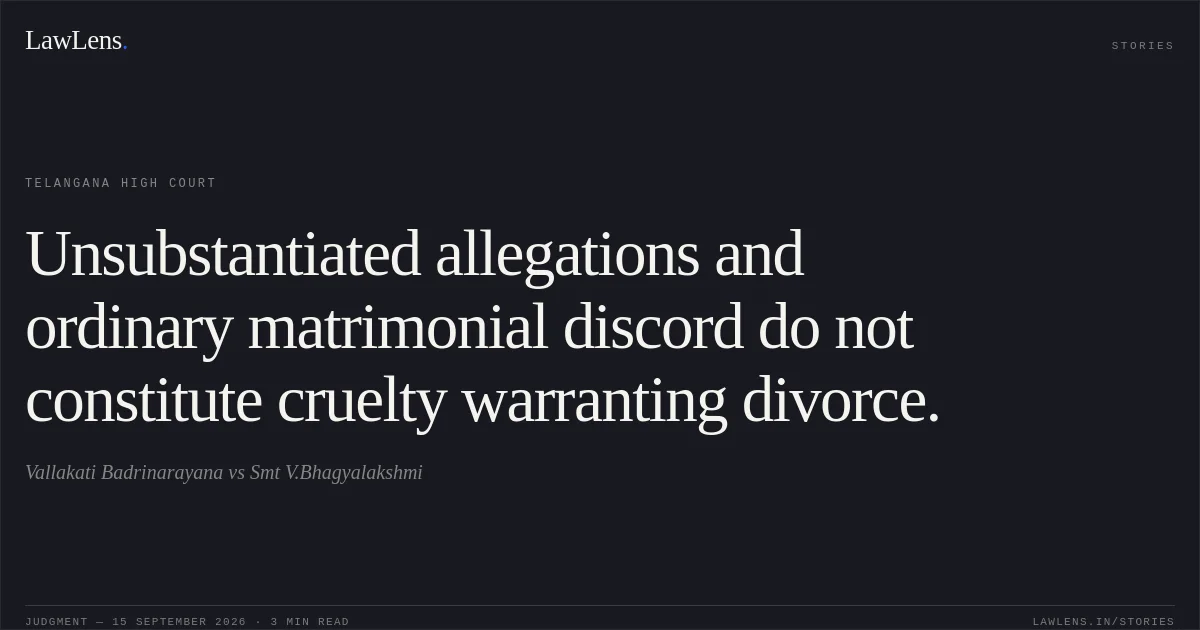
The Court held that the husband failed to plead and prove that the wife had subjected him to cruelty under Section 13(1)(ia) of the Hindu Marriage Act, 1955.
The Family Court’s dismissal of FCOP No. 1037 of 2014 was found to be correct and warranted no interference.
Source reference: paras. 32–34The appeal was accordingly dismissed, with no order as to costs.
Source reference: para. 34Any pending miscellaneous applications were closed.
Source reference: para. 34Acts & Sections Cited
1 provisions across 1 statute referred to in this judgment. Each provision opens on LawLens.
Hindu Marriage Act, 19551
Original Court PDF
Vallakati BadrinarayanavsSmt V.Bhagyalakshmi
Click to open original judgment
Original judgment, available to read, download and summarize on LawLens.in