Facts
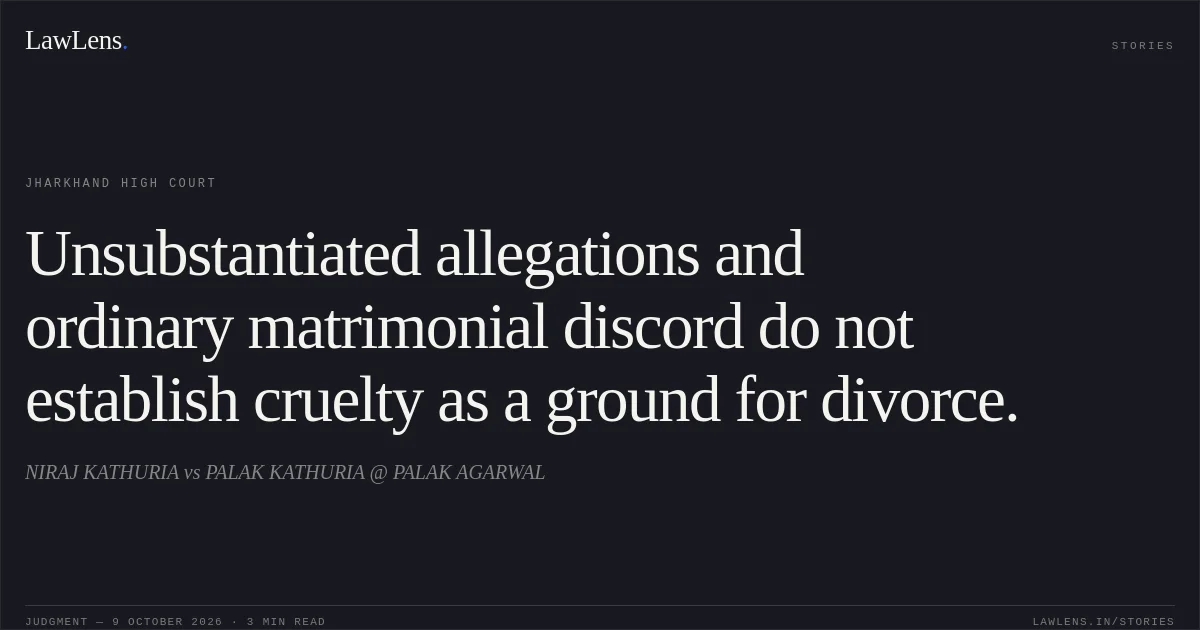
The parties married on 29 April 2018. The husband sought divorce under Section 13(1)(i-a) of the Hindu Marriage Act, 1955, alleging that the wife refused intimacy, behaved abusively and disrespectfully, and was influenced by her mother to disrupt the marriage. The wife denied cruelty and alleged dowry harassment and other mistreatment by the husband and his family; she maintained that she wished to resume cohabitation.
Source reference: para. 2.1–2.10The Family Court dismissed the suit, finding that the husband had not proved cruelty even on a preponderance of probabilities. He appealed under Section 19 of the Family Courts Act, 1984, contending, among other things, that the Family Court had failed to consider electronic material on a pen-drive.
Source reference: para. 8–9; para. 10–13Issues
Whether the husband proved that the wife treated him with cruelty within the meaning of Section 13(1)(i-a) of the Hindu Marriage Act, 1955
Source reference: para. 39–41Whether the Family Court’s dismissal of the divorce suit warranted appellate interference, including on the basis of the pen-drive material
Source reference: para. 27–29; para. 72–84Law Applied
Section 13(1)(i-a) of the Hindu Marriage Act permits divorce for cruelty; the conduct alleged must be proved and, viewed in the parties’ circumstances and the relationship as a whole, must be sufficiently grave to amount to cruelty. Ordinary disagreements and the normal wear and tear of married life are insufficient
Source reference: para. 41–46; para. 50–58; para. 62Under Section 19 of the Family Courts Act, an appeal lies to the High Court on facts and law, and the appellate court may reappraise the evidence; interference is warranted where the findings are perverse or otherwise unsustainable, not merely because another view is possible. Section 14 of the Family Courts Act gives the Family Court discretion to receive material that may assist it, while electronic records must be properly authenticated and proved under the applicable evidence law. The judgment discusses Sections 65B(1) and 65B(4) of the Indian Evidence Act, 1872, and the principles in Anvar P.V. v. P.K. Basheer and Arjun Panditrao Khotkar v. Kailash Kushanrao Gorantyal concerning proof and certification of electronic records
Source reference: para. 29–30; para. 34–38; para. 73–79; para. 84–85Reasoning
The High Court independently reviewed the evidence and concluded that the husband’s allegations were not established by reliable evidence. The brother-in-law’s evidence was largely hearsay, while the husband’s testimony was considered alongside his admissions that the wife had participated in family and social events, attended to his father during illness and funeral rites, and had sought to return to the matrimonial home. The court also noted that the husband did not wish to keep her and that his mother had prevented her from entering the home
Source reference: para. 22(i)–(iii); para. 66–69The pen-drive could not support reversal because it had not been effectively admitted and the wife had not been supplied a copy despite opportunities; in any event, its production alone did not prove its contents. The court found no ignored material or perversity in the Family Court’s assessment
Source reference: para. 72–81; para. 82–90Holding
The Court held that the husband had failed to prove cruelty under Section 13(1)(i-a) of the Hindu Marriage Act and that no basis for appellate interference had been established
It dismissed the appeal and affirmed the Family Court’s judgment dismissing the divorce suit and the decree signed on 29 January 2025
Source reference: para. 92–94Acts & Sections Cited
5 provisions across 3 statutes referred to in this judgment. Each provision opens on LawLens.
Family Courts Act, 19843
Hindu Marriage Act, 19551
Code of Civil Procedure, 19081
Original Court PDF
NIRAJ KATHURIAvsPALAK KATHURIA @ PALAK AGARWAL
Click to open original judgment
Original judgment, available to read, download and summarize on LawLens.in