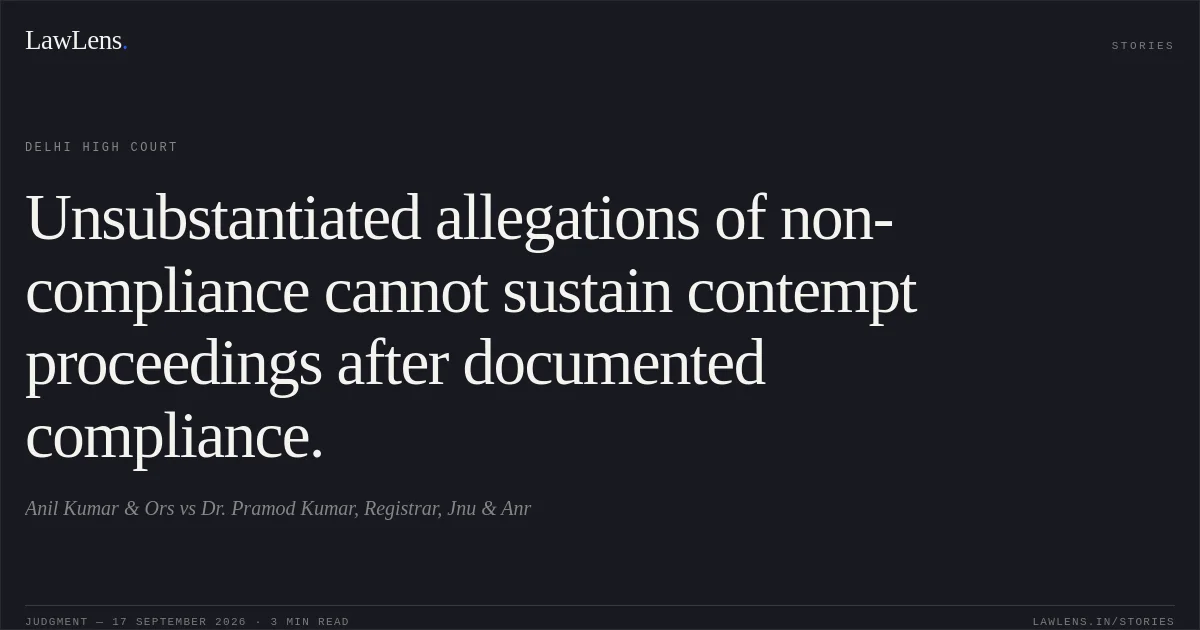
Facts
The Petitioners filed a contempt petition under Sections 10 and 12 of the Contempt of Courts Act, 1971, read with Section 151 CPC, alleging non-compliance with the Delhi High Court’s orders dated 22 November 2013 and 10 January 2017 in Bam Dev Chhetri & Ors. v. Jawaharlal Nehru University & Anr.
Source reference: para. 1The Respondents relied on a Compliance Report stating that the pay of certain Petitioners had been restored and revised in accordance with the applicable pay scales and CPC recommendations, while the remaining Petitioners had already been drawing a higher scale and therefore required no further revision.
Source reference: pp. 2–3; para. 2In April 2023, the Court granted the Petitioners liberty to file a reply affidavit or communicate specific outstanding monetary claims to the Registrar, with a corresponding direction to the University to respond.
Source reference: pp. 3–4; para. 4No such communication, reply affidavit, tabulation of arrears, or supporting material was filed by the Petitioners.
Source reference: p. 4; para. 5The Respondent thereafter filed a Short Compliance Affidavit dated 5 January 2026, asserting that the Court’s directions had been fully implemented and that no monetary or service-related dues remained payable.
Source reference: pp. 4–5; para. 6Issues
Whether the Respondents had complied with the directions contained in the High Court’s orders dated 22 November 2013 and 10 January 2017, so as to negate the allegation of contempt?
Source reference: paras. 1–3, 6Whether the contempt proceedings should remain pending in the absence of any specific material from the Petitioners demonstrating outstanding dues or non-compliance?
Source reference: paras. 4–10Law Applied
The Court exercised jurisdiction under Sections 10 and 12 of the Contempt of Courts Act, 1971, concerning contempt jurisdiction and punishment for contempt, read with the inherent procedural power under Section 151 CPC.
Source reference: para. 1The governing principle applied was that contempt proceedings require a demonstrated failure to comply with the Court’s directions; where the alleged contemnor produces material showing compliance and the complainant fails to identify any specific continuing breach, arrears, or unperformed obligation, the proceedings need not be continued.
Source reference: paras. 5–10The Court also applied the procedural principle that a party alleging non-compliance must place concrete and verifiable particulars of the alleged default before the Court, particularly when given an express opportunity to do so.
Source reference: paras. 4–8Reasoning
The Respondents produced records showing restoration and revision of pay for the concerned employees, while explaining that two Petitioners had already continuously received the higher applicable pay scale and therefore did not require a fresh revision.
Source reference: pp. 2–3, 5; paras. 2, 6The Court treated the Compliance Report of 22 November 2022 and the Compliance Affidavit of 5 January 2026 as sufficient material supporting compliance.
Source reference: pp. 3–4, 5–6; paras. 4–8Although the Petitioners orally asserted that no payments had been made, they had not filed the promised reply affidavit, quantified the alleged arrears, or identified any particular direction that remained unimplemented despite the opportunity granted in April 2023.
Source reference: pp. 3–4, 5–6; paras. 4–8In the absence of specific contrary material, the Court found no evidentiary basis to conclude that the Respondents had disobeyed the earlier orders or that any actionable contempt persisted.
Source reference: paras. 7–9Holding
The Court held that the Respondents had demonstrated compliance with the orders dated 22 November 2013 and 10 January 2017, and that the Petitioners had failed to establish any specific outstanding payment, arrear, service benefit, or continuing non-compliance.
It therefore declined to keep the contempt proceedings pending and disposed of the contempt petition along with all pending applications, with no further directions.
Source reference: paras. 9–11Acts & Sections Cited
3 provisions across 2 statutes referred to in this judgment. Each provision opens on LawLens.
Contempt of Courts Act, 19712
Code of Civil Procedure, 19081
Original Court PDF
Anil Kumar & OrsvsDr. Pramod Kumar, Registrar, Jnu & Anr
Click to open original judgment
Original judgment, available to read, download and summarize on LawLens.in
![Relief is made contingent on the Supreme Court’s eventual determination in the analogous pending case.. Ashok Tolani vs REVENUE. CAT - ['Jaipur']. LawLens](/stories/thumbnails/relief-is-made-contingent-on-the-supreme-courts-eventual-determination-in-the-analogous-pe-0a05b6600e0644cf9facfda571d15955.webp)