Facts
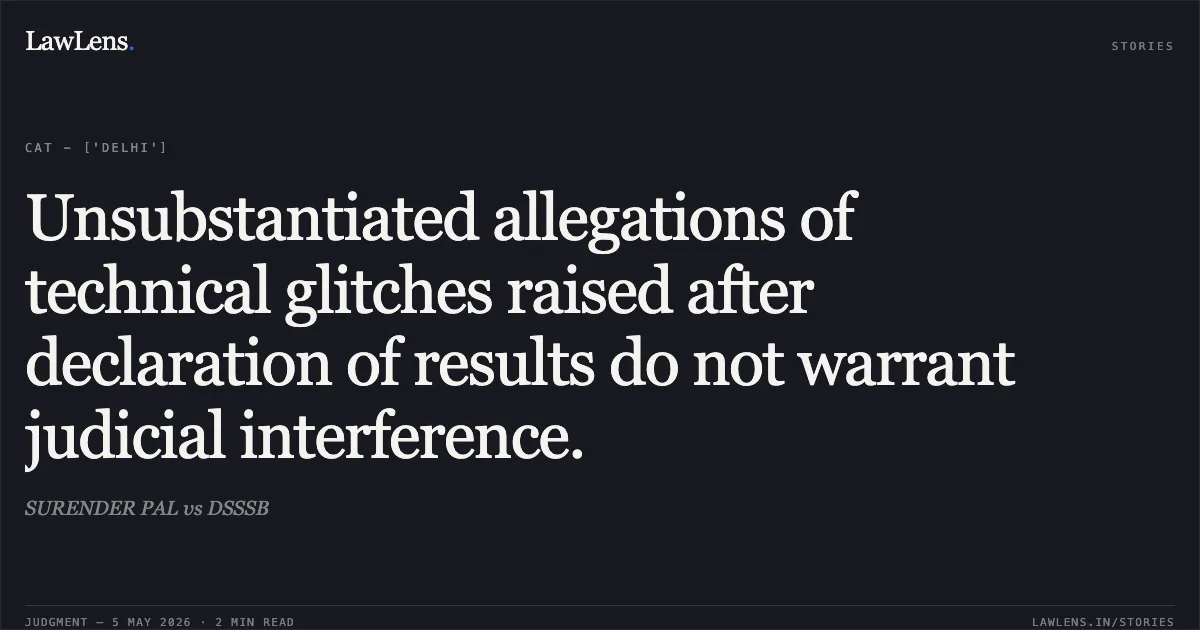
The applicant participated in a computer-based test (CBT) on 21.11.2025 for Post Code 47/24.
Source reference: p. 3, 5He alleged that during the exam, a technical "pop-up" appeared, and despite the invigilator’s oral assurance that his progress would be auto-saved, his responses were not properly recorded.
Source reference: p. 3, 5After the results were declared on 27.02.2026, the applicant found he secured only 19 marks in Part-A, with most questions marked as "Not Attempted" despite his claim of attempting 80–85 questions.
Source reference: p. 4He submitted a representation via email on 08.03.2026 demanding a forensic audit and verification of server logs.
Source reference: p. 5-7He subsequently filed this Original Application (OA) seeking to quash the result and seeking a re-evaluation.
Source reference: p. 2Issues
1. Whether the applicant provided sufficient cogent evidence to substantiate claims of technical malfunctions and systemic failure during the examination
Source reference: para 4.3, 4.62. Whether a candidate, after participating in a selection process and being declared unsuccessful, is barred by the principle of estoppel from challenging the examination process
Source reference: para 4.63. Whether the Tribunal should direct a roving inquiry/forensic audit based on unsubstantiated allegations
Source reference: para 4.6, 4.7Law Applied
The Court applied the constitutional principles of fairness and transparency under Articles 14 and 16.
Source reference: p. 2Heavily relied on the doctrine of estoppel, which dictates that a candidate who participates in a recruitment process without protest cannot challenge it after failing to qualify.
Source reference: para 4.6The principle regarding the burden of proof, noting that the onus lies on the person alleging malpractice or technical errors to provide documentary evidence.
Source reference: para 4.7Reasoning
The Tribunal found that the applicant failed to prove any technical error during the exam, noting that no written complaint was made to the invigilator or supervisors at the time of the occurrence.
Source reference: para 4.2, 4.3The Court observed that the applicant’s first formal grievance was raised only after the declaration of results, making it a "belated claim" and an "afterthought".
Source reference: para 4.5, 4.6The Tribunal reasoned that the allegations were vague and unsupported by contemporaneous records.
Source reference: para 4.6It further held that entertaining such claims without evidence would open the "floodgates of litigation" and disrupt the sanctity of competitive examinations involving lakhs of candidates.
Source reference: para 4.7The delay in declaring results was deemed insufficient to doubt the integrity of the process without proof of prejudice.
Source reference: para 4.4Holding
The Tribunal dismissed the Original Application, holding that the applicant failed to substantiate his claims with documentary evidence.
The Court answered the issues by ruling that the applicant was estopped from challenging the exam after being unsuccessful and that the Tribunal cannot embark on a "roving enquiry" based on unsubstantiated allegations.
Source reference: para 4.6No costs were awarded.
Source reference: para 5.2Acts & Sections Cited
1 provisions across 1 statute referred to in this judgment. Linked provisions open on LawLens.
Indian Evidence Act, 18721
Original Court PDF
SURENDER PALvsDSSSB
Click to open original judgment
Original judgment, available to read, download and summarize on LawLens.in