Facts
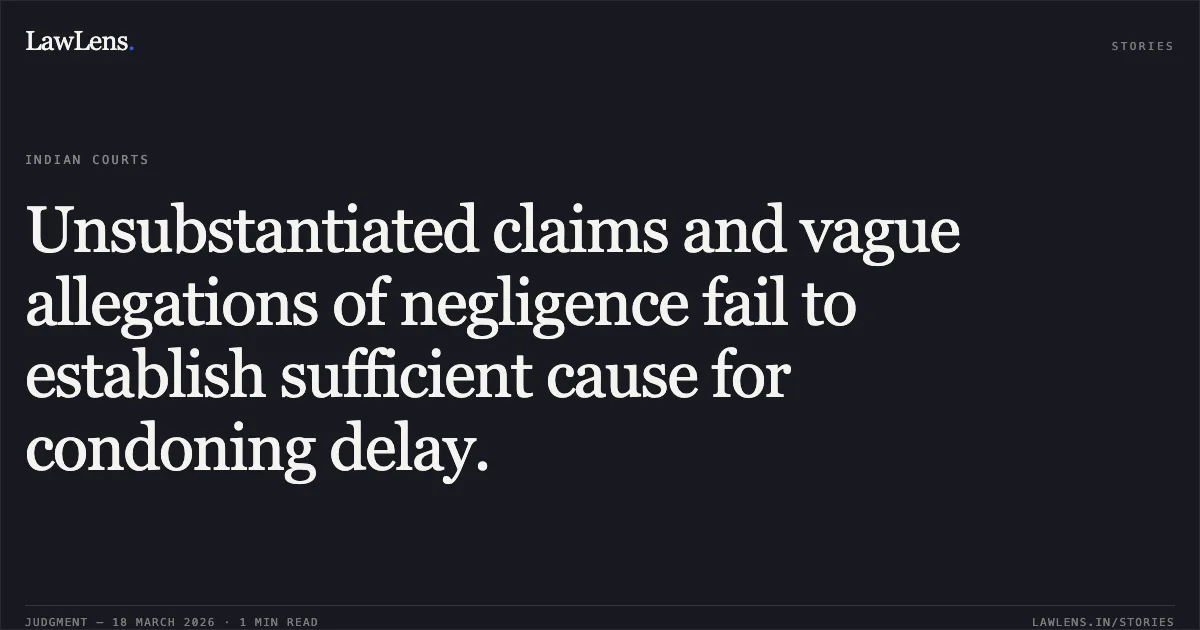
The applicant sought condonation of a 1,938-day delay (over six years) in filing a first appeal against a City Civil Court Mumbai order dated 27 July 2016.
Source reference: para. 1, 3The appeal, which was required to be filed within 30 days, was only preferred on 18 December 2021.
Source reference: para. 3The applicant attributed the delay to a paralytic attack suffered in 2012, subsequent communication failures by his previous advocate, financial constraints, and old age.
Source reference: para. 4It was further noted that the respondent had initiated execution proceedings against the applicant.
Source reference: para. 4, 10Issues
Whether the applicant demonstrated "sufficient cause" to warrant the exercise of judicial discretion for condoning a delay of 1,938 days.
Source reference: para. 1, 11Law Applied
The court relied on the principle that condonation of delay requires the demonstration of "sufficient cause" supported by evidence rather than bald averments.
Source reference: para. 6, 11The ratio from the Supreme Court decision in Shivamma (dead) by Lrs. v. Karnataka Housing Board & Ors. (2025 SCC OnLine Sc 1969), which emphasizes that discretionary relief should not be granted where the delay is a strategic attempt to frustrate the execution of a decree.
Source reference: para. 10, 11Reasoning
The Court found the applicant's justifications unsubstantiated and contradictory.
Source reference: para. 6, 7The applicant failed to provide any documentary evidence to support claims of illness or professional negligence by his prior advocate.
Source reference: para. 6, 7The Court noted that the paralytic attack occurred in 2012, whereas the impugned order was passed in 2016; therefore, the pre-existing condition did not sufficiently explain the post-order delay.
Source reference: para. 8The Court questioned why the applicant’s son, who eventually assisted in filing the appeal in 2021, could not have done so in 2016.
Source reference: para. 9The Court observed a trend where unsuccessful litigants file belated appeals primarily to obstruct execution proceedings, concluding that granting condonation in such instances would unfairly penalize the decree-holder.
Source reference: para. 10Holding
The Court held that no sufficient cause was shown to exercise its discretion to condone the delay.
The Interim Application for condonation of delay was dismissed, and consequently, the First Appeal was also dismissed.
Source reference: para. 12Original Court PDF
VISHNU GANPAT TAYSHETEvsASHOK GANPAT TAYSHETE AND ORS
Click to open original judgment
Original judgment, available to read, download and summarize on LawLens.in