Facts
Respondent No. 1 filed proceedings under Section 12 of the Protection of Women from Domestic Violence Act, 2005 (“DV Act”) against the petitioners and Respondent No. 2 before the Judicial Magistrate 1st Class (City Judge), Jammu.
Source reference: para. 3The petitioners’ application seeking dropping of the proceedings was dismissed on 11.04.2025.
Source reference: para. 3The petitioners thereafter filed an appeal under Section 29 of the DV Act, accompanied by an application for condonation of delay.
Source reference: para. 4They claimed that Petitioner No. 2 had undergone surgery, was unable to travel to Jammu to sign the necessary documents, and could not communicate with counsel until 06.06.2025.
Source reference: para. 4They further stated that the certified copy of the Magistrate’s order was obtained on 01.07.2025, after the courts had closed for summer vacation.
Source reference: para. 4The appeal was filed on 30.07.2025, beyond the prescribed period of 30 days.
Source reference: para. 10The appellate court dismissed the condonation application and consequently the appeal on 12.02.2026, holding that the petitioners had failed to establish sufficient cause.
Source reference: paras. 1, 6The petitioners challenged that order under Section 528 of the Bharatiya Nagarik Suraksha Sanhita, 2023 (“BNSS”).
Source reference: para. 12Issues
Whether the petitioners established “sufficient cause” under Section 5 of the Limitation Act, 1963 for condonation of the delay in filing an appeal under Section 29 of the DV Act.
Source reference: paras. 4, 8, 10Whether the appellate court’s refusal to condone the delay was perverse, illegal, or otherwise liable to interference by the High Court under Section 528 of the BNSS.
Source reference: para. 12Law Applied
Section 29 of the DV Act prescribes a limitation period of 30 days for filing an appeal against an order passed by the Magistrate.
Source reference: paras. 3, 10Section 5 of the Limitation Act permits admission of an appeal after expiry of the prescribed period only when the appellant satisfies the court that sufficient cause prevented timely filing.
Source reference: para. 8“Sufficient cause” is to receive a liberal interpretation so as to advance substantial justice, but the litigant must nevertheless demonstrate due diligence and good faith; gross negligence or lack of bona fides does not constitute sufficient cause, and condonation is not warranted merely because the delay is short or the case may have merit.
Source reference: para. 8Relying on Thirunagalingam v. Lingeswaran and Another, 2025 INSC 672, the Court held that the primary consideration is the bona fides of the explanation for delay, and that delay cannot be condoned as an act of generosity where reasonable grounds are absent or prejudice may be caused to the opposing party.
Source reference: para. 9Under Section 528 of the BNSS, the High Court does not ordinarily interfere with a criminal court’s order unless it is grossly erroneous, illegal, or perverse.
Source reference: para. 12Reasoning
The Court found that the medical documents established that Petitioner No. 2 had undergone surgery on 24.06.2024 and follow-up treatment in June and September 2024, but there was no medical material showing that he suffered from any disabling ailment during 2025 or that he was unable to travel to Jammu or instruct counsel during the relevant period.
Source reference: para. 10The surgery had occurred more than a year before the appeal was filed and therefore did not substantiate the asserted cause for the delay.
Source reference: para. 10Further, the memorandum of appeal had been signed by Petitioner No. 1, who was not shown to have suffered from any disability; consequently, the petitioners could not rely entirely on Petitioner No. 2’s alleged incapacity to explain the delay.
Source reference: para. 11Applying the requirements of bona fides, due diligence, and sufficient cause under Section 5 of the Limitation Act, the Court agreed that the petitioners had remained negligent and silent and had failed to provide a credible explanation for the delayed filing.
Source reference: paras. 8, 10–11Since the appellate court’s order was neither perverse nor illegal, no interference under Section 528 of the BNSS was warranted.
Source reference: para. 12Holding
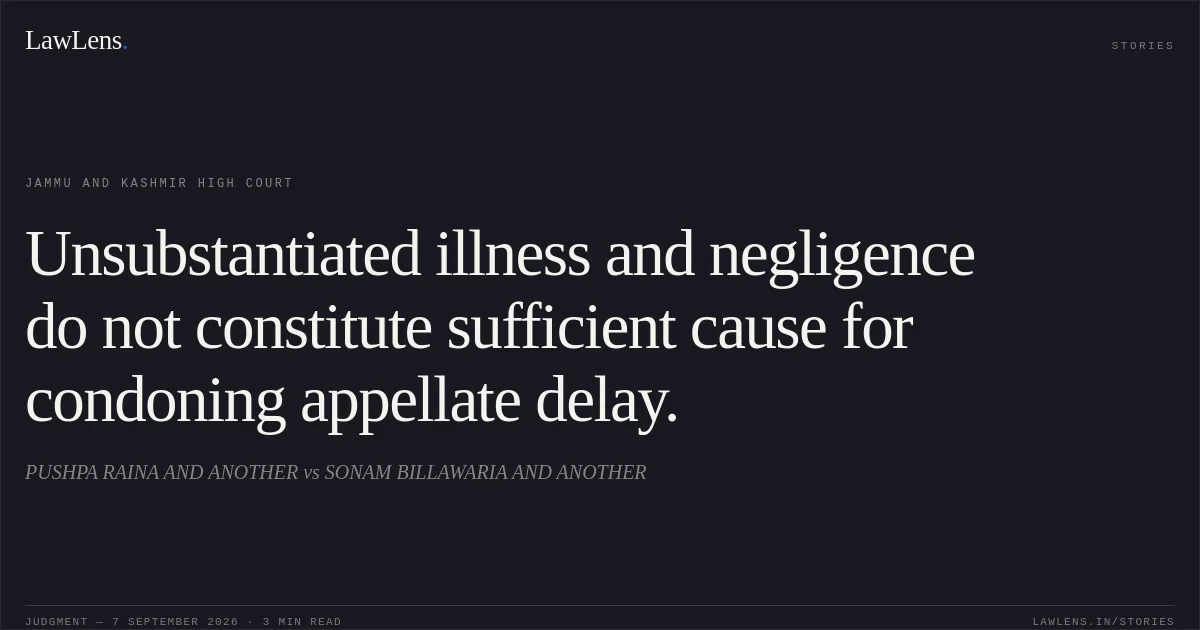
The High Court answered the first issue against the petitioners, holding that they had failed to establish sufficient cause for condonation of the delay in filing the appeal under Section 29 of the DV Act.
It also answered the second issue against them, finding no perversity or illegality in the appellate court’s order warranting interference under Section 528 of the BNSS.
Source reference: para. 12The petition was accordingly dismissed, and the appellate court’s dismissal of the condonation application and the appeal was upheld.
Source reference: para. 13Acts & Sections Cited
4 provisions across 3 statutes referred to in this judgment. Each provision opens on LawLens.
Protection of Women from Domestic Violence Act, 20052
Limitation Act, 19631
Bharatiya Nagarik Suraksha Sanhita, 20231
Original Court PDF
PUSHPA RAINA AND ANOTHERvsSONAM BILLAWARIA AND ANOTHER
Click to open original judgment
Original judgment, available to read, download and summarize on LawLens.in