Facts
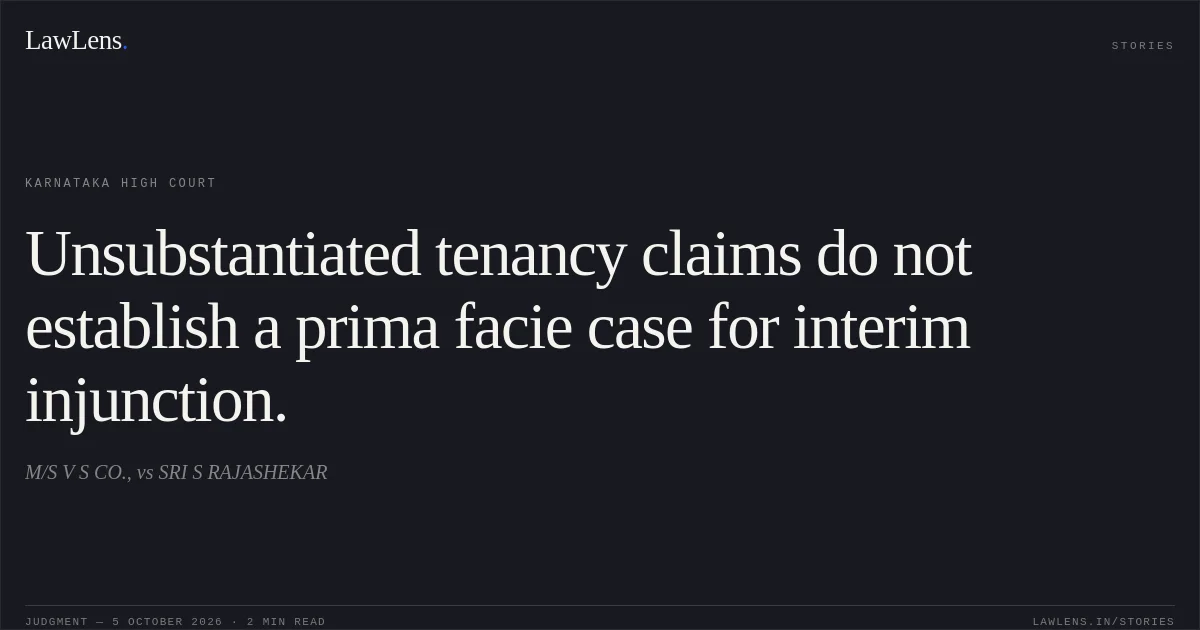
The plaintiff filed a suit for permanent injunction, claiming that he possessed the suit shop as a tenant under an oral arrangement and had also paid substantial consideration under an oral agreement of sale. He sought interim protection under Order XXXIX Rules 1 and 2 CPC. The defendant denied the tenancy and sale agreement, asserting that the plaintiff’s presence was permissive and that the defendant held a licence over the shop, which belonged to BBMP.
Source reference: pp. 2–6, 13–16The trial court dismissed the plaintiff’s injunction application and allowed the defendant’s application under Order XXXIX Rule 4 to vacate the interim injunction. The plaintiff appealed under Section 43 Rule 1(r) CPC.
Source reference: pp. 1–2Issues
1. Whether the trial court’s order dismissing the plaintiff’s application under Order XXXIX Rules 1 and 2 CPC and allowing the defendant’s application under Order XXXIX Rule 4 CPC warranted appellate interference
Source reference: para. 7, p. 182. Whether the plaintiff established a prima facie case, balance of convenience, and risk of irreparable hardship sufficient to obtain interim protection
Source reference: paras. 9–12, pp. 19–21Law Applied
Under Order XXXIX Rules 1 and 2 CPC, interim injunction requires consideration of a prima facie case, balance of convenience, and irreparable injury; the court need not conduct a mini-trial at the interlocutory stage.
Source reference: para. 9, p. 19The Court referred to Dalpat Kumar v. Prahlad Singh, Wander Ltd. v. Antox India (P) Ltd., and Ramakant Ambalal Chokshi v. Harish Ambalal Choksi on interim-injunction principles and the discretionary character of such relief.
Source reference: paras. 11, 15, pp. 20, 23–24It also relied on Vyankati Raghobaji Parbat v. Sau. Varsha Vinod Deshpande concerning injunction claims by unlawful possessors against an owner.
Source reference: paras. 13–14, pp. 22–23The Court stated that an appellate court should not substitute its view for the trial court’s discretionary decision absent good grounds for interference.
Source reference: para. 15, p. 24Reasoning
The Court noted that the defendant was not the owner of the shop but held a licence from BBMP, while the plaintiff asserted possession based on an oral lease, an oral sale agreement, and part performance.
Source reference: paras. 8, 10, pp. 18–20It found that the plaintiff had produced no documents establishing a lease or payment of rent, and concluded that the trial court had considered the parties’ materials and reasonably found no prima facie case, with the balance of convenience and potential hardship favouring the defendant.
Source reference: para. 12, p. 21Applying the restraint owed to a trial court’s discretionary injunction decision, the High Court found no sufficient basis to interfere.
Source reference: para. 15, p. 24Holding
The High Court answered the question of appellate interference in the negative.
It dismissed the appeal, thereby leaving in force the trial court’s dismissal of the plaintiff’s application under Order XXXIX Rules 1 and 2 CPC and its allowance of the defendant’s application under Order XXXIX Rule 4 CPC.
Source reference: para. 16, p. 24Acts & Sections Cited
4 provisions across 2 statutes referred to in this judgment. Each provision opens on LawLens.
Code of Civil Procedure, 19083
Transfer of Property Act, 18821
Original Court PDF
M/S V S CO.,vsSRI S RAJASHEKAR
Click to open original judgment
Original judgment, available to read, download and summarize on LawLens.in