Facts
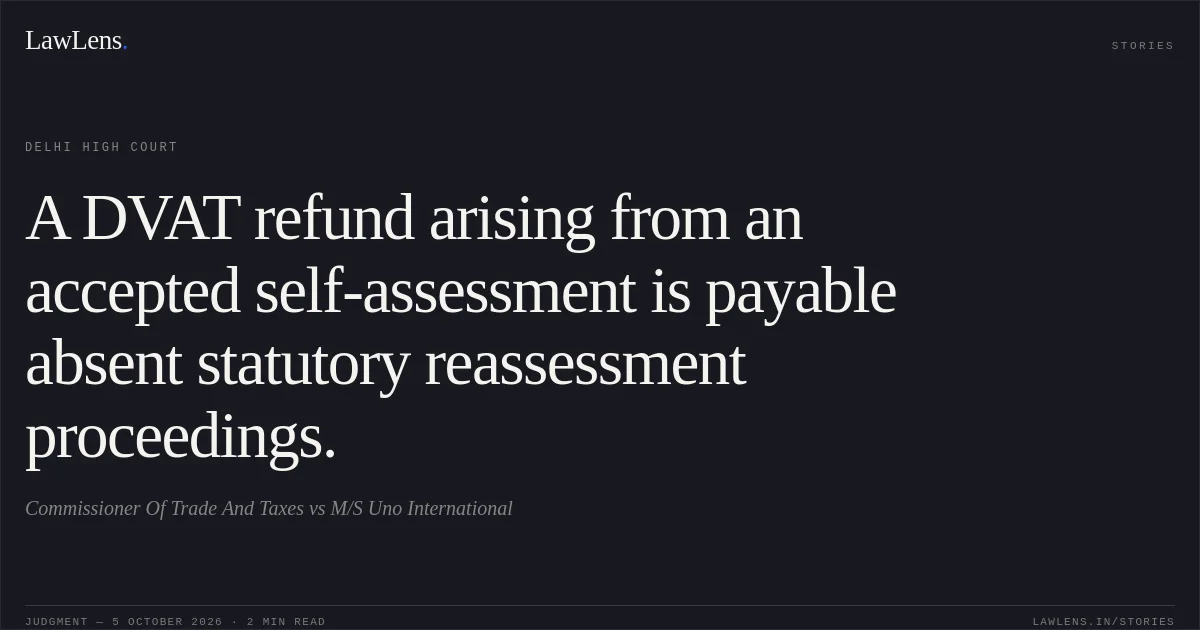
The respondent filed a revised return for the fourth quarter of assessment year 2013–14 claiming a refund of ₹15,31,661. It paid a demand of ₹1,836, and the CST assessment was later finalised with nil demand.
Source reference: p. 1–2After the respondent’s refund claim was rejected by the Assessing Authority and the Objection Hearing Authority, the Tribunal allowed the respondent’s appeal and set aside the rejection.
Source reference: p. 2The Commissioner appealed under Section 81 of the Delhi Value Added Tax Act, 2004 (DVAT Act), contending, among other things, that the transactions involved collusion and paper-trail dealings.
Source reference: p. 2–3Issues
Whether the order rejecting the refund claim was barred by limitation under Section 34 of the DVAT Act
Source reference: p. 2; p. 5Whether Section 40A of the DVAT Act applied so as to permit rejection of the refund claim on the basis of an allegedly void arrangement involving collusion or fraud
Source reference: p. 2–3, 5Whether the Tribunal’s decision concerning the applicability of On Quest Merchandising India Pvt. Ltd. v. GNCTD raised a substantial question of law
Source reference: p. 3; p. 6Whether, in the absence of proceedings under Sections 32, 58 or 59 of the DVAT Act and any outstanding demand, the respondent was entitled to the claimed refund under Section 38
Source reference: p. 4–5Law Applied
Section 31 of the DVAT Act provides for self-assessment through a compliant return, which is treated as an assessment by the Commissioner; Section 32 provides for default assessment or reassessment, including on a best-judgment basis in specified circumstances; and Section 58 provides for an audit of business affairs.
Source reference: p. 3–4Under Section 38, excess tax paid is refundable, subject to the statutory adjustments and other provisions of that section; for a quarterly tax period, the refund is generally to be made within two months of the return or refund claim.
Source reference: p. 4Section 34 concerns assessment or reassessment proceedings, rather than a refund application.
Source reference: p. 5The Court also considered Section 40A, invoked on the ground that an agreement intended to defeat the DVAT Act would be void; it held that the provision did not support rejection on the record where the department had not declared the arrangement void or investigated and established collusion.
Source reference: p. 5Reasoning
The return had been accepted under Section 31, the respondent had paid the demand raised, and no proceedings had been initiated under Sections 32, 58 or 59; nor was any outstanding demand identified for adjustment.
Source reference: p. 4–5In those circumstances, Section 38 governed the refund, and the authority could not treat the refund application as an occasion to exercise powers associated with default assessment or audit.
Source reference: p. 4–5The department’s allegations of paper transactions and collusion were insufficient to invoke Section 40A because it had not investigated the alleged arrangement or declared it void.
Source reference: p. 5The Court held that Section 34 did not apply to the refund application and that the proposed issue concerning On Quest Merchandising was factual, not a substantial question of law.
Source reference: p. 5–6Holding
The Court held that no substantial question of law arose.
It upheld the Tribunal’s conclusion that the respondent’s refund could not be rejected on the grounds advanced and dismissed the appeal.
Source reference: p. 5–6Acts & Sections Cited
1 provisions across 1 statute referred to in this judgment. Each provision opens on LawLens.
Delhi Sales Tax Act, 19751
Original Court PDF
Commissioner Of Trade And TaxesvsM/S Uno International
Click to open original judgment
Original judgment, available to read, download and summarize on LawLens.in