01Facts
The petitioner, who had chronic kidney disease, sought approval for a kidney transplant from a non-relative donor—the wife of his driver—after his family members were found unsuitable as donors.
¶ 2–6The donor and petitioner stated that they had known each other for approximately three to four years, and that the donor’s husband had driven the petitioner and taken him to hospital.
¶ 17, 19, 24A police enquiry reported no commercial transaction or involvement of a middleman.
¶ 8, 24The District and State-level committees nevertheless declined to recommend the transplant, citing inconsistencies concerning the donor’s husband’s driving-licence date and the absence of documents proving his work as a driver for the recipient.
¶ 11–15, 24The petitioner challenged the refusal by writ petition.
¶ 1, 902Issues
i.Whether the Authorization Committee’s refusal to approve the proposed transplant was lawful where the donor and recipient were not near relatives and the committee relied on the absence of documentary proof of the donor’s husband’s driving work and the date of his driving licence.
¶ 20–22, 24, 28ii.Whether the evidence of affection and acquaintance, together with the findings of no commercial transaction or middleman, required the committee to reconsider the application.
¶ 24–2803Law Applied
Section 9(3) of the Transplantation of Human Organs and Tissues Act, 1994 permits donation by a person who is not a near relative where the donor acts because of affection, attachment, or other special reasons, subject to prior approval by the Authorization Committee.
¶ 20Rule 7(3) of the Transplantation of Human Organs and Tissues Rules, 2014 requires the committee, in such cases, to assess the absence of commercial dealing, the link and circumstances leading to the offer, the donor’s reasons, supporting evidence, and the possible involvement of a middleman.
¶ 22In Kuldeep Singh v. State of T.N., (2005) 11 SCC 122, the Supreme Court held that the committee must ascertain the donor’s true intent and exclude commercial elements, with the applicants bearing the burden of establishing that intent through relevant material.
¶ 23Rule 17 provides for scrutiny of applications and permits the committee to seek explanations or conduct verification where doubts arise.
¶ 2704Reasoning
The Court considered that the donor, her husband, and the recipient’s wife gave accounts of a relationship extending over several years, with the acquaintance arising through the husband’s driving work and developing into a family-like bond.
¶ 17–19, 24, 26The police report found no commercial transaction or middleman, and the committee had recorded the donor’s income.
¶ 24, 26Against that material, the absence of employment records and the discrepancy concerning when the donor’s husband obtained his licence did not, without more, establish commercial dealing or negate the donor’s stated affection and attachment.
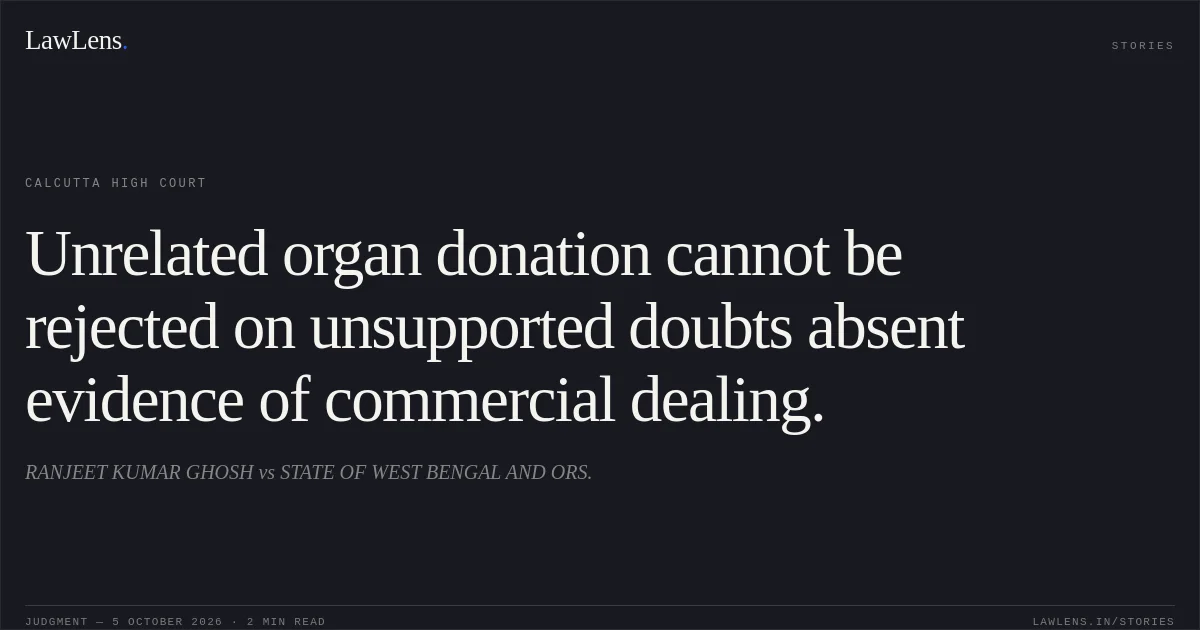
The Court held that the refusal was not in accordance with the statutory scheme and that, absent definite material indicating financial dealing, permission should not be withheld solely on those grounds.
¶ 27–2805Holding
The Court set aside and quashed the Authorization Committee’s decision refusing to recommend the transplant.
¶ 29It directed the State Level Authorization Committee to reconsider the petitioner’s request and make an appropriate decision within two weeks of receiving the order; the writ petition was allowed.
¶ 29–30Original Court PDF
RANJEET KUMAR GHOSHvsSTATE OF WEST BENGAL AND ORS.
Click to open original judgment
Original judgment, available to read, download and summarize on LawLens.in