Facts
The applicants challenged the selection and appointment of private respondents to Class-IV posts in District Kathua pursuant to Advertisement Notice No. 01 of 2006
Source reference: para 4(b)The recruitment was governed by Government Order No. 42-GAD of 2006, which mandated a fast-track process to be completed within three months
Source reference: para 4(c)Applicants participated in interviews conducted between December 2006 and January 2007
Source reference: para 4(e)However, the final selection list was not published until July 30, 2013—a delay of over six years
Source reference: para 4(h)The applicants, having been declared unsuccessful in the 2013 list, approached the High Court (later transferred to the CAT) seeking certiorari to quash the appointments and mandamus for their own selection
Source reference: para 1-3They alleged arbitrariness, excessive weightage to oral interviews (150 marks for interview vs. 50 for academics), selection of non-local candidates, and prejudice due to the inordinate delay
Source reference: para 4(i)Issues
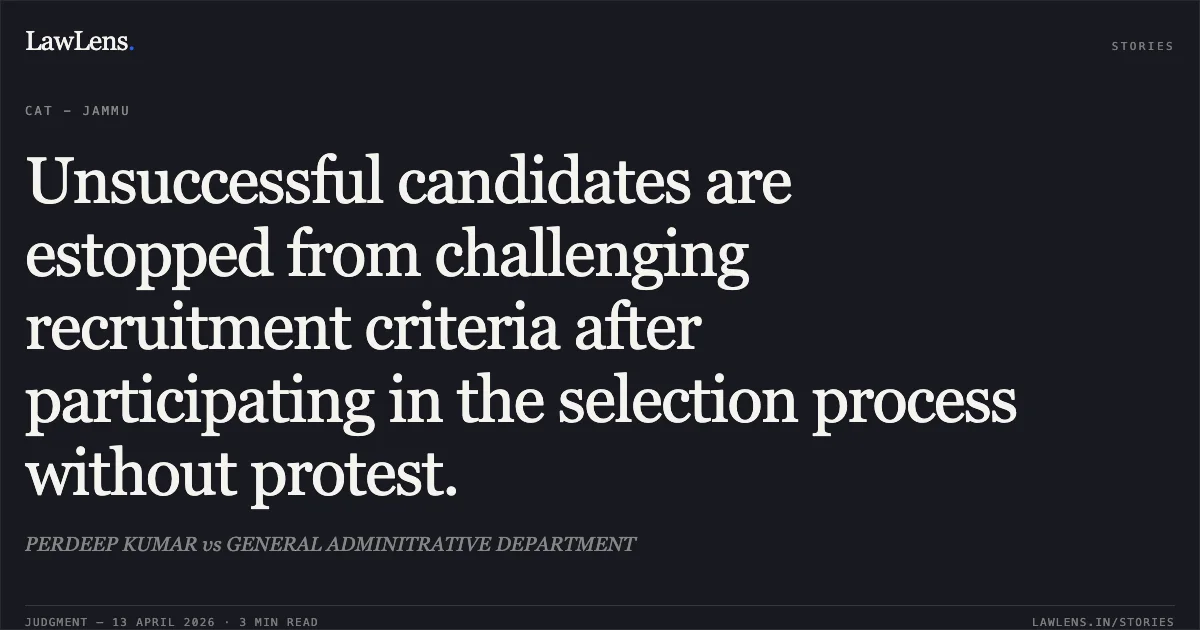
1. Whether candidates who voluntarily participated in a selection process with full knowledge of the criteria can challenge the said process after being declared unsuccessful
Source reference: para 8-92. Whether the allocation of 150 marks for viva voce against 50 marks for academic qualification was unconstitutionally excessive or arbitrary
Source reference: para 133. Whether the selection of candidates from outside District Kathua violated the requirement of "local preference" stipulated in the governing Government Order
Source reference: para 144. Whether the six-year delay in publishing the selection list per se vitiated the recruitment process
Source reference: para 15Law Applied
The Tribunal applied the principle of estoppel by conduct, relying on Madan Lal v. State of J&K (1995), which holds that a candidate cannot challenge a selection process after participating in it without protest
Source reference: para 9This was reinforced by K.H. Siraj v. High Court of Kerala (2006) and Ramesh Chandra Shah v. Anil Joshi (2013), established that candidates cannot "blow hot and cold" by questioning the procedure only after an unfavorable result
Source reference: para 10-11Regarding interview marks, the court followed Ashok Kumar Yadav v. State of Haryana (1985), which posits that there is no rigid rule for viva voce weightage
Source reference: para 13Finally, Dalpat Abasaheb Solunke v. Dr. B.S. Mahajan (1990) was cited to affirm that judicial review cannot substitute the merit assessment of expert selection committees
Source reference: para 16Reasoning
The Tribunal reasoned that the applicants were fully aware of the marks distribution and recruitment scheme at the time of application but chose to participate and take a "calculated chance"
Source reference: para 12Consequently, they were barred by the principles of estoppel and acquiescence from challenging the criteria post-facto
Source reference: para 20On the issue of local preference, the Tribunal held that the term "as far as possible" in the Government Order was directory, not mandatory, and could not override merit
Source reference: para 14Regarding the delay, the Tribunal noted that while the respondents failed to explain the six-year gap satisfactorily, the applicants failed to demonstrate any "nexus" between the delay and actual manipulation or arbitrariness in the result
Source reference: para 15The Tribunal emphasized that it does not sit as an appellate authority over selection committees, and in the absence of proven mala fides or statutory violations, the evaluation of suitability remains the exclusive domain of the recruiters
Source reference: para 16-17Holding
The Tribunal dismissed all the Transfer Applications, holding that the challenge was barred by estoppel and lacked merit
The court answered the issues by affirming that unsuccessful candidates cannot assail a process they voluntarily joined
Source reference: para 12equitable considerations like "overage" or "sympathy" cannot override settled legal principles of public employment
Source reference: para 17No order as to costs was made
Source reference: para 21Original Court PDF
PERDEEP KUMARvsGENERAL ADMINITRATIVE DEPARTMENT
Click to open original judgment
Original judgment, available to read, download and summarize on LawLens.in