Facts
The petitioner, a directly recruited Sub-Inspector in the CRPF, was appointed as an Assistant Commandant in 2007 and promoted as Deputy Commandant with effect from 27 December 2016.
Source reference: p.3While deputed as a trainer at the Sardar Vallabhbhai Patel National Police Academy, Hyderabad, from 6 August 2012 to 5 August 2017, he was additionally entrusted with responsibility for the Senior Officers’ Mess.
Source reference: p.3For the APAR period from 1 April 2016 to 14 September 2016, the Reporting Officer awarded him an “Outstanding” grading of 8.7. However, the Reviewing Officer awarded 5.98, graded him “Good,” and made adverse remarks concerning his emotional balance, discipline, alleged manipulative conduct, and suitability for critical work; the Accepting Authority concurred.
Source reference: pp.6–7The downgrade was attributed to an incident on 11 August 2016 in which approximately 20 IPS probationers allegedly chatted and laughed during the Academy song while the petitioner did not take action against them.
Source reference: p.6The petitioner challenged the adverse grading and remarks, alleging personal bias on the part of the then Deputy Director, but his appeal was rejected by order dated 23 May 2018.
Source reference: pp.2, 5He therefore invoked Article 226 of the Constitution seeking quashing of the appellate order, expunging of the adverse APAR entries, and consequential grant of JAG under NFFU with pay equivalent to the rank of Second-in-Command, CRPF.
Source reference: pp.1–2Issues
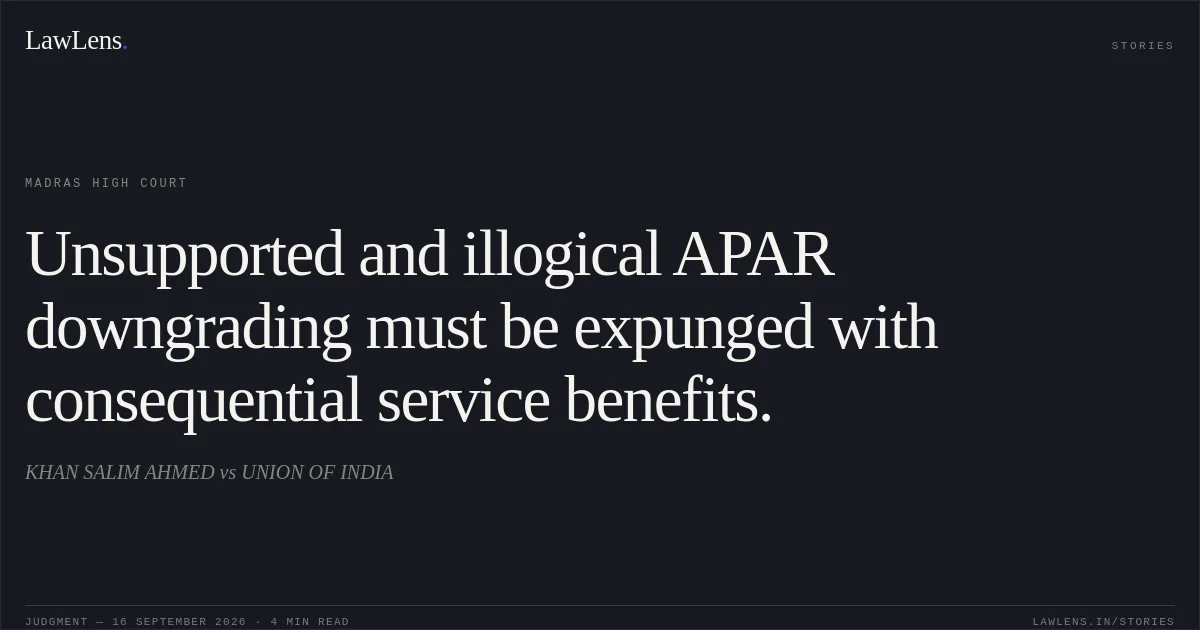
1. Whether the downgrading of the petitioner’s APAR from “Outstanding” to “Good,” together with the adverse remarks recorded for the period 1 April 2016 to 14 September 2016, was legally sustainable on the facts relied upon by the respondents.
Source reference: pp.6–10 / paras. 7–142. Whether the Reviewing Officer and Accepting Authority were justified in departing from the Reporting Officer’s “Outstanding” assessment without adequate reasons.
Source reference: p.8 / para. 123. Whether the petitioner was entitled to consequential grant of JAG under NFFU after expunging the impugned APAR grading and remarks.
Source reference: p.11 / para. 14Law Applied
The Court exercised judicial review under Article 226 of the Constitution over the legality and rationality of the impugned APAR assessment and appellate decision.
Source reference: no citationIt applied the principle that confidential reports and APARs must be prepared objectively, fairly, and dispassionately, on the basis of relevant facts and an overall assessment of the officer’s performance.
Source reference: no citationRelying on State of Uttar Pradesh v. Yamuna Shanker Misra, (1997) 4 SCC 7, the Court held that adverse material should be disclosed to the concerned officer, who must be given an opportunity to respond before such material is incorporated into the confidential report.
Source reference: pp.9–10 / para. 13The Court further applied the principle that an assessment must be rationally supported by the record and that an unexplained departure from a favourable assessment by the Reporting Officer may be vitiated.
Source reference: p.8 / para. 12Consequential service benefits, including JAG under NFFU, may follow where the adverse APAR entries forming the basis for denial are lawfully expunged.
Source reference: p.11 / para. 14Reasoning
The Court noted that the petitioner had received “Very Good” or “Outstanding” gradings for approximately seven years before and six years after the disputed period, and that even during the disputed period the Reporting Officer had assessed him as “Outstanding”.
Source reference: pp.5, 8 / paras. 6, 12The alleged misconduct was committed by the IPS probationers, not by the petitioner; the respondents’ case was only that he failed to intervene.
Source reference: p.7 / para. 8Since senior officers, including the Deputy Director, were present, the Court considered it illogical to treat the petitioner’s failure to act as proof of indiscipline warranting a substantial downgrade.
Source reference: p.7 / para. 8The remarks that the petitioner was emotionally unstable, manipative, lacking in discipline, and incapable of handling critical work were held to be hyperbolic and inconsistent with his otherwise continuous record of high performance; such traits could not logically be confined to a single short APAR period.
Source reference: pp.7–8 / paras. 9–11Further, the respondents failed to explain why the Reviewing and Accepting Authorities rejected the Reporting Officer’s “Outstanding” assessment. The unexplained downgrade was therefore irrational and contrary to the requirement of an objective and fact-based APAR assessment.
Source reference: p.8 / para. 12Applying the principles in Yamuna Shanker Misra, the Court held that the impugned grading and remarks were contrary to law.
Source reference: pp.9–10 / paras. 13–14Holding
The Madras High Court allowed the writ petition and ordered expunging of the “Good” grading and adverse remarks recorded by the Reviewing and Accepting Authorities for the period 1 April 2016 to 14 September 2016.
It consequently directed the respondents to grant the petitioner JAG under NFFU for the applicable period, enabling him to receive pay equivalent to the rank of Second-in-Command, CRPF.
Source reference: p.11 / para. 14The impugned appellate order dated 23 May 2018 was therefore quashed to the extent challenged.
Source reference: p.11 / para. 15No costs were awarded.
Source reference: p.11 / para. 15Original Court PDF
KHAN SALIM AHMEDvsUNION OF INDIA
Click to open original judgment
Original judgment, available to read, download and summarize on LawLens.in