Facts
The petitioner challenged a Lok Adalat compromise in O.S. No. 43/2009, alleging that her signatures had been obtained hurriedly and without explaining the terms, which gave her only a limited life interest in certain properties.
Source reference: paras. 2, 7–8The Lok Adalat record showed that she was represented by counsel, that the compromise terms were read over and explained, and that she confirmed her understanding of them.
Source reference: paras. 2, 7–8After her application under Section 151 CPC to recall the compromise was rejected on 27 May 2019, she filed this writ petition.
Source reference: paras. 1, 5The compromise was recorded nearly a decade before the challenge, and the Court found the delay insufficiently explained.
Source reference: paras. 1, 5, 10The judgment contains inconsistent references to the date of the Lok Adalat decree: the prayer refers to 21 February 2009, while the body also refers to 21 February 2019.
Source reference: p. 3; paras. 1, 5Issues
1. Whether a challenge alleging fraud or coercion in a Lok Adalat compromise may be brought before the High Court under Article 227, rather than by an application under Order XXIII Rule 3 CPC.
Source reference: para. 62. Whether the petitioner established grounds to set aside the compromise, having regard to the Lok Adalat record and the delay in challenging it.
Source reference: paras. 9–10, 13–14Law Applied
The Court stated that a Lok Adalat compromise award cannot be challenged before the Civil Court by invoking Order XXIII Rule 3 CPC; a party alleging that such a settlement is vitiated by fraud or coercion may invoke the High Court’s supervisory jurisdiction under Article 227 of the Constitution.
Source reference: para. 6The availability of that remedy does not dispense with the need to establish the alleged vitiating circumstances or satisfactorily explain the delay.
Source reference: no citationIn exercising supervisory jurisdiction, the Court should respect a settlement reached after deliberation and with counsel’s assistance, and interfere where its validity is materially affected or it results in a manifest miscarriage of justice.
Source reference: paras. 6, 12Reasoning
The Court considered the petitioner’s Article 227 challenge but found that the contemporaneous Lok Adalat proceedings contradicted her assertion that the compromise terms were not explained: she was represented by counsel, the terms were read over and explained, and she confirmed her understanding.
Source reference: paras. 7–9, 13Her allegation of fraud was unsupported by tangible material, and her limited interest in the allotted properties did not, by itself, establish involuntary consent.
Source reference: paras. 9, 11The nearly decade-long delay was also not satisfactorily explained.
Source reference: paras. 5, 10, 13Holding
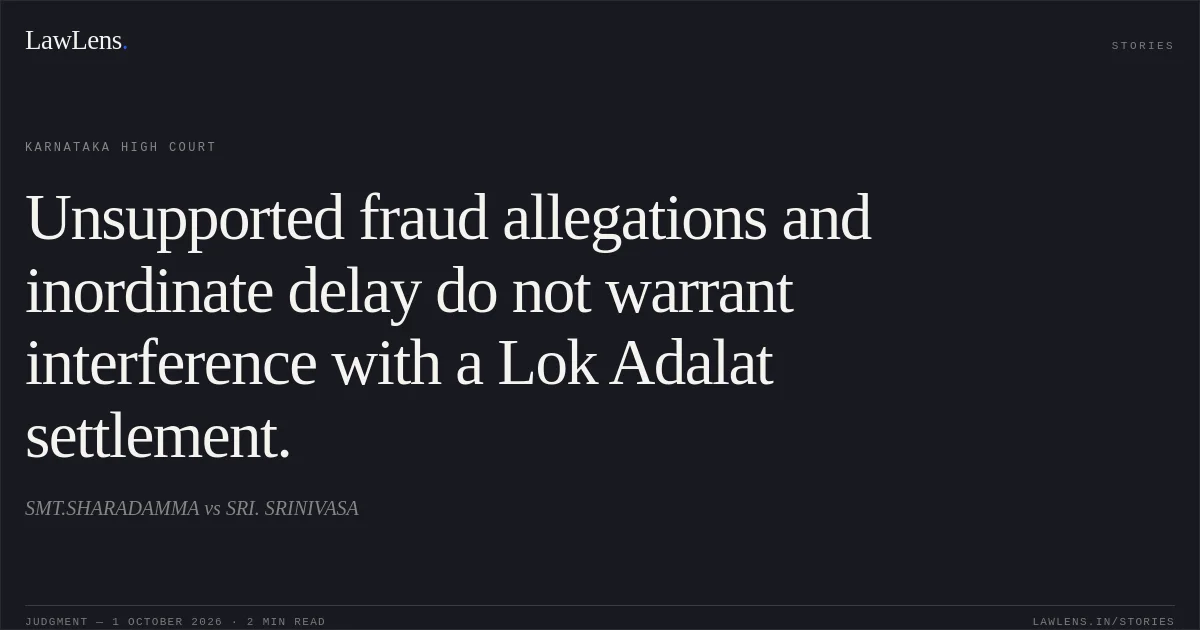
The Court held that the petitioner had not established fraud or another circumstance invalidating her consent, nor explained the delay.
Finding no jurisdictional error warranting intervention under Article 227, it dismissed the writ petition and made no order as to costs.
Source reference: para. 14; p. 12Acts & Sections Cited
1 provisions across 1 statute referred to in this judgment. Each provision opens on LawLens.
Code of Civil Procedure, 19081
Original Court PDF
SMT.SHARADAMMAvsSRI. SRINIVASA
Click to open original judgment
Original judgment, available to read, download and summarize on LawLens.in