Facts
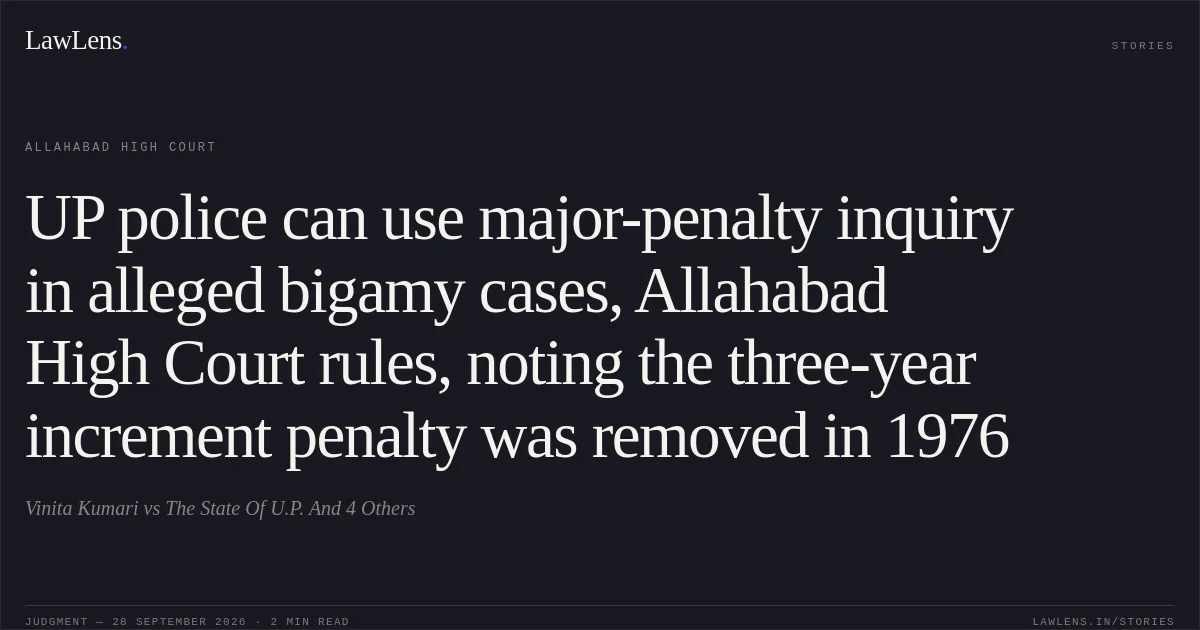
The petitioner, a constable in the Uttar Pradesh Police, was issued a charge-sheet under Rule 14(1) of the U.P. Police Officers of Subordinate Ranks (Punishment and Appeal) Rules, 1991.
Source reference: para. 3The charge alleged that, after joining service, she married Durgesh Kumar Gautam while her first marriage subsisted, thereby violating Rule 29 of the U.P. Government Servants’ Conduct Rules, 1956.
Source reference: para. 3She challenged the charge-sheet, arguing that Rule 29 permitted only a minor penalty and that proceedings should therefore have been initiated under Rule 14(2), rather than Rule 14(1).
Source reference: paras. 4–7Issues
Whether, following the 1976 amendment deleting Rule 29(3) of the 1956 Conduct Rules, a violation of Rule 29(1) or (2) could attract a major penalty.
Source reference: paras. 8–15, 35Whether initiation of proceedings under Rule 14(1) of the 1991 Rules was invalid because that provision prescribes the procedure for imposing a major penalty.
Source reference: paras. 36–39Law Applied
Rule 29(1) and (2) of the U.P. Government Servants’ Conduct Rules, 1956, prohibit a government servant from contracting or entering into a marriage in the specified circumstances without prior government permission.
Source reference: paras. 11–13The former Rule 29(3), which prescribed withholding of increments for three years as the minimum punishment for contravention, was deleted by the U.P. Government Servant Conduct (Fourth Amendment) Rules, 1976; it therefore could not govern the petitioner’s case.
Source reference: paras. 11–13, 35Under Rule 14(1) of the 1991 Rules, the procedure for a major-penalty inquiry may be followed, but doing so does not require the disciplinary authority to impose a major penalty; after inquiry, it may impose a minor penalty if the facts warrant it.
Source reference: paras. 37–39The Court distinguished earlier High Court decisions concerning Rule 29 because they had relied on the pre-amendment text without considering the deletion of sub-rule (3).
Source reference: paras. 17–30Reasoning
The Court found that the petitioner’s argument depended on the former Rule 29(3), but the State demonstrated that the provision had been deleted in 1976 and had not been reintroduced.
Source reference: paras. 12–15, 35The authorities relied upon by the petitioner either considered the unamended rule or turned on other grounds, and thus did not establish that only a minor penalty could be imposed under the rule as it stood.
Source reference: paras. 17–30The Court further held that the choice to proceed under Rule 14(1) did not predetermine the penalty: the disciplinary authority could impose a minor penalty after following that procedure, while a major penalty could not be imposed following only the minor-penalty procedure under Rule 14(2).
Source reference: paras. 37–39Holding
The Court held that Rule 29 did not restrict the disciplinary authority to imposing only a minor penalty, since the provision that had prescribed a minimum punishment had been deleted.
It also held that proceedings under Rule 14(1) were not invalid merely because the authority might ultimately impose a minor penalty.
Source reference: paras. 35–41The challenge to the charge-sheet was rejected, and the writ petition was dismissed.
Source reference: paras. 35–41Acts & Sections Cited
5 provisions across 2 statutes referred to in this judgment. Each provision opens on LawLens.
Hindu Marriage Act, 19553
Indian Penal Code, 18602
Original Court PDF
Vinita KumarivsThe State Of U.P. And 4 Others
Click to open original judgment
Original judgment, available to read, download and summarize on LawLens.in