Facts
The applicants, working in various Group ‘C’ technical and ministerial cadres in Pay Matrix Level-7 within the Western Railway, challenged the Railway Board’s policy under RBE No. 155/2022 dated 17.11.2022
Source reference: para 1, 4.2This policy mandated the upgradation of 50% of posts from Level-7 to Level-8.
Source reference: para 1, 4.2The applicants contested the subsequent eligibility and select lists issued by the Ahmedabad Division, which applied the reservation policy (SC/ST) to these upgraded posts
Source reference: para 1, 4.1The applicants argued that the scheme constituted "upgradation simpliciter" aimed at removing stagnation, which does not attract reservation, whereas the respondents maintained it was a "promotion" arising out of cadre restructuring
Source reference: para 5.2, 7.5Issues
1. Whether the upgradation from Pay Matrix Level–7 to Level–8 under RBE No. 155/2022 is a case of "upgradation simpliciter" or "promotion"
Source reference: para 122. Whether the application of the reservation policy in this process is legally sustainable
Source reference: para 123. Whether the impugned eligibility and select lists suffer from illegality warranting judicial interference
Source reference: para 12Law Applied
The court primarily relied on the distinction between "upgradation" and "promotion" as defined by the Hon’ble Supreme Court in Bharat Sanchar Nigam Ltd. v. R. Santhakumari Velusamy (2011) 9 SCC 510, which held that if advancement to a higher pay scale involves a selection process, residency periods, or is linked to the availability of posts, it constitutes "promotion"
Source reference: para 13.1It further applied the ratio from Union of India v. Pushpa Rani (2008) 9 SCC 242, establishing that cadre restructuring involving the creation of additional posts through "matching savings" (surrendering lower posts) to be filled by eligible and suitable employees attracts the rule of reservation
Source reference: para 13.2, 17The court also noted the 3-Judge Bench decision in Rama Nand v. Chief Secretary, Govt. of NCT of Delhi (2020) 9 SCC 208, which clarified that reorganization involving selection criteria and higher pay scales beyond mere re-description constitutes promotion
Source reference: para 15.2Reasoning
The Tribunal found that the scheme under RBE No. 155/2022 was not a "mass upgradation" because it was restricted to 50% of the cadre strength, making placement contingent upon vacancy and seniority
Source reference: para 13The process involved specific elements of selection, including a five-year residency period, scrutiny of service records, and vigilance clearance, which elevated it from a time-bound financial benefit to a promotional exercise
Source reference: para 13.3, 15.3Crucially, the Tribunal noted that the cadre was restructured through "matching savings," where posts in Level-1 to Level-7 were surrendered to create new posts in Level-8; thus, it was a selective advancement rather than an en masse pay revision
Source reference: para 8.6, 17The Bench distinguished the applicants' reliance on a previous Mumbai Bench order (OA No. 327/2023) by noting it had failed to consider the Railway Board’s July 2023 clarification and the Rama Nand precedent
Source reference: para 15.1, 16.1Consequently, the Tribunal concluded that the process partook the character of promotion, thereby making the application of the reservation policy legally mandatory
Source reference: para 18, 19Holding
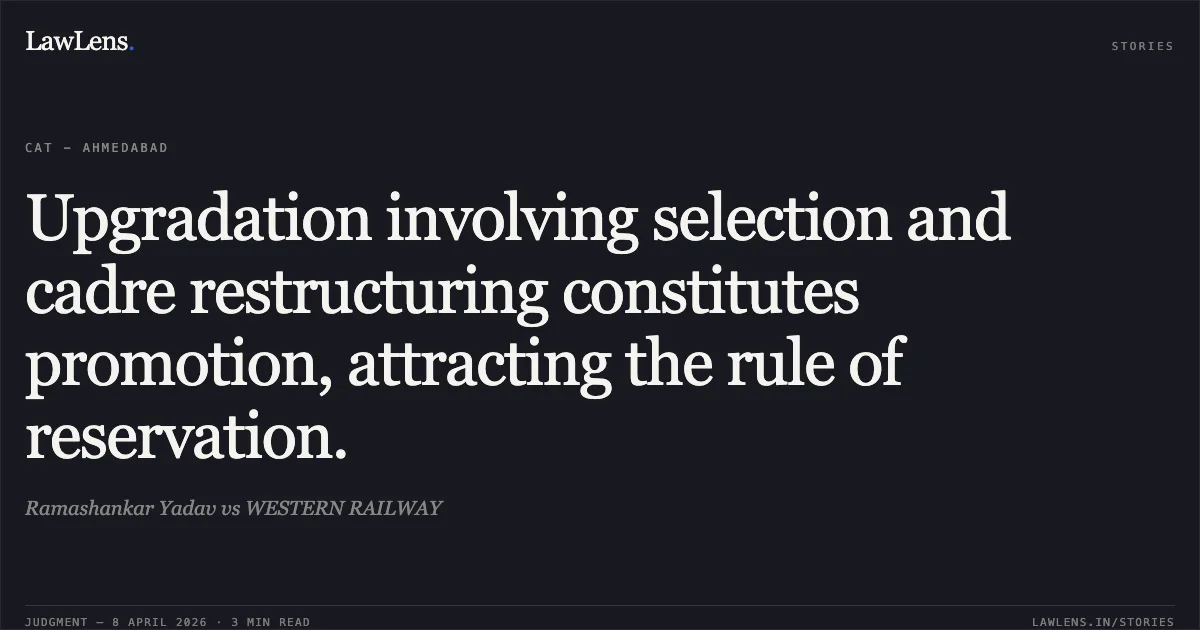
The Tribunal answered all issues in favor of the respondents, holding that the upgradation under RBE No. 155/2022 is a "promotion" arising out of cadre restructuring and not "upgradation simpliciter"
It affirmed that the application of reservation is valid as per settled law and Railway Board clarifications
Source reference: para 18The Tribunal dismissed all Original Applications, finding no illegality or arbitrariness in the impugned eligibility or select lists, and vacated all previous interim orders
Source reference: para 20, 21Acts & Sections Cited
2 provisions across 2 statutes referred to in this judgment. Each provision opens on LawLens.
Administrative Tribunals Act, 19851
Indian Penal Code, 18601
Original Court PDF
Ramashankar YadavvsWESTERN RAILWAY
Click to open original judgment
Original judgment, available to read, download and summarize on LawLens.in