Facts
The applicant joined as an Inspector in Central Excise Customs in 1980, was promoted to Superintendent in 1996, and retired as Assistant Director in 2016.
Source reference: para. 2Following the 5th Central Pay Commission (CPC) recommendations, the pay scales for Inspectors and Superintendents were revised to Rs. 6500–10500 and Rs. 7500–12000, respectively.
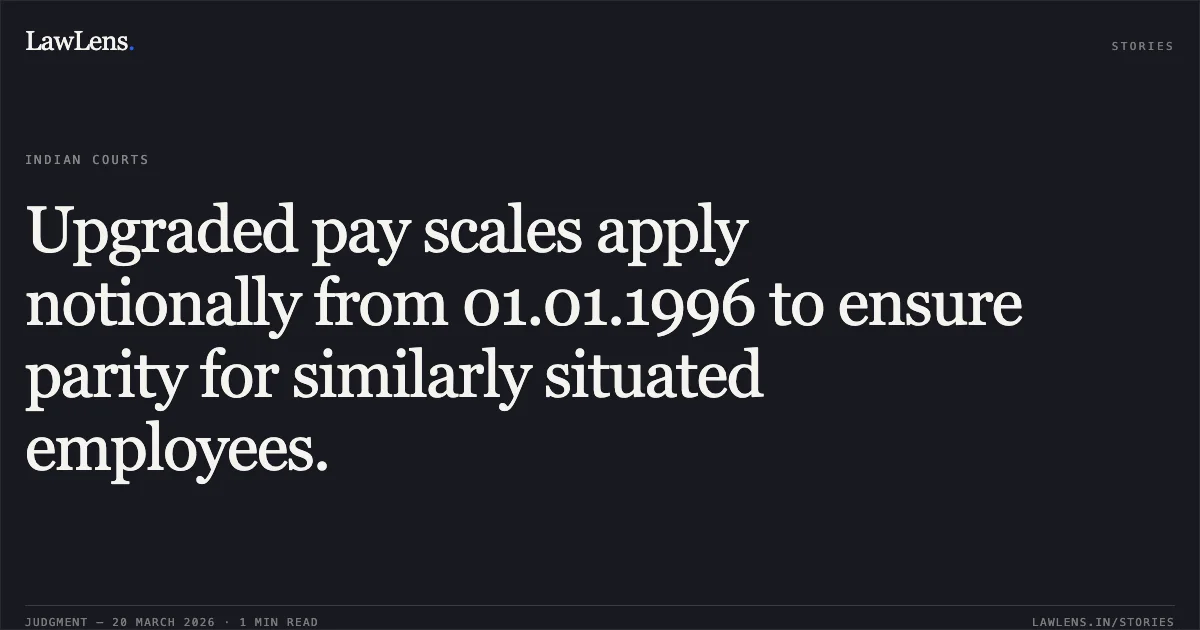
Source reference: para. 2However, the government made these scales effective from 21.04.2004 instead of 01.01.1996 (the implementation date of the 5th CPC).
Source reference: para. 2Following litigation by similarly situated employees in other Benches (Mumbai, Kolkata, and Hyderabad), a Special Anomaly Committee recommended notional fixation from 01.01.1996, which was implemented by the Central Board of Direct Taxes (CBDT) and later affirmed for Central Board of Indirect Taxes Customs (CBIC) employees by the Telangana High Court and the Supreme Court.
Source reference: paras. 24, 27-28The applicant filed this OA seeking parity, while the respondents argued the claim was barred by limitation and that the applicant was a "fence-sitter".
Source reference: paras. 1, 13-14Issues
1. Whether the applicant is entitled to notional pay fixation from 01.01.1996 and actual monetary benefits from 21.04.2004 based on parity with similarly situated employees.
Source reference: para. 212. Whether the Original Application is barred by limitation under Section 21 of the Administrative Tribunals Act, 1985, or by the doctrine of laches.
Source reference: paras. 17, 303. Whether the previous judicial pronouncements on this subject operate as judgments in rem or in personam.
Source reference: para. 35Law Applied
The court primarily applied the principle of parity under Article 14 of the Constitution of India, ensuring that similarly situated employees are treated equally.
Source reference: para. 34It relied on State of Karnataka v. C. Lalitha, which established that service jurisprudence requires benefits granted to one set of employees to be extended to all others similarly placed.
Source reference: para. 32The court also invoked K.L. Shephard Others v. Union of India, asserting that there is no justification to penalize employees for not having litigated earlier.
Source reference: para. 33Regarding limitation, the court applied the doctrine that pay fixation constitutes a recurring cause of action.
Source reference: para. 30Section 21 of the Administrative Tribunals Act, 1985, does not bar claims where the delay is explained by the timeline of administrative committee recommendations.
Source reference: paras. 13, 31Reasoning
The Tribunal rejected the respondents' plea of limitation, observing that the Special Anomaly Committee—constituted under the directions of the Kolkata High Court—only submitted its report on 22.09.2023, thus providing a fresh basis for the claim.
Source reference: para. 30The Tribunal held that since the CBDT and CBIC both function under the Department of Revenue, the recommendations of the Special Anomaly Committee must be applied uniformly to the entire Department to avoid discrimination.
Source reference: paras. 26-27It determined that the previous judgments of the Hyderabad and Mumbai Benches, affirmed by High Courts and the Supreme Court, were judgments in rem.
Source reference: para. 35The Tribunal reasoned that the respondent department cannot unilaterally reinterpret binding judicial decisions as being in personam to deny benefits to non-litigants, as such action is arbitrary and contrary to settled law.
Source reference: para. 37It further noted that restricting the benefit to a specific group of litigants while denying it to the applicant violated the principles of equality and fair treatment.
Source reference: para. 34Holding
The Tribunal allowed the OA and set aside the impugned orders.
It held that the applicant is entitled to the revised pay scale notionally from 01.01.1996 and on an actual monetary basis from 21.04.2004.
Source reference: para. 40The respondents were directed to refix the applicant’s pay in accordance with the Central Civil Services (Revised Pay) Rules, 1997, and grant all consequential benefits, including pensionary adjustments, within two months from the receipt of the order.
Source reference: para. 40No order was made as to costs.
Source reference: para. 41Acts & Sections Cited
1 provisions across 1 statute referred to in this judgment. Each provision opens on LawLens.
Administrative Tribunals Act, 19851
Original Court PDF
S RajarethinamvsM/O FINANCE
Click to open original judgment
Original judgment, available to read, download and summarize on LawLens.in