Facts
The applicant joined as a Customs Examiner on February 10, 1993, and was subsequently promoted to Appraiser and Assistant Commissioner
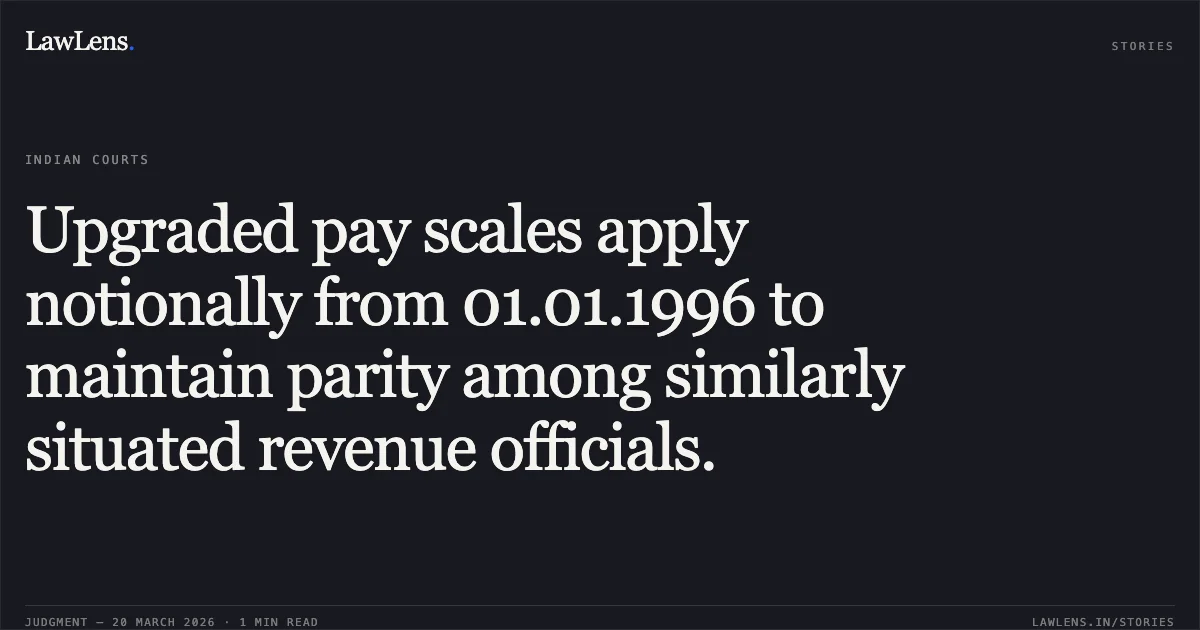
Source reference: para. 2Following the 5th Central Pay Commission (CPC) recommendations, the pay scales for Inspectors/Customs Examiners and Superintendents/Appraisers were revised to Rs. 6500–10500 and Rs. 7500–12000, respectively.
Source reference: para. 2However, the government made these revised scales effective from April 21, 2004, rather than January 1, 1996—the date the 5th CPC came into effect
Source reference: para. 2The applicant sought retrospective notional fixation from 1996, citing numerous decisions by various Benches of the Tribunal and High Courts (notably Hyderabad, Jaipur, and Calcutta) that granted such benefits to similarly situated employees
Source reference: paras. 3-11The respondents opposed the application on grounds of limitation under Section 21 of the Administrative Tribunals Act, 1985, arguing that the applicant was a "fence-sitter" and that previous judicial orders were in personam rather than in rem
Source reference: paras. 13-17Issues
1. Whether the applicant is entitled to the benefit of notional fixation of pay with effect from January 1, 1996, and consequential monetary benefits, to bring him on par with similarly situated employees
Source reference: para. 212. Whether the claim is barred by limitation or delay, and whether previous judicial pronouncements on this subject operate as judgments in rem
Source reference: paras. 30, 32, 35Law Applied
The Tribunal applied the Central Civil Services (Revised Pay) Rules, 1997, which governed the implementation of the 5th CPC recommendations
Source reference: para. 40It relied on the principle of Article 14 of the Constitution of India, emphasizing equality and fair treatment for similarly situated employees
Source reference: para. 34The Tribunal further invoked the doctrine from State of Karnataka v. C. Lalitha, which stipulates that service jurisprudence requires all similarly situated persons to be treated equally, regardless of whether they were original litigants
Source reference: para. 32Additionally, it referenced K.L. Shephard v. Union of India, holding that there is no justification to penalize employees for not having litigated earlier when the legal issue has been settled
Source reference: para. 33Reasoning
The Tribunal rejected the respondents' plea regarding limitation, noting that pay fixation constitutes a recurring cause of action and that the government, as a "model employer," should have extended benefits to all similarly placed employees once the law was settled
Source reference: paras. 30-31It observed that a Special Anomaly Committee had already recommended notional fixation from January 1, 1996, for CBDT employees, and since both CBDT and CBIC function under the Department of Revenue, the same logic must apply to both
Source reference: paras. 24-27The Tribunal emphasized that several Benches across India had already granted this relief, and the Hon’ble Supreme Court had affirmed these views
Source reference: paras. 28, 38It concluded that restricting the benefit to individual litigants (in personam) was arbitrary and that the prior judgments on this issue were in rem, as they addressed a general policy and pay structure affecting an entire class of employees
Source reference: paras. 35-37Holding
The Tribunal allowed the Original Application and set aside the impugned orders
It held that the applicant is entitled to the upgraded pay scales on par with his peers.
Source reference: no citationRefix the applicant's pay with effect from January 1, 1996, in accordance with the CCS (Revised Pay) Rules, 1997
Source reference: para. 40Grant consequential benefits in the grades of Inspector and Superintendent on a notional basis from January 1, 1996, and on an actual monetary basis from April 21, 2004
Source reference: para. 40Complete the exercise within two months from the date of receipt of the order
Source reference: para. 40Acts & Sections Cited
1 provisions across 1 statute referred to in this judgment. Each provision opens on LawLens.
Administrative Tribunals Act, 19851
Original Court PDF
Anand Kumar SavalamvsM/O FINANCE
Click to open original judgment
Original judgment, available to read, download and summarize on LawLens.in