Facts
The applicant is the widow of T.K. Vijayavelan, who joined the department as an Inspector in 1980, was promoted to Superintendent in 1997, and died in harness as an Assistant Director on January 1, 2016.
Source reference: para. 2Following the 5th Central Pay Commission (CPC), the Union Government revised the pay scales for Inspectors and Superintendents via an Office Memorandum (OM) dated April 21, 2004; however, this revision was granted prospective effect from the date of the OM rather than the implementation date of the 5th CPC (January 1, 1996).
Source reference: para. 2The applicant’s representation dated September 30, 2025, seeking retrospective upgradation was rejected by the Additional Director (Admn), DG Systems, Chennai, on October 8, 2025, on the grounds that the Department of Expenditure did not agree to the retrospective extension.
Source reference: para. 2The applicant approached the Tribunal seeking parity with similarly situated employees who received retrospective benefits through various judicial interventions.
Source reference: para. 2-3Issues
1. Whether the applicant's claim for pay scale upgradation with effect from January 1, 1996, is barred by limitation and the doctrine of "fence-sitting" under Section 21 of the Administrative Tribunals Act, 1985.
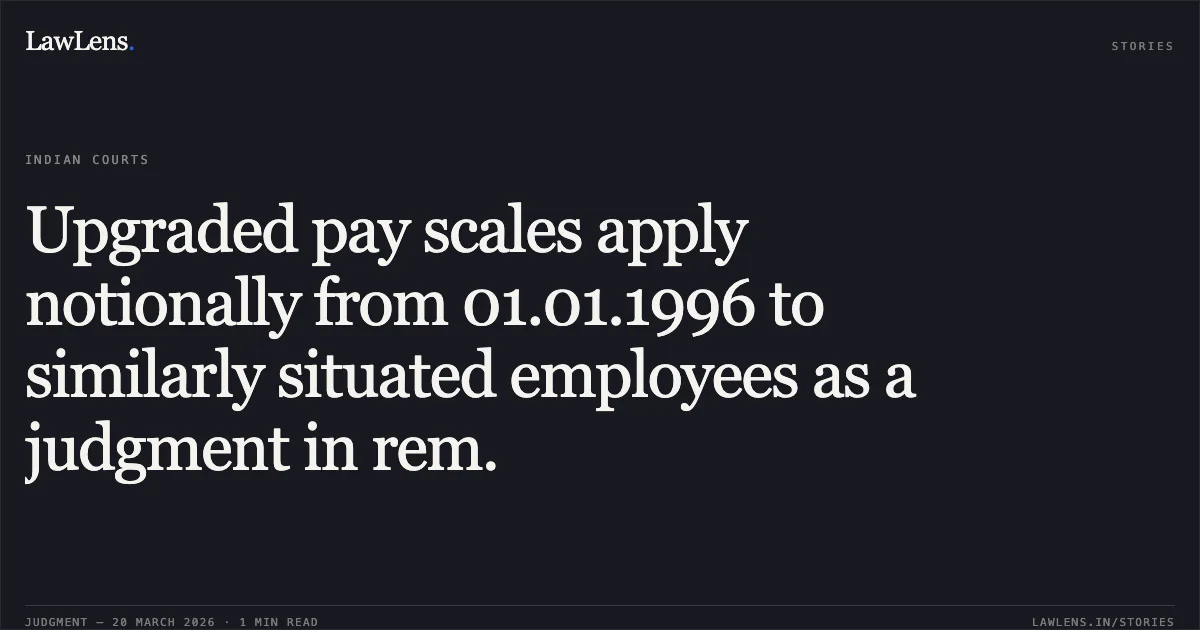
Source reference: para. 13-142. Whether the revised pay scales under the 5th CPC must be granted notionally from January 1, 1996, and on an actual basis from April 21, 2004, to maintain parity across the Department of Revenue.
Source reference: para. 21, 273. Whether the prior judgments granting such benefits operate in rem (applicable to all similarly situated employees) or in personam (restricted to the litigants therein).
Source reference: para. 32, 35Law Applied
The court primarily applied the principle that pay fixation constitutes a "recurring and continuing" cause of action, as established in M.R. Gupta v. Union of India, thereby exempting it from strict limitation bars.
Source reference: para. 2It relied on Article 14 of the Constitution regarding parity and the "Model Employer" concept, citing State of Karnataka v. C. Lalitha, which mandates that similarly situated persons be treated equally.
Source reference: para. 32-33Furthermore, it applied the doctrine that judgments resolving departmental anomalies are judgments in rem, as supported by K.L. Shephard v. Union of India.
Source reference: para. 33The Tribunal also noted Section 21 of the Administrative Tribunals Act, 1985, regarding the limitation period for filing applications.
Source reference: para. 13Reasoning
The Tribunal rejected the respondents' argument on limitation, observing that pay fixation and pension computation involve a continuous cause of action.
Source reference: para. 2, 30It noted that a Special Anomaly Committee, constituted following a Calcutta High Court direction, had already recommended granting the enhanced pay scale notionally from January 1, 1996, for the Central Board of Direct Taxes (CBDT).
Source reference: para. 24The Tribunal reasoned that since both CBDT and the Central Board of Indirect Taxes and Customs (CBIC) function under the same Department of Revenue, denying the same benefit to CBIC employees would be discriminatory.
Source reference: para. 26-27It further observed that several Benches across India (Hyderabad, Chandigarh, Principal Bench, etc.) had already granted this relief, and the CBIC had implemented those orders for over 1,500 employees.
Source reference: para. 11, 26The Tribunal concluded that judicial consistency requires the application of these precedents in rem, especially since the respondents had already implemented similar directions for other applicants within the same Bench.
Source reference: para. 35-37Holding
The Tribunal allowed the Original Application, setting aside the impugned rejection orders dated October 8, 2025, and July 25, 2023.
It held that the applicant's husband was entitled to the revised pay scales notionally from January 1, 1996, with actual monetary benefits (including arrears and revised family pension) payable from April 21, 2004.
Source reference: para. 40The respondents were directed to complete the re-fixation exercise and disburse all consequential benefits within two months.
Source reference: para. 40No order as to costs was made.
Source reference: para. 41Acts & Sections Cited
1 provisions across 1 statute referred to in this judgment. Each provision opens on LawLens.
Administrative Tribunals Act, 19851
Original Court PDF
T M Renuka DevivsM/O FINANCE
Click to open original judgment
Original judgment, available to read, download and summarize on LawLens.in