Facts
The Applicant joined the department as an Inspector in 1980, was promoted to Superintendent on October 3, 1996, and retired on April 30, 2012.
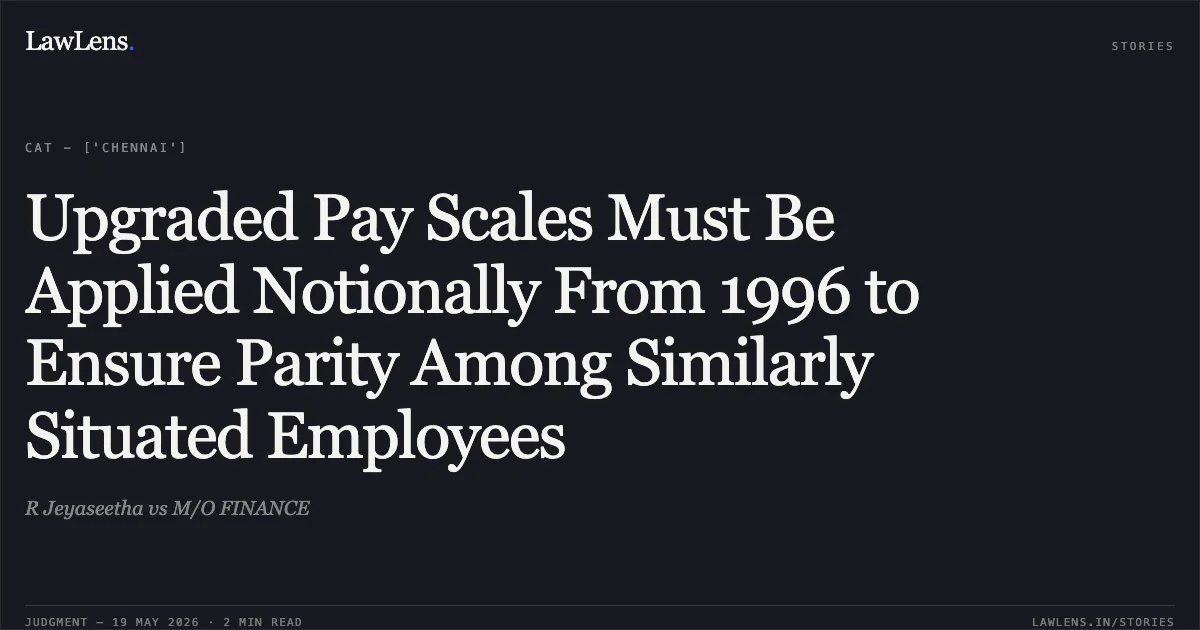
Source reference: p. 3Following the 5th Central Pay Commission (CPC) recommendations, the pay scales for Inspectors and Superintendents were upgraded to Rs. 6,500–10,500 and Rs. 7,500–12,000, respectively.
Source reference: p. 3The government made these revised scales effective from April 21, 2004, rather than the implementation date of the 5th CPC, which was January 1, 1996.
Source reference: p. 3The Applicant sought parity with other employees who had secured judgments from various High Courts and the Supreme Court directing notional fixation from 1996.
Source reference: p. 4-9The Respondents opposed the claim primarily on grounds of limitation, arguing the Applicant was a "fence-sitter" who approached the Tribunal decades after the cause of action.
Source reference: p. 10-12Issues
1. Whether the enhanced/revised pay scales under the 5th CPC should be granted with effect from January 1, 1996 (notionally) or from April 21, 2004.
Source reference: p. 8 / para. 102. Whether the claim is barred by limitation and the doctrine of "fence-sitters" under Section 21 of the Administrative Tribunals Act, 1985.
Source reference: p. 10 / para. 13Law Applied
The Tribunal applied the principle of "judgment in rem," holding that service benefits granted to a class of employees must be extended to all similarly situated persons to avoid violating Article 14 of the Constitution.
Source reference: p. 22-24It relied on State of Karnataka v. C. Lalitha, which mandates that similarly situated persons be treated similarly regardless of who approached the court first.
Source reference: p. 22It further applied the principle from K.L. Shephard v. Union of India, establishing that there is no justification to penalize employees for not having litigated earlier.
Source reference: p. 23Regarding limitation, the Tribunal followed the Delhi High Court's view in W.P.(C) 15760/2023, holding that pay fixation involves a recurring cause of action and that the government, as a model employer, should extend benefits once a series of decisions have attained finality.
Source reference: p. 21-22Reasoning
The Tribunal reasoned that since the Central Board of Direct Taxes (CBDT) and the Central Board of Indirect Taxes & Customs (CBIC) both function under the Department of Revenue, a Special Anomaly Committee's recommendation to grant notional fixation from 1996 for one board must apply to the other.
Source reference: p. 19The court rejected the "fence-sitter" argument, noting that the finality of the legal issue was only recently established through a series of litigations culminating in the Supreme Court’s dismissal of the government's SLP in 2024 and 2025.
Source reference: p. 19-20The Tribunal observed that the CBIC had already implemented similar orders for over 1,500 applicants nationwide, making it arbitrary to deny the same to the current Applicant.
Source reference: p. 9, 25-26It concluded that once the government accepts a CPC recommendation, it cannot arbitrarily shift the effective date for actual or notional benefits in a discriminatory manner.
Source reference: p. 21Holding
The Tribunal allowed the OA, holding that the Applicant is entitled to parity with similarly situated employees.
The Respondents were directed to refix the Applicant’s pay in the grades of Inspector and Superintendent according to the CCS (Revised Pay) Rules, 1997, providing notional fixation from January 1, 1996, and actual monetary benefits (including revised pensionary benefits) from April 21, 2004, within two months.
Source reference: para. 40Acts & Sections Cited
1 provisions across 1 statute referred to in this judgment. Each provision opens on LawLens.
Administrative Tribunals Act, 19851
Original Court PDF
R JeyaseethavsM/O FINANCE
Click to open original judgment
Original judgment, available to read, download and summarize on LawLens.in