Facts
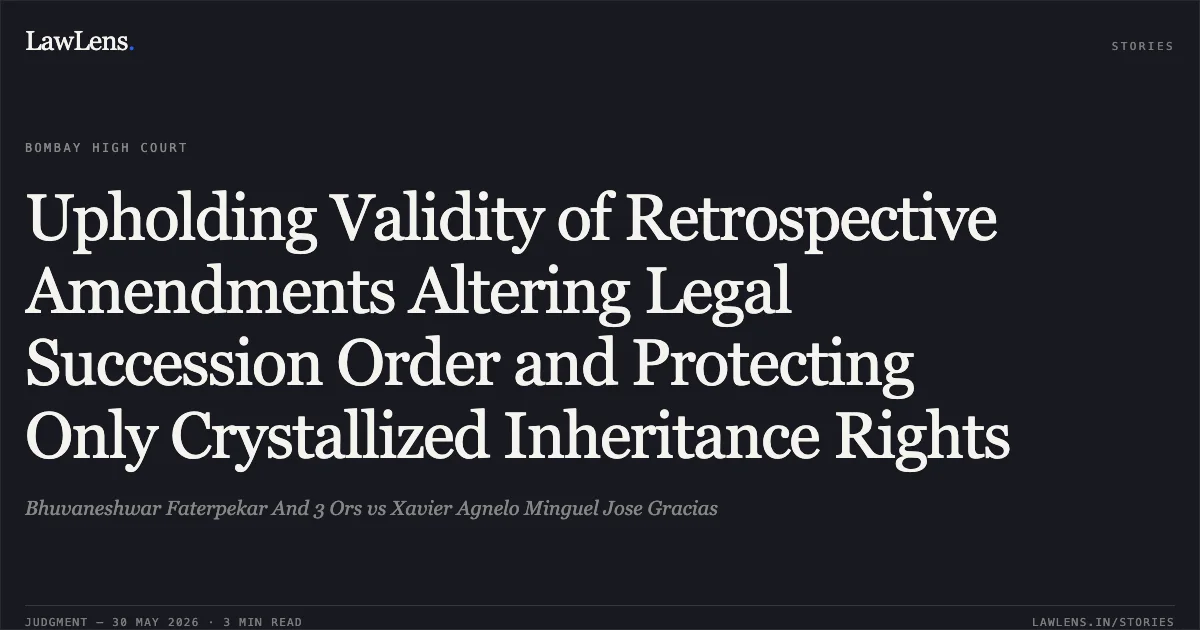
The petitioners challenged the constitutionality of the Goa Succession, Special Notaries and Inventory Proceedings (Amendment) Acts of 2022 and 2023.
Source reference: para. 1Under the original 2012 Act (based on the Portuguese Civil Code), a surviving spouse was 4th in the order of legal succession, behind descendants, ascendants (parents), and siblings.
Source reference: para. 20The 2022 Amendment moved the surviving spouse to 2nd place, ahead of parents.
Source reference: para. 24The 2023 Amendment gave this change retrospective effect from December 21, 2016.
Source reference: para. 25One petitioner, whose brother died intestate in May 2022, argued this retrospectively divested his vested inheritance rights.
Source reference: para. 4-6Another set of petitioners (parents) argued the amendment left them without support by prioritizing the widow.
Source reference: para. 9-11Issues
1. Whether the alteration of the order of legal succession, specifically elevating the surviving spouse over ascendants, is manifestly arbitrary and violative of Article 14 of the Constitution.
Source reference: para. 2, 892. Whether the retrospective application of the Amendment Acts (deemed to be in force from 2016) unconstitutionally divests "vested" or "crystallized" rights of heirs.
Source reference: para. 1, 1063. Whether the amendment to Section 83 regarding the "legitime" (the portion of the estate reserved for forced heirs) violates personal autonomy and Article 21.
Source reference: para. 5, 43-44Law Applied
The Court applied the doctrine of "manifest arbitrariness" as established in Shayara Bano v. Union of India, which permits striking down legislation that is capricious, irrational, or lacks an adequate determining principle.
Source reference: para. 81-84, 92It further applied the "presumption of constitutionality," holding that the burden lies on the challenger to prove a clear transgression of constitutional principles.
Source reference: para. 69Regarding retrospectivity, the Court relied on CIT v. Vatika Township (P) Ltd, noting that while the law traditionally looks forward, the legislature is competent to enact retrospective laws to cure defects or advance public interest, provided they do not unfairly impair vested rights.
Source reference: para. 111-112The Court also referenced Section 8 of the Hindu Succession Act, 1956, and Section 33 of the Indian Succession Act, 1925, as benchmarks for reasonable succession orders.
Source reference: para. 96-104Reasoning
The Court found the legislative decision to elevate the surviving spouse in the order of succession was not arbitrary but aimed at "rectifying" historical sequences to better reflect modern social needs.
Source reference: para. 95, 102By comparing the Goa law with the Hindu and Indian Succession Acts—where spouses generally take precedence over or share with parents—the Benches concluded the Goa Legislature acted within its wisdom and followed established legal trends.
Source reference: para. 102-105On retrospectivity, the Court interpreted the "Explanation" appended to Section 52 by the 2023 Act, which protects "crystallized rights".
Source reference: para. 117The Court defined "crystallized rights" as those resulting from final decrees or completed partitions; however, it clarified that mere death ("transmission") creates a vested interest, but the legislature is competent to modify these interests in pending proceedings to advance a policy goal.
Source reference: para. 122, 133The Court rejected the "autonomy" argument regarding prenuptial agreements, ruling that statutory succession laws operate independently of matrimonial regimes upon death.
Source reference: para. 134Holding
The Court held that the re-ordering of succession is a matter of legislative policy and does not constitute "manifest arbitrariness".
The Court concluded that the retrospective effect (backdated to 2016) is valid because the Act expressly saves "crystallized" rights while allowing the new order to apply to pending litigation, which is a permissible exercise of legislative power.
Source reference: para. 122, 134The Court upheld the constitutional validity of the 2022 and 2023 Amendment Acts. All Writ Petitions and intervention applications were dismissed, and Rule was discharged.
Source reference: para. 134Acts & Sections Cited
12 provisions across 4 statutes referred to in this judgment. Each provision opens on LawLens.
Hindu Succession Act, 19567
Indian Succession Act, 19253
Goa, Daman and Diu (Administration) Act, 19621
Arbitration and Conciliation Act, 19961
Original Court PDF
Bhuvaneshwar Faterpekar And 3 OrsvsXavier Agnelo Minguel Jose Gracias
Click to open original judgment
Original judgment, available to read, download and summarize on LawLens.in