Facts
The informant (P.W.1) filed a police report alleging that the appellant enticed his minor daughter (P.W.3) and took her to Bangalore
Source reference: para. 3While the prosecution relied on a school certificate dated 07.05.2016 indicating the victim was a minor (DOB 13.01.2002), the victim testified that she was born in January 2000, making her an adult at the time of the incident
Source reference: para. 7(III), 12She stated she left with the appellant of her own will due to a romantic relationship opposed by her parents
Source reference: para. 7(III)The Trial Court convicted the appellant under Sections 363 and 376 IPC, and Sections 4, 8, and 12 of the POCSO Act, sentencing him to 7 years R.I.
Source reference: para. 2The appellant challenged the conviction primarily on the grounds of the victim’s majority
Source reference: para. 10Issues
1. Whether the victim was a minor at the time of the incident to attract the provisions of the POCSO Act and Section 363 IPC
Source reference: para. 122. Whether the conviction can be sustained when the medical evidence and victim’s testimony contradict the prosecution's claim of minority
Source reference: para. 14, 16Law Applied
The court applied Sections 363 (Kidnapping) and 376 (Rape) of the IPC, and Sections 4, 8, and 12 of the POCSO Act, 2012, which specifically govern sexual offenses against children
Source reference: para. 2The court relied on the evidentiary principle that when a medical board provides an age range, the "upper side" or higher age limit should be considered in favor of the accused, especially when corroborated by the victim's own testimony
Source reference: para. 14It also scrutinized the reliability of school records under the Juvenile Justice (Care and Protection of Children) Act framework, noting that a lack of verification of school registers or examination of the school principal renders such certificates unreliable
Source reference: para. 12Reasoning
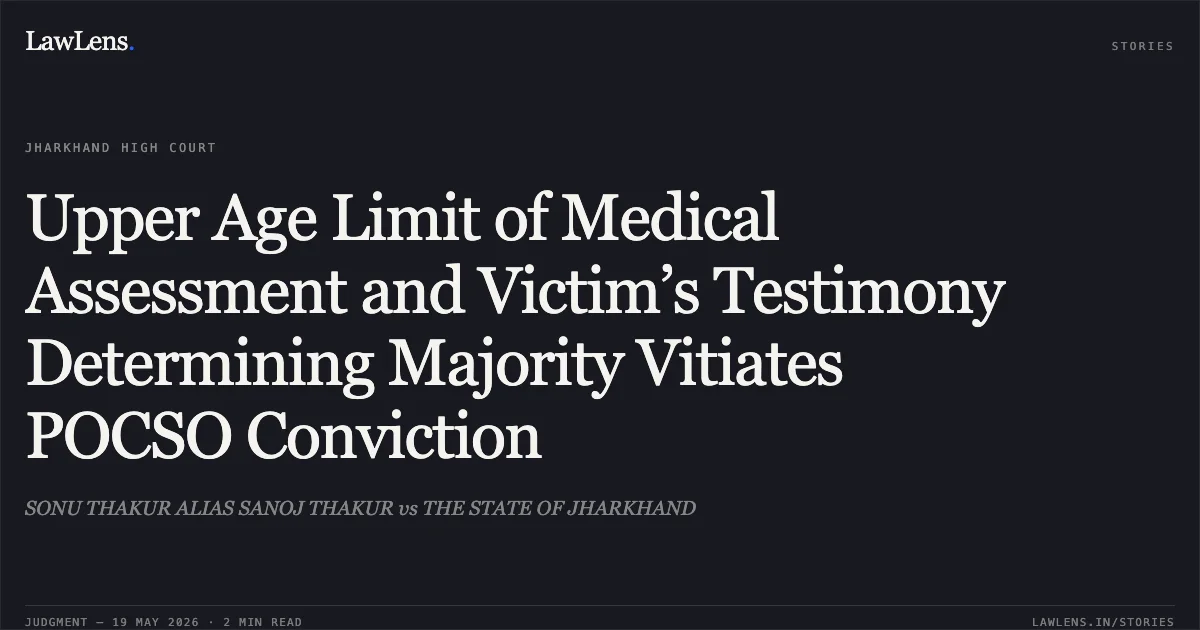
The High Court found the Trial Court’s reliance on the lower side of the medical assessment to be erroneous. A Medical Board (P.W.7) assessed the victim’s age between 17-18 years
Source reference: para. 7(VII)The Court reasoned that in cases of age ambiguity, the benefit of the upper age limit must be given, which in this case (18 years) aligned with the victim’s own testimony
Source reference: para. 14The court noted significant lacunae in the investigation: the Investigating Officer (P.W.8) failed to verify school registers or examine the Principal, making the school certificate regarding the 2002 birth date suspicious and improbable
Source reference: para. 12Since the victim was determined to be a major who exercised her right to choose a partner, the essential element of "lack of consent" or "taking from lawful guardianship" was absent
Source reference: para. 15, 16Holding
The Court held that the victim had attained majority and was a consenting party to the relationship
Consequently, the conviction under the POCSO Act and IPC was bad in law. The High Court allowed the appeal, quashed the judgment of conviction and order of sentence dated 04.02.2019, and discharged the appellant from his bail bonds
Source reference: para. 16, 17-18Acts & Sections Cited
7 provisions across 4 statutes referred to in this judgment. Each provision opens on LawLens.
Indian Penal Code, 18602
Protection of Children from Sexual Offences Act, 20123
Juvenile Justice (Care and Protection of Children) Act, 2015.1
Code of Criminal Procedure, 19731
Original Court PDF
SONU THAKUR ALIAS SANOJ THAKURvsTHE STATE OF JHARKHAND
Click to open original judgment
Original judgment, available to read, download and summarize on LawLens.in