Facts
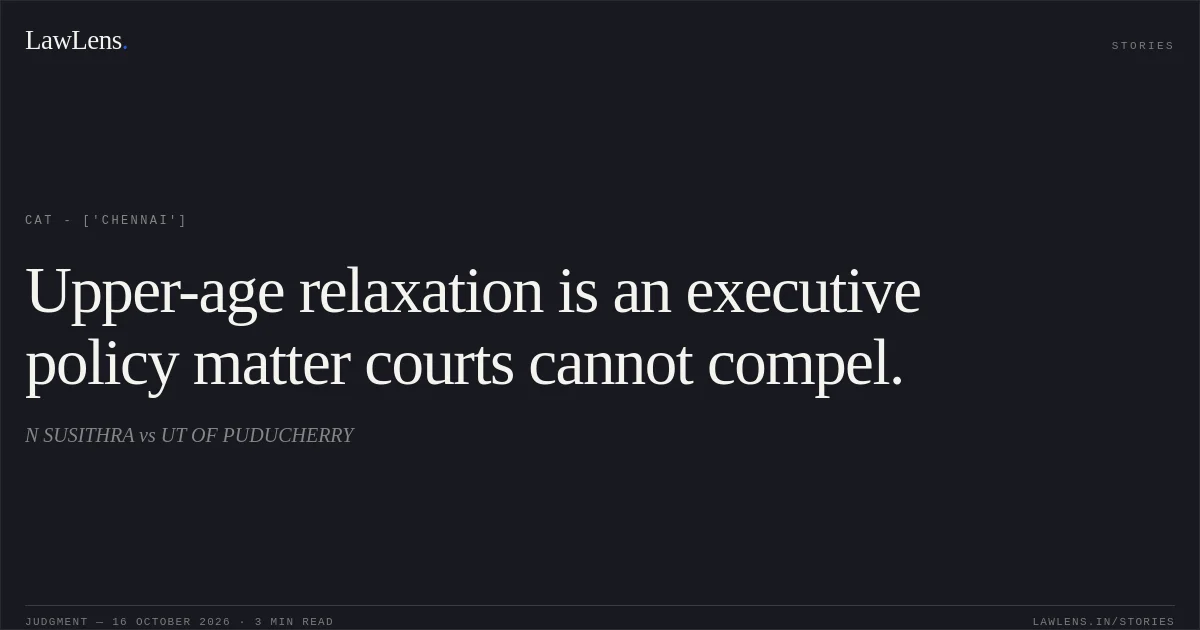
The Directorate of School Education, Puducherry, invited applications for Trained Graduate Teacher (TGT) posts by notification dated 22 January 2024, prescribing an upper age limit of 30 years as of 22 February 2024.
Source reference: p. 2The applicant, aged 34 and belonging to the OBC category, claimed that she met the other eligibility criteria but was overage, including after the applicable three-year category relaxation.
Source reference: p. 2She sought to quash the age-limit clause and obtain a further two-year relaxation under Puducherry G.O. Ms. No. 50 dated 29 July 2022, which provided a one-time relaxation for direct recruitment to Group C posts.
Source reference: p. 2The respondents stated that the Government had not secured approval for a comparable relaxation for Group B posts, including TGT posts.
Source reference: pp. 3–4By interim order, the Tribunal permitted the applicant to submit her application without conferring any right to appointment; the application was received.
Source reference: p. 4Issues
Whether the applicant was entitled to a further two-year upper-age relaxation under G.O. Ms. No. 50 for recruitment to the TGT post, a Group B post.
Source reference: pp. 2–3, 5Whether the Tribunal could direct the respondents to relax the prescribed age limit despite the absence of an applicable relaxation policy or reserved power to relax the eligibility criteria.
Source reference: pp. 5–7Law Applied
Under Section 19 of the Administrative Tribunals Act, 1985, the applicant invoked the Tribunal’s jurisdiction to challenge the recruitment notification.
Source reference: p. 2The Tribunal treated the prescription of an age limit and the extent of any relaxation as matters of executive or legislative policy, relying on Union of India v. Shivbachan Rai, (2001) 9 SCC 356.
Source reference: p. 5It also relied on N.S. Siva Kumar v. Addl. Chief Secretary to Govt. of Tamil Nadu, (2020) 2 CTC 241, for the principle that delayed recruitment, without mala fides, does not itself justify further age relaxation.
Source reference: pp. 5–6Mallikarjuna Rao v. State of A.P., (1990) 2 SCC 707, and Asif Hameed v. State of Jammu & Kashmir, 1989 Supp (2) SCC 364, for the limits on judicial directions in matters within the executive’s policy domain.
Source reference: p. 6Bedanga Talukdar v. Saifudaullah Khan, (2011) 12 SCC 85, and Ankita Thakur v. H.P. Staff Selection Commission, Civil Appeal No. 7602 of 2023, for the rule that eligibility conditions cannot be relaxed unless the rules or advertisement reserve that power and the relaxation is properly indicated.
Source reference: p. 7Reasoning
The Tribunal accepted that the applicant was over the prescribed age and that G.O. Ms. No. 50 concerned Group C recruitment, whereas the TGT post was Group B; the proposed Group B relaxation had not been agreed to by the relevant authorities.
Source reference: pp. 2–3, 5In light of the cited authorities, it held that the Tribunal could not require the Government to extend a one-time relaxation beyond the policy’s scope.
Source reference: pp. 5–7It also considered that numerous other overage candidates had submitted offline applications, so relief to the applicant alone would be inappropriate.
Source reference: pp. 4, 7–8Holding
The Tribunal held that the applicant had no entitlement to the requested age relaxation and found no merit in the Original Application.
It dismissed the OA and any pending miscellaneous applications, with no order as to costs; the interim permission to submit an application did not create an indefeasible right to the post.
Source reference: pp. 4, 8Acts & Sections Cited
1 provisions across 1 statute referred to in this judgment. Each provision opens on LawLens.
Administrative Tribunals Act, 19851
Original Court PDF
N SUSITHRAvsUT OF PUDUCHERRY
Click to open original judgment
Original judgment, available to read, download and summarize on LawLens.in