Facts
The prosecution arose from a written application by the informant (PW-3) alleging that the appellant committed rape on her daughter (PW-4) under the pretext of marriage, resulting in pregnancy
Source reference: para. 4A medical examination conducted on 27.09.2018 determined the victim was 30 weeks pregnant
Source reference: para. 19-20The Trial Court convicted the appellant under Section 4 of the POCSO Act and Section 376(2)(i) of the IPC, sentencing him to twenty years of rigorous imprisonment
Source reference: para. 3The appellant challenged the conviction, contending that the victim’s age was not proved according to statutory requirements and that Section 376(2)(i) IPC had been omitted by Act 22 of 2018
Source reference: para. 14-15, 20Issues
1. Whether the prosecution successfully established that the victim was a "child" as defined under Section 2(d) of the POCSO Act
Source reference: para. 182. Whether the conviction under Section 376(2)(i) of the IPC is legally sustainable despite its omission by Act 22 of 2018
Source reference: para. 20Law Applied
The Court primarily applied Section 2(d) of the POCSO Act, which defines a child as any person below eighteen years of age
Source reference: para. 18It utilized Section 94 of the Juvenile Justice (Care and Protection of Children) Act, 2015, to evaluate age determination evidence, noting that unexhibited school certificates lack evidentiary value
Source reference: para. 18The Court further relied on the "plus/minus two years" rule for radiological age estimation as established in Rajak Mohammad v. State of H.P. (2018) and Court on its own Motion v. NCT of Delhi (2024)
Source reference: para. 19For the IPC charge, the Court applied Section 376(2)(i) as it existed prior to its omission on 21.04.2018, based on the date of the offence
Source reference: para. 20Reasoning
The Court found that the Trial Court erroneously relied on a school transfer certificate that was neither exhibited nor proved by a competent witness
Source reference: para. 18Examining the medical evidence, the Medical Board estimated the victim’s age between 16 and 18 years
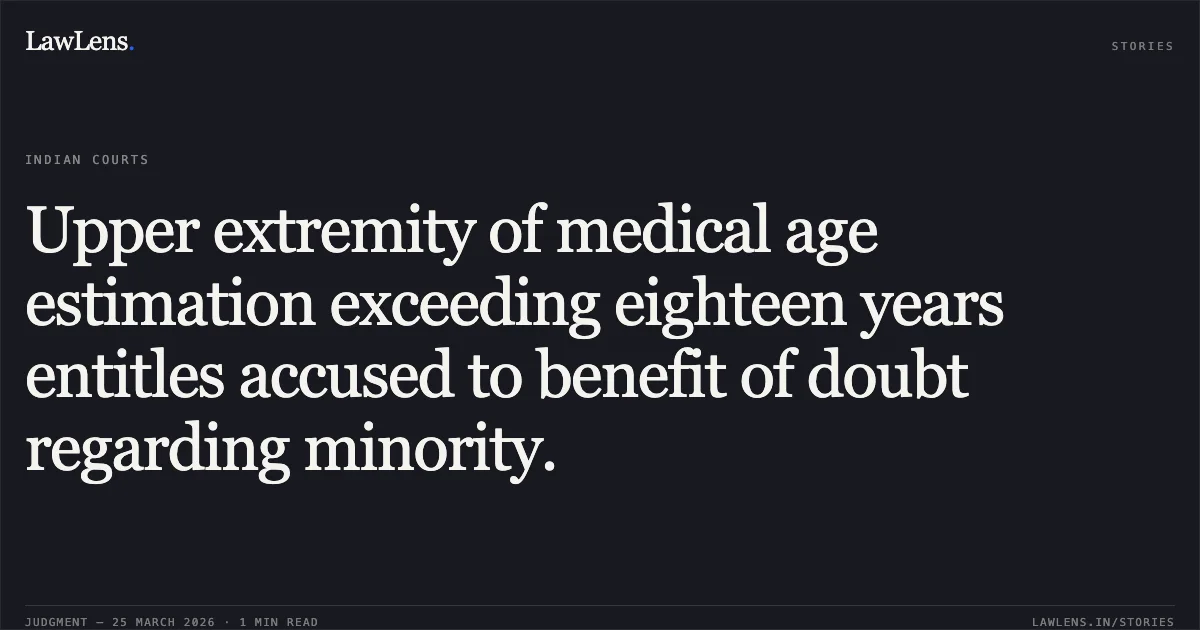
Source reference: para. 19Applying the judicial "plus/minus two years" rule, the Court observed the upper extremity of the age could be 19 years, thereby creating reasonable doubt as to whether the victim was a "child" under POCSO
Source reference: para. 19Regarding the IPC, the Court rejected the appellant's argument on the omission of Section 376(2)(i), noting that the 30-week pregnancy period indicated the offence occurred prior to the April 2018 amendment
Source reference: para. 20The Court deemed the victim a "sterling witness" whose testimony, corroborated by a DNA report confirming the appellant as the biological father, sufficiently proved the charge of rape
Source reference: para. 11, 21Holding
The Court partly allowed the appeal, setting aside the conviction and sentence under Section 4 of the POCSO Act due to insufficient proof of the victim’s minority
However, it upheld the conviction under Section 376(2)(i) of the IPC
Source reference: para. 22The sentence was modified from twenty years to twelve years of rigorous imprisonment, with a fine of Rs. 25,000
Source reference: para. 24The Court also directed the District Legal Services Authority, Sheohar, to ensure payment of compensation to the victim within three months
Source reference: para. 25Acts & Sections Cited
9 provisions across 3 statutes referred to in this judgment. Each provision opens on LawLens.
Indian Penal Code, 18606
Juvenile Justice (Care and Protection of Children) Act, 2015.1
Original Court PDF
DILIP RAM @ DILIP KUMARvsTHE STATE OF BIHAR
Click to open original judgment
Original judgment, available to read, download and summarize on LawLens.in