01Facts
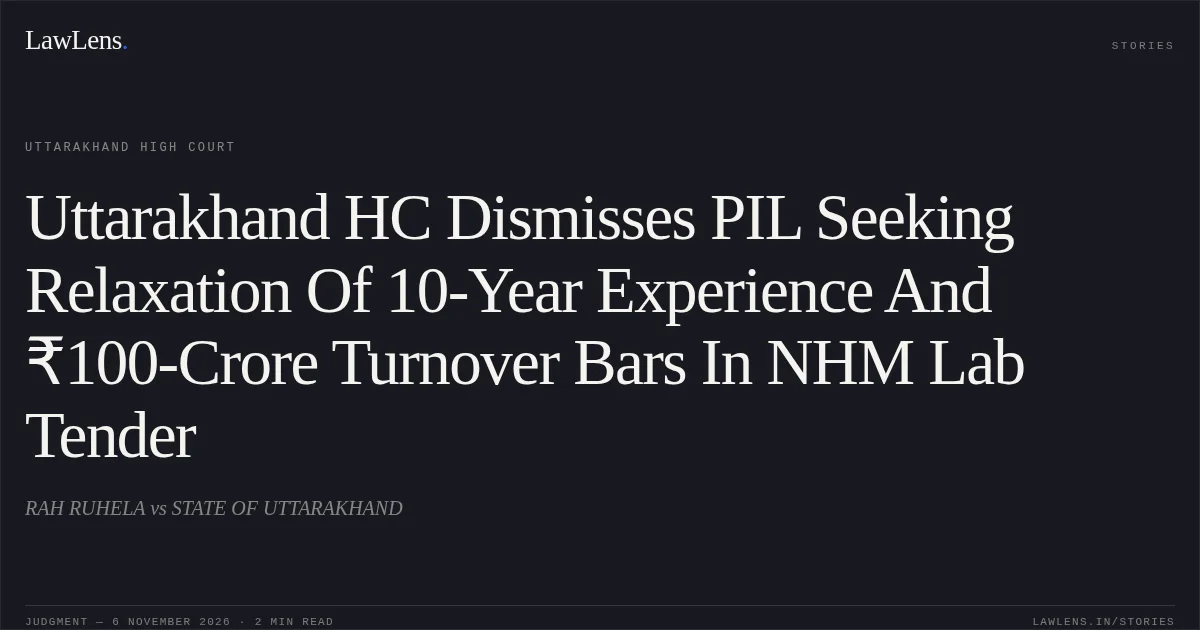
The petitioner filed a public interest litigation challenging an NHM Uttarakhand Request for Proposal for laboratory services. He sought to quash or revise several RFP conditions, including eligibility and experience requirements, turnover, earnest money deposit and performance bank guarantee requirements, and the prohibition on joint ventures, alleging that they unduly restricted competition and violated Articles 14 and 19(1)(g) of the Constitution.
pp. 1–3Respondent No. 2 objected that a PIL was not maintainable to challenge tender eligibility conditions. The petitioner relied on Article 51A(h) and (i) and Vinishma Technologies Pvt. Ltd. v. State of Chhattisgarh.
p. 3 · p. 1002Issues
i.Whether a PIL was an appropriate vehicle for challenging the eligibility and other conditions of the laboratory-services tender.
pp. 3–10ii.Whether the challenged RFP conditions were shown to be arbitrary, discriminatory, or otherwise open to judicial interference under Articles 14 and 19(1)(g).
pp. 10–1203Law Applied
In Directorate of Education v. Educomp Datamatics Ltd., (2004) 4 SCC 19, the Supreme Court held that tender terms are generally within the contracting authority’s domain and may be interfered with only where the policy decision is arbitrary, discriminatory, mala fide, or actuated by bias.
p. 11The Court also relied on the principle that an employer may frame eligibility conditions in light of its requirements and the nature of the work. It distinguished Vinishma Technologies Pvt. Ltd. v. State of Chhattisgarh, where a tender condition excluding suppliers from other States was held unconstitutional.
p. 10 · p. 12Provisions in the judgment · 1 · Linked ones open on LawLens
Specific Relief Act, 1963 Section 41
04Reasoning
The Court treated the tender requirements as conditions framed by the procuring authority for its stated procurement, rather than as a restriction comparable to the inter-State exclusion considered in Vinishma Technologies.
pp. 10–11Applying Educomp Datamatics, it held that the Court could not substitute its view of what eligibility conditions would be fairer or more suitable; interference was warranted only on recognised grounds such as arbitrariness, discrimination, mala fides, or bias. The judgment did not separately examine each challenged RFP condition.
pp. 11–1205Holding
The Court rejected the petitioner’s reliance on Vinishma Technologies, held that the employer was entitled to formulate tender eligibility conditions according to its requirements, and dismissed the writ petition.
pp. 10–12The writ petition was dismissed.
pp. 10–12Original Court PDF
RAH RUHELAvsSTATE OF UTTARAKHAND
Click to open original judgment
Original judgment, available to read, download and summarize on LawLens.in