01Facts
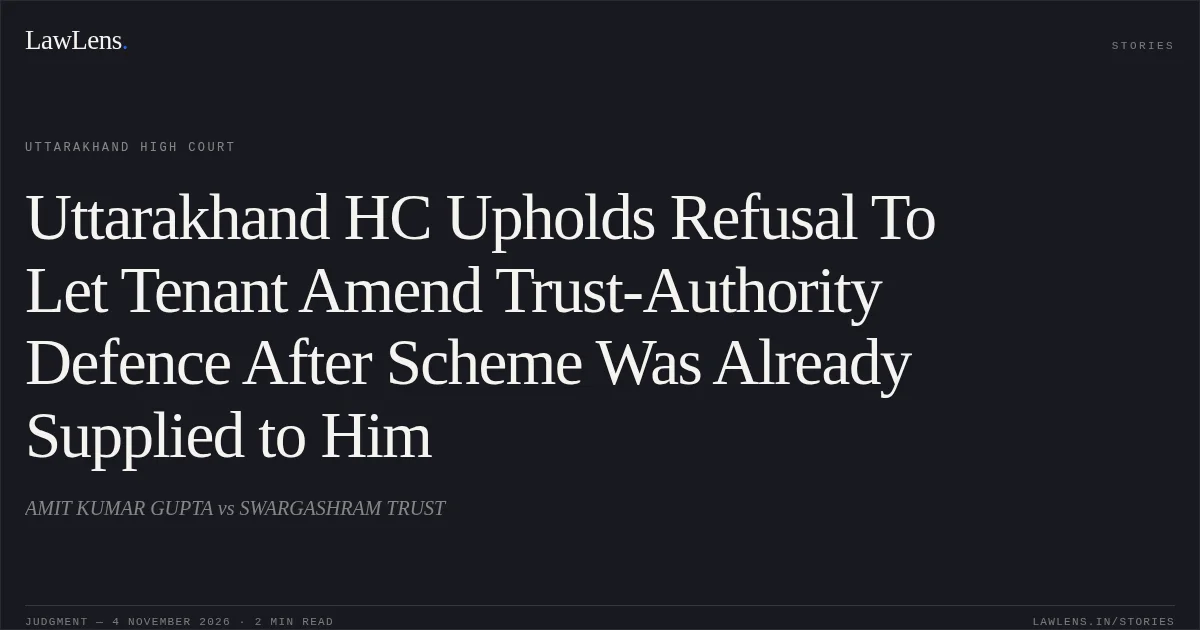
Swargashram Trust sued Amit Kumar Gupta for eviction, arrears of rent and damages.
¶ 3–10In his written statement, Gupta disputed the authority of the Trust’s manager to institute the suit.
¶ 3–10After the Trust placed a copy of its registered Scheme of Administration on record, Gupta applied under Order VI Rule 17 CPC to amend his written statement to plead terms of that Scheme.
¶ 3–10The trial court rejected the application, finding that the case was at the final arguments stage, Gupta had known of the document, and he had not shown due diligence.
¶ 3–10The revisional court dismissed his revision. Gupta then challenged both orders under Article 227 of the Constitution.
¶ 3–1002Issues
i.Whether the amendment to the written statement could be allowed after commencement of trial without establishing that, despite due diligence, the matter could not have been raised earlier.
¶ 12–17ii.Whether the trial court’s refusal of the amendment, and the revisional court’s dismissal of the revision, warranted interference under Article 227 of the Constitution.
¶ 19–2003Law Applied
The proviso to Order VI Rule 17 CPC bars an amendment after commencement of trial unless the court concludes that, despite due diligence, the party could not have raised the matter earlier.
¶ 13In Ajendraprasadji N. Pandey v. Swami Keshavprakeshdasji N., (2006) 12 SCC 1, the Supreme Court affirmed this due-diligence requirement; in Vidyabai v. Padmalatha, (2009) 2 SCC 409, it held that the proviso is mandatory and that the court lacks jurisdiction to allow an amendment unless its conditions are met.
¶ 14–16The High Court may interfere under Article 227 where the challenged order discloses a jurisdictional error.
¶ 1904Reasoning
The proposed amendment concerned a Scheme of Administration that Gupta already knew of, since the Trust had supplied the document and placed it on record. He did not explain why, despite due diligence, he had failed to seek the amendment earlier.
¶ 12, 17–19Further, the matter was at the final arguments stage and part arguments had already been heard. The High Court therefore found that the mandatory condition in the proviso to Order VI Rule 17 was not satisfied and that neither the trial court nor the revisional court had committed a jurisdictional error warranting Article 227 intervention.
¶ 12, 17–19Original Court PDF
AMIT KUMAR GUPTAvsSWARGASHRAM TRUST
Click to open original judgment
Original judgment, available to read, download and summarize on LawLens.in