Facts
The applicants, serving as Tax Assistants (Group ‘C’) in the Income Tax Department, were promoted to their current posts on June 6, 2022
Source reference: p. 15Under the erstwhile Recruitment Rules (2003), the posts of Senior Tax Assistant (STA) and Office Superintendent (OS) were filled 100% through promotion
Source reference: p. 15On September 20, 2024, the respondents notified new Recruitment Rules (RR), merging the STA and OS cadres into a single "Office Superintendent" cadre and introducing a Direct Recruitment (DR) quota of 70%, leaving only 30% for promotion
Source reference: p. 15, 21The applicants contended that approximately 173 backlog vacancies arising prior to the 2024 amendment should be filled 100% via promotion under the old rules
Source reference: p. 28The respondents carried these unfilled vacancies forward to the 2025 vacancy year and applied the new 70:30 ratio, treating the old rules as repealed
Source reference: p. 22, 32Issues
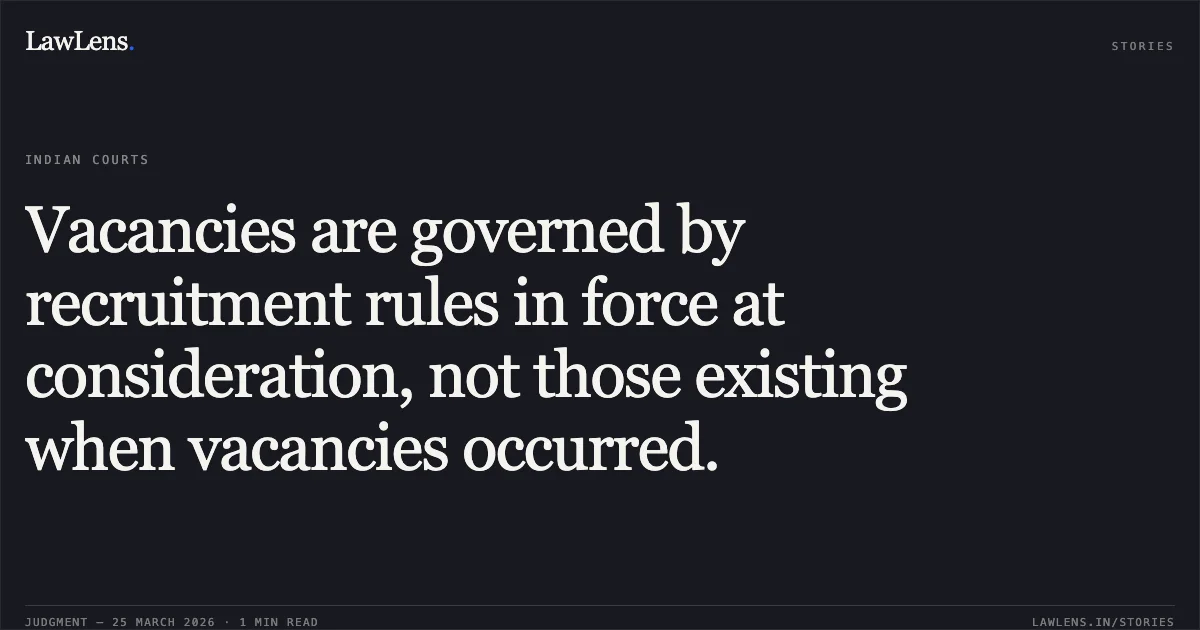
1. Whether vacancies arising prior to the amendment of Recruitment Rules must be filled according to the rules in force at the time of the vacancy's occurrence or the rules in force at the time of consideration for promotion.
Source reference: p. 36 / para. 752. Whether the respondents’ action of applying the 70% Direct Recruitment quota to backlog vacancies under the 2024 Rules was arbitrary or violative of Articles 14 and 16.
Source reference: p. 36 / para. 75Law Applied
The Tribunal applied the principle that an employee has no vested right to be promoted under repealed rules, but only a right to be considered under the rules currently in force
Source reference: p. 23, 37It relied on the Supreme Court’s decision in State of Himachal Pradesh v. Raj Kumar (2022), which overruled Y.V. Rangaiah v. J. Sreenivasa Rao and established that vacancies are governed by the rules applicable at the time of consideration
Source reference: p. 21, 25the Tribunal referenced Deepak Aggarwal v. State of U.P. (2011) and Union of India v. Krishna Kumar (2019) regarding the non-existence of a universal rule to fill vacancies by old rules
Source reference: p. 23Administrative instructions via DoP&T OMs (dated 07.02.1986 and 13.08.2021) were applied regarding the carrying forward of unfilled vacancies into a subsequent year's pool
Source reference: p. 22Reasoning
The Tribunal reasoned that upon the notification of the 2024 Rules, the previous cadres and their respective RRs ceased to exist
Source reference: para. 76Since the Departmental Promotion Committee (DPC) was convened for the vacancy year 2025 (crucial date 01.01.2025), the 2024 Rules were the only statutory framework available
Source reference: para. 78The Tribunal rejected the applicants' claim to "backlog" exclusivity, noting that once vacancies are carried forward, they merge into the current pool and lose their original character
Source reference: para. 79-80the Tribunal observed that the applicants were attempting to "approbate and reprobate" by accepting the 2024 Rules' beneficial relaxation clause (which reduced eligibility service for them) while simultaneously challenging the 70% DR quota within the same integrated framework
Source reference: para. 67, 84The court found the merger and DR introduction were valid policy decisions aimed at addressing acute manpower shortages (57% vacancy rate)
Source reference: para. 62, 85Holding
The Tribunal dismissed all the Original Applications
It held that the respondents legally applied the 2024 Recruitment Rules to the entire pool of vacancies (including backlog) for the 2025 vacancy year
Source reference: para. 86The court concluded that the applicants failed to establish any enforceable right to seek promotion under repealed rules or to demand that backlog vacancies be filled exclusively through promotion
Source reference: para. 86No order as to costs was made
Source reference: para. 87Original Court PDF
Vivek Kumar KhicharvsM/O FINANCE, D/O REVENUE
Click to open original judgment
Original judgment, available to read, download and summarize on LawLens.in


